
From Gio Ponti’s Superleggera to Ettore Sottsass’s Carlton, furniture reveals how ideas about the body, tradition, privacy and identity take shape inside a room.
Before anyone sits down, a room has already begun to speak.
Chairs pulled towards a table suggest conversation. A deep armchair beside a window offers somewhere to withdraw. A cabinet filled with carefully arranged objects makes something of its owner visible, while keeping other things behind closed doors.
We read these arrangements almost instinctively. Furniture places bodies in relation to one another and gives everyday habits a physical structure. It also makes values tangible: what deserves attention, how much room we give to guests, which objects we choose to preserve.
Certain designs make this relationship particularly legible. Their forms carry ideas about how life might be organised, how materials should be used and what beauty is allowed to look like. Encountering them today means encountering those ideas again, within the circumstances of our own lives.
The Body as a Starting Point

The chaise longue commonly known as the LC4, designed in 1928 by Le Corbusier, Pierre Jeanneret and Charlotte Perriand, makes the reclining body central to its composition. Its curved support rests on a separate base, giving rest a visible, adjustable structure.
Seen through the theme of cultural language, its exposed frame suggests a particular understanding of modern life: comfort can be studied, engineered and expressed through industrial materials. The body becomes a starting point for design.
But the object also asks us to think about authorship. Naming all three collaborators matters. An iconic piece can become so familiar that its history is reduced to a single famous name; restoring the full attribution changes the story we tell about it.
Furniture communicates through its form, and through the histories we attach to that form.
Tradition Made Lighter

Gio Ponti’s Superleggera, produced by Cassina from 1957, offers another way to understand modernity. Informed by the chair-making traditions of Chiavari in Liguria, it combines a remarkably slender wooden structure with a design weighing approximately 1.7 kilograms.
Its lightness depends on careful construction. Cassina describes a process that brings machine-made components together with hand finishing and, in the classic version, a hand-woven seat.
The cultural interest lies in that meeting of inherited knowledge and manufacturing innovation. Here, tradition provides something to work with: a structure to reconsider, refine and bring into another moment.
A light chair also has social possibilities. It can be pulled towards a table, carried across a room or brought into a conversation when another guest arrives. Its significance can be read through those ordinary movements as well as through its silhouette.
The Superleggera makes an elegant proposition: refinement can reside in how little an object needs in order to do its work.
Privacy Within a Public Room

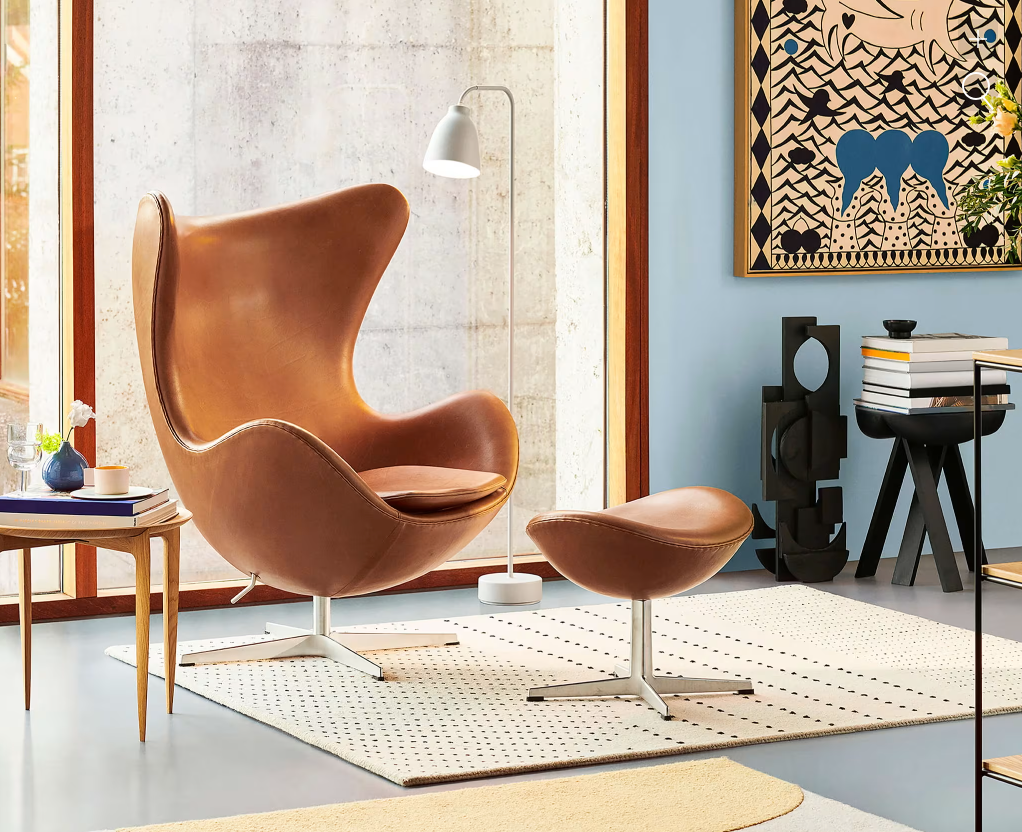
Arne Jacobsen’s Egg chair, designed in 1958 for the SAS Royal Hotel in Copenhagen, brings furniture into a close relationship with architecture. Its enveloping shape gives the person sitting in it a degree of enclosure within a larger space.
In a hotel lobby, that gesture has a particular meaning. The room is shared, yet the chair establishes a small territory around one body. Its high back and curved sides give privacy a physical outline.
Read this way, the Egg offers a useful reminder that furniture can shape the emotional experience of an interior. The scale of a room tells us one thing; the place we occupy within it can tell us another.
A chair becomes a way of negotiating between participation and withdrawal. We remain present, with somewhere to retreat.
When Furniture Challenges Taste

With Ettore Sottsass’s Carlton room divider, designed in 1981 for Memphis, expression becomes impossible to overlook.
Its vivid colours, angled shelves and totemic composition combine the roles of divider, bookcase and drawers. The Metropolitan Museum of Art describes its use of plastic laminate within a finely crafted object as a challenge to distinctions between high and low.
Carlton invites a different question from those posed by a restrained wooden chair: who decides which colours, materials and shapes belong in a sophisticated interior?
Its presence can be read as an argument for visual freedom. Furniture may be playful, conspicuous and open to several interpretations. Function remains part of the object, while its appearance creates a conversation about taste.
Placed in a room, Carlton asks the surrounding objects to enter that conversation too. Even quieter pieces look different beside it.
A Language That Travels

Patricia Urquiola’s Fjord seating for Moroso, introduced in 2002, shows how a design can bring several references into a new form. Her studio identifies a wave-worn fragment of seashell as its original inspiration, alongside Scandinavian influences and references to Arne Jacobsen.
The resulting cut-away forms allow nature and design history to meet within the same object.
This is a useful way to think about cultural language: influences travel, but they acquire meaning through the decisions made in translating them. A reference becomes interesting when it is developed into something with its own proportions, materials and relationship to the body.
Fjord can be read as a conversation across time. An earlier approach to sculptural seating becomes part of a later designer’s vocabulary, without exhausting what the new piece has to say.
The Room We Make Our Own
These objects carry distinct propositions: rest shaped through engineering, tradition refined through lightness, privacy offered by an enclosing form, taste challenged through colour, influences brought into dialogue.
Yet their meaning continues to develop when someone lives with them.
A celebrated chair might stand beside an inherited table or an inexpensive lamp. An object chosen for its design history gradually becomes associated with reading, visitors or a familiar place at the end of the day. Personal experience adds another layer to its public identity.
Recognising an icon can deepen our understanding of a room. So can noticing the less celebrated pieces: the repaired cabinet, the table that has moved between apartments, the chair everyone knows belongs to one person.
Furniture becomes cultural language where these histories meet. The designer proposes a way of living; the person who uses the object gives that proposition a life of its own.
Editor’s Note
At QEditorial, we approach design as an expression of culture and identity. This article brings together historical references and editorial interpretation to explore how furniture shapes our experience of space. The selected works offer distinct perspectives on comfort, craftsmanship, privacy and taste, inviting readers to consider what the objects they live with say about their own lives.
QEditorial Magazine Fashion Culture Identity



Leave a Reply