
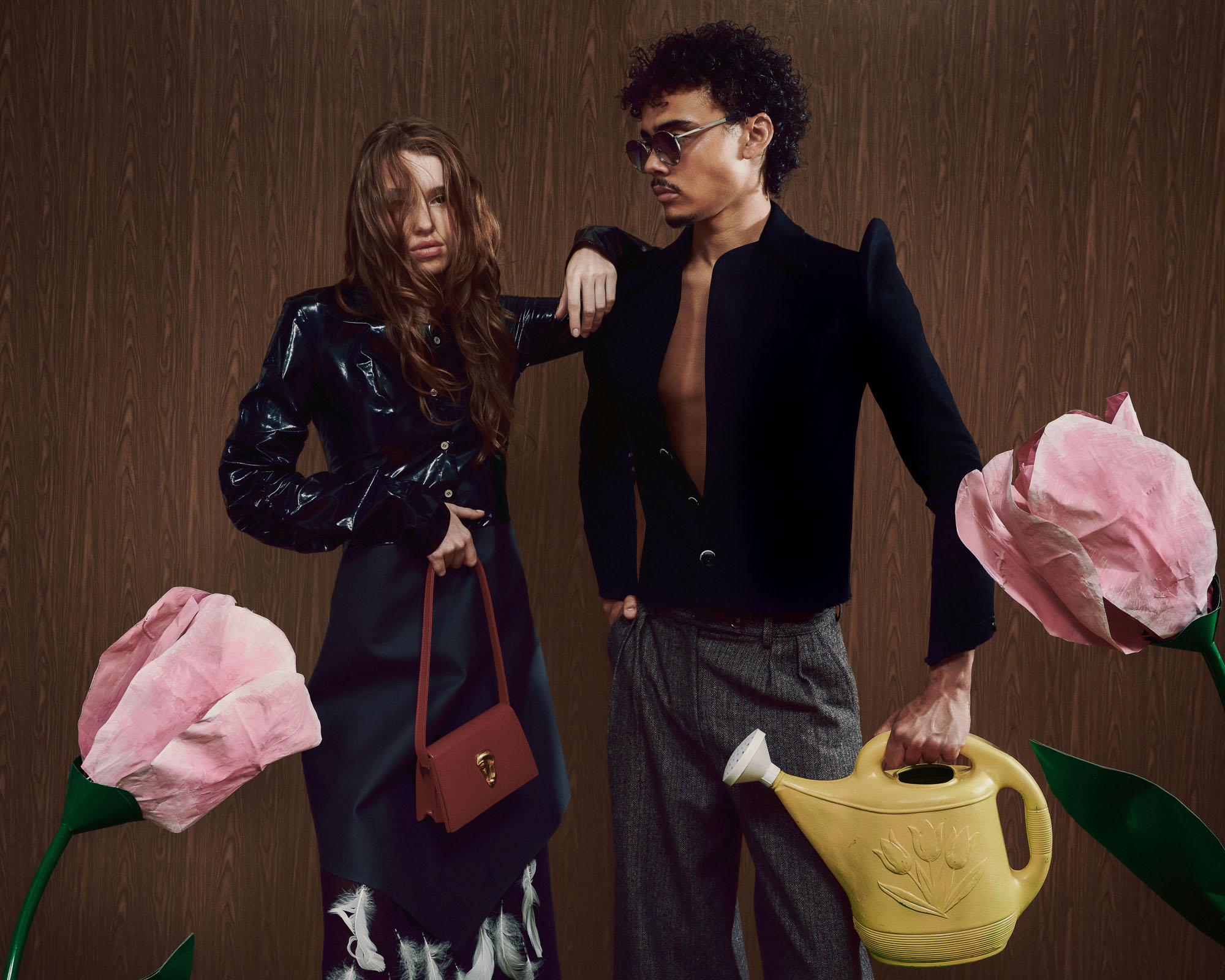
From the rooms of international diplomacy to an atelier in Dakar, Verlaine-Diane Soobroydoo has built a fashion house around a deceptively simple conviction: the person who makes an object should remain part of its story. In an exclusive conversation with QEditorial, she speaks about the first Maam bag, the memory held in leather, and what it takes to make dignity tangible.
By Nicolò Di Stefano | QEditorial Magazine

One artisan makes a MAISON MOTEMA bag from its first cut to its final detail. When Verlaine-Diane Soobroydoo told me this as we discussed the house, I kept returning to the person behind the finished object. What does it mean for a bag to have a maker, rather than simply a place of manufacture? And what changes when that maker is allowed to remain visible in the story of luxury?
QEditorial had already introduced MAISON MOTEMA, a young house shaped between New York and Dakar. I had since met Verlaine-Diane, seen the collection in person and spoken with her about the work and its future. Those encounters gave us a view of the objects. I wanted this interview to take us further: into the atelier, into the decisions a photograph cannot explain, and into the life that led her there.
For more than a decade, Verlaine-Diane worked in international policy, women’s rights and development. She knew the language of economic empowerment from inside the institutions where it is discussed. Eventually, she wanted to give that language a physical form. She imagined something a woman could make, sell, carry and pass on. The first object was the Maam bag, bearing a sculptural bronze face. Its appearance announced a house with an eye for form; the way it was made revealed the deeper ambition.
From policy to the object

QEDITORIAL: When did fashion become more than a personal interest—when did you realize it could become your own way of creating change?
VERLAINE-DIANE SOOBROYDOO: “For more than a decade, I worked in international policy, women’s rights and development. I was often in rooms where we spoke about economic empowerment, trade, skills, leadership and access. But at a certain point, I wanted to move from policy to implementation. I wanted to build something tangible, something a woman could hold, wear, sell, make, inherit.”
The movement from a conference room to a workshop is not as abrupt as it might sound. Verlaine-Diane describes herself as having long used creativity to imagine more human ways of building change. What has shifted is the scale at which she can see a decision’s effect. A policy can set out to expand opportunity; an atelier must decide who does the work, how it is valued and whose name is remembered when the finished piece leaves.
She spent about three years living and learning in Dakar before the first collection launched. Moving between Dakar, New York and Paris, she saw exceptional technical skill that, in her view, did not receive the recognition it deserved in the global luxury conversation. She did not want to build a house from a distance. She wanted to learn the craft herself and understand the people and pace of the atelier.
QEDITORIAL: What does each of those cities give the house?
VERLAINE-DIANE SOOBROYDOO: “New York gives the house speed, ambition and scale. It sharpens the commercial side of the work. It asks: how does this object live in the world?” Dakar, she says, gives it “its hand, rhythm and soul.” Paris brings “its dialogue with heritage, refinement and the language of luxury.”
These are places with different demands. New York asks a product to make its way through a market; Dakar asks that the time and skill required to make it be respected; Paris gives Verlaine-Diane a language for considering fashion as culture and form. She is building a house that must answer to all three.
One bag, one maker

The question I most wanted to return to was the one she had raised when we met. Many brands speak of artisanship, yet the artisan often disappears as soon as the object reaches a customer. Verlaine-Diane has organized the making of a bag around a different relationship.
QEDITORIAL: Why was it important to preserve the relationship between one maker and one finished piece?
VERLAINE-DIANE SOOBROYDOO: “When one artisan makes a bag from beginning to end, the piece carries continuity. It is not anonymous. The same hand understands the leather, the construction, the tension, the finishing. There is responsibility, pride and authorship in that.”
Authorship is a precise word here. It changes the way we look at the familiar details of a handbag: an edge finished cleanly, pressure applied to a seam, a correction made where a customer may never think to look. Verlaine-Diane says that if we followed one bag through the atelier, we would first learn its maker’s patience. We would also see discipline, memory and a kind of intelligence expressed through the hands.
Asked whether she can recognize a particular person’s work, she speaks of the chef d’atelier. His pieces, especially the Maam and the Cayor, have what she calls structure and calm. Other makers leave a softer impression or reveal themselves through their attention to detail. “Over time, you begin to recognize a hand the way you would recognize handwriting.”
It is a beautiful comparison, though it also sets a demanding standard for the house. If each bag carries an identifiable hand, growth cannot be measured only in the number of bags it can produce. Training, trust and the continuity of the atelier become part of what MAISON MOTEMA is selling—and what it must protect.
QEDITORIAL: What has this work made possible for the people and families connected to it?
VERLAINE-DIANE SOOBROYDOO: “The first thing it makes possible is income through skilled work. That matters.” Beyond income, she points to pride, continuity and visibility. Her hope is to build a stronger atelier, expand training and, eventually, create opportunity that reaches beyond the house itself.
I am drawn to the directness of that first sentence. Verlaine-Diane has spent years in the language of development, but here she insists on a test that can be understood without a slogan: a person works with skill and is paid for that skill. Later in our exchange, she puts it even more simply: “The most moving lesson is that making is a form of dignity.”
When the material answers back

That attention extends to the leather. Verlaine-Diane sometimes works with limited stocks or existing materials whose size and character restrict what can be made. She does not describe a remnant as a ready-made claim to virtue. She describes the decisions it requires.
QEDITORIAL: Can a limited piece of leather lead you toward a design you would never have imagined with an unlimited supply?
VERLAINE-DIANE SOOBROYDOO: “When material is limited, you cannot design with arrogance. You have to respond. Sometimes the leather tells you the size of the bag. Sometimes the color asks for a different hardware finish. Sometimes a small quantity becomes a limited edition because there is no possibility of repeating it.”
A piece too small for industrial production might become a Maam, a Mini Maam or a singular design. The available material guides the cut; its texture, color and imperfections become part of the answer. Rarity here begins before a marketing decision. It begins with a material that cannot be ordered in endless identical quantities.
This does not make every bag a symbol of the same process. What interests me is the discipline behind the choice: the designer has to pay attention before insisting on the shape she first imagined. The finished object records a negotiation between idea, material and maker.
The face and the name

The Maam was the first bag and remains an emotional center of the house. Its sculptural emblem gives it an immediate identity: a bronze face that Verlaine-Diane imagined as something closer to jewelry than a conventional logo. She connects its form to the face, the body, the mask and the ancestral object, interpreted through a contemporary design language. It asks to be read as part of the object, not merely as its signature.
QEDITORIAL: What is held in the name Maam?
VERLAINE-DIANE SOOBROYDOO: “Maam evokes the maternal, the ancestral, the elder, the one who came before. I wanted the bag to feel small but powerful, intimate but sculptural. Its shape is not loud, but it has presence.”
You carry a Maam close to the body. For Verlaine-Diane, that closeness matters. She speaks of women in her lineage, of objects kept carefully and handed on, and of the restrained elegance with which those women carried themselves. She also speaks of moving between countries, of belonging to several places and sometimes to none completely. These memories do not become a literal illustration on the bag. They inform the way it holds itself.
“Motema” means “heart” in Lingala, she tells us. Verlaine-Diane describes her own heritage as Bantu and Desi, with Tamil and Telugu ancestry, shaped by Africa, the Indian Ocean, Europe and New York. The name offers a center for those experiences without forcing them into one simple origin story. She leaves room, too, for the object to exist beyond explanation: sometimes, she says, a person or a thing “just is.”
The courage to be seen

At first, Verlaine-Diane imagined the woman carrying the bag as quietly powerful, independent and sure of her taste. Meeting customers has made that imagined figure less fixed. Women of different ages and backgrounds respond to the pieces for different reasons: their form, their story or the experience of holding something made by hand. The house will have to keep listening to them as it grows.
QEDITORIAL: What has surprised you most about yourself while moving from diplomacy into building a fashion house?
VERLAINE-DIANE SOOBROYDOO: “What has surprised me most is how much courage it takes to build something visible.” In institutional work, she explains, much can happen behind process and language. With MAISON MOTEMA, “Every choice has my name, my eye and my risk attached to it.”
The line returns me to the artisan and the bag. She is asking makers to be seen as authors of their work while accepting that her own name will be attached to the choices that shape the house. Neither visibility is effortless. Both carry responsibility.
Five years from now, she hopes MAISON MOTEMA will be recognized as a serious luxury house with a strong atelier and a distinct visual language. Yet her private measure of success is closer to the beginning of our conversation: whether the people who make the pieces feel proud, whether the people who carry them feel something, and whether the work has created a real connection between beauty and economic dignity.
We began by asking what it means for one person to make one bag. Verlaine-Diane’s answers led us well beyond the bag, though they never lost sight of it. In her vision, a luxury house is tested by what remains visible when an object is finished: the material’s limits, the founder’s choices and the skill of the person whose hand gave it form. That is a demanding idea to build a business around. It is also what makes MAISON MOTEMA worth watching.
This feature is based on an exclusive written interview with Verlaine-Diane Soobroydoo and QEditorial’s earlier conversations with her. Selected questions have been shortened for presentation; quotations retain her wording. Reporting on the atelier and its social impact reflects the founder’s account.
Editor’s Note
It was a pleasure to meet Verlaine-Diane and to discover MAISON MOTEMA’s work in person. Seeing the collection opened a conversation I wanted to continue: about the people who make these pieces, the care behind their construction and the life Verlaine-Diane hopes the house can create beyond the objects themselves. I am grateful that she trusted QEditorial with her story. I hope this interview gives our readers the chance to see what first drew me to her work—and to understand the hands and convictions that give MAISON MOTEMA its heart.
Nicolò Di Stefano
Founder & Editor-in-Chief, QEditorial Magazine
QEditorial — Fashion · Culture · Identity



Leave a Reply