
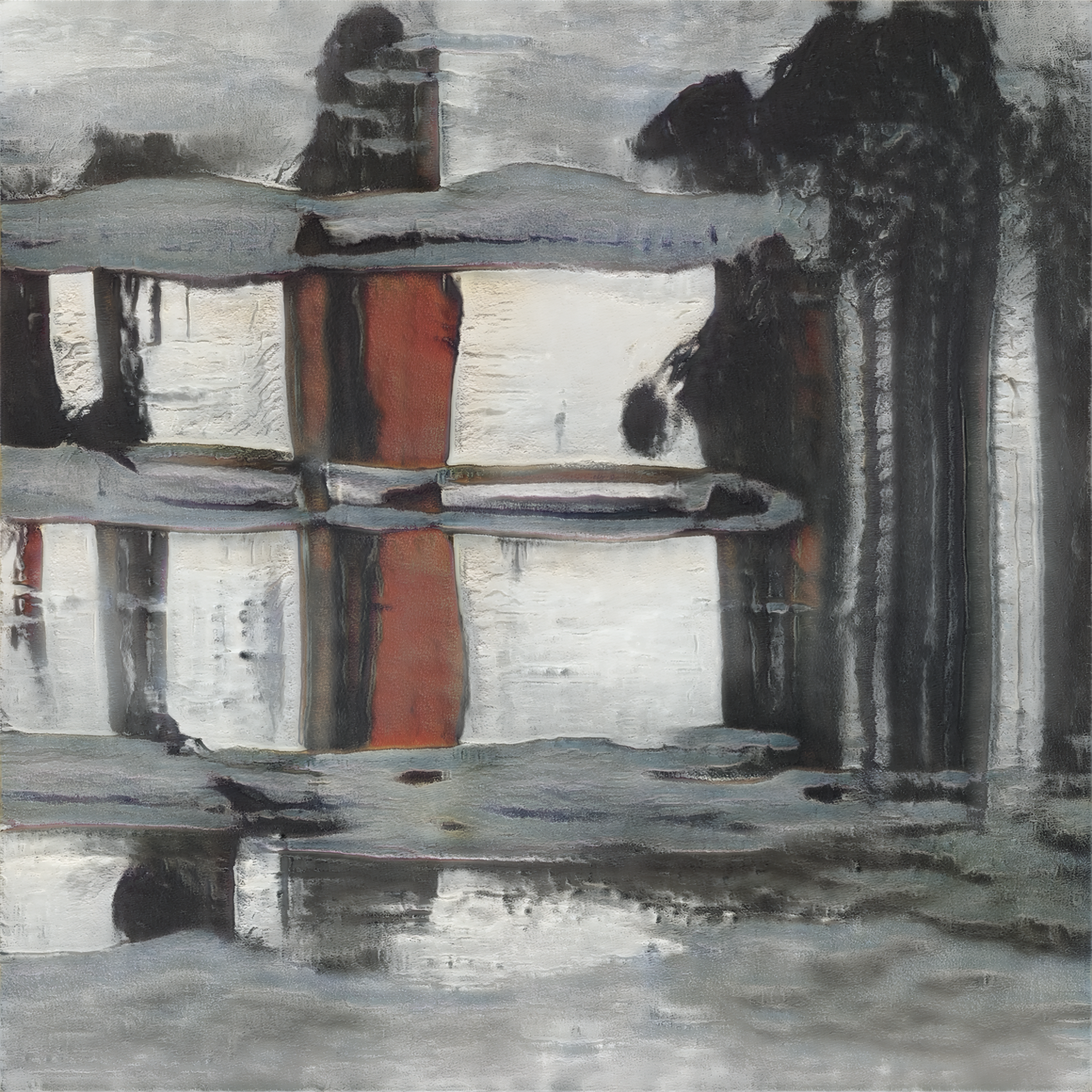
From marketplace prints to a studio built around careful looking, Whispart asks who gives a machine-made image a life beyond the screen.
By QEditorial | Art · Technology · Identity

One of the first images Whispart decided to keep ended up in Tan Liyuan’s mother’s study. It had emerged from a period of experimenting with generative models: more than 100,000 outputs, according to Tan, had yielded only two works the team chose to make physical. In his mother’s room, one of them was no longer a result to compare with thousands of others. It became something a person could pass each day, notice in changing light and perhaps see differently over time.
That small domestic scene reveals more about Whispart than the language of artificial intelligence usually does. The studio works with models capable of producing images in enormous quantities. Its most consequential decisions, however, concern what to keep, how to make it and whether someone might want to live with it.
Whispart did not begin with that question. Tan and his collaborators initially sold AI-generated decorative canvas prints on Walmart and Amazon. Over two years, they sold thousands. The business was viable, but Tan felt its images were becoming interchangeable. Customers might remember a pleasing piece of wall décor without remembering who had made it. Other sellers produced similar work, prices fell, and the studio struggled to build a recognizable identity.
They closed their marketplace stores and began developing Whispart as a brand. The name joins “whisper” and “art”: an ambition for images that can settle into a space quietly, rather than demand an instant reaction. Yet the team still did not know exactly where its experiments were leading.
A question between two people

Tan locates the turning point in a conversation with a friend. He had seen an article about Portrait of Edmond Belamy, the GAN-generated portrait that sold at Christie’s for $432,500 in 2018. What first stopped him was its appearance: broken textures, negative space and areas that seemed to resist completion. He wanted to know how a machine had produced them. Then he and his friend began talking about the price.
They knew one world of AI imagery intimately: images made and sold in volume as inexpensive prints. Here was another, in which a machine-generated picture could enter an auction house and acquire an entirely different status. Neither the low price of a print nor the high price of a portrait could tell Tan what a particular image meant to someone looking at it. But the gulf between them made him question the kind of company he wanted to build.
Whispart’s answer was to pursue a third possibility: works selected with care and made well enough to enter an ordinary home, without claiming an exalted meaning merely because AI was involved. The shift was both commercial and personal. Tan writes that the team stopped asking only how to make a better image to sell. They began asking why a machine could make a visual decision they had never requested, and whether such images could find a more honest place in people’s lives.
A generative adversarial network, or GAN, offered them a way to explore that surprise. Whispart assembles visual material around a broad mood, trains a model, then looks through many resulting images. Tan Lichang works with data and training material and handles shipping from Guangzhou. Tan Liyuan, based in Kunming, directs the studio and its visual and production choices. Yan Jiajing has also provided technical guidance. Behind the apparent immediacy of an AI image is a small team arguing, testing, rejecting and sometimes changing its mind.
The value of an unfinished form

Tan is drawn to images that seem almost recognizable. A form might suggest a shore, a ruin or a building, then refuse to become any one of them. In one landscape model, he compared the same area at two stages of training. At the earlier stage it remained pale and uncertain; later, the model rendered it more coherently as a coast. The improvement made the image easier to understand. For Tan, it also gave him less reason to return to it. He does not suggest that every incomplete output has value. He looks for enough structure to sustain attention, with enough openness to leave the viewer a part in seeing it.
The four works Whispart shared with QEditorial give that thought a visible form. River Styx Crossing sets dark uprights against pale horizontal spaces and a muted red opening; its title proposes a passage, while the image leaves its destination uncertain. In The Unfinished Dance, branchlike marks gather and disperse across a light ground. What Eve Dreamed draws the eye through green, yellow and earthen red, toward a place that feels wooded without becoming a literal scene. The warm light and layered forms of What Remained of Heaven might evoke dwellings, cliffs or a remembered landscape. None requires the viewer to settle on one description.
Kunming shapes Tan’s way of looking, though he is careful about claiming a local visual style. He describes the city’s bright light, wide sky and proximity to plants and mountains. He does not want to turn the cultures of Yunnan into decorative motifs. Instead, he speaks of a slower rhythm: after the model has produced its images, he puts one aside and comes back to it. The final judgment is quiet and subjective, however complex the computation that preceded it.
That judgment also takes place off-screen. The team tested materials and suppliers before choosing fine-art giclée prints on textured canvas. The works shown here are framed at 50 × 50 cm. Tan calls printing a material translation: color, texture, scale and light make the physical work a different encounter from the digital file. His mother’s study was an early version of the test that still matters to him. Can the image remain present in a real room after its initial novelty has faded?
Who stands behind the machine?

Whispart’s responses changed as our conversation continued. Asked whether selecting an output is itself creative, Tan initially said no. When QEditorial pressed him, he reconsidered: “My ‘No’ was too absolute.” The creative act, he explained, is not the click that saves a file. It lies in deciding why this image survives while hundreds of others do not, why an uncertain detail remains and why the studio is willing to give the result a title and a physical life. Selection can be creative without making the selector the sole author of everything visible in the image.
He was equally direct about another apparent contradiction. Whispart wants generative work to receive serious attention, yet Tan calls its physical purpose “decoration first.” He stands by the phrase. Someone should be able to place a work at home without first accepting a theory about its artistic importance. For him, the more demanding question is whether, after living with it, the owner still discovers something unresolved.
These answers bring the people behind AI back into view. Training material has to be chosen. An image has to be refused or kept. A disagreement within the team has to be resolved. A print has to be held up to the light. Technology may generate the possibility, but Whispart’s business and its aesthetic develop through human relationships: between collaborators, between Tan and his friend, between an image and his mother’s room, and eventually between a work and someone they have never met.
If AI becomes the artist
AI is becoming more present in the way companies develop products and in the way people make and encounter images. It is reasonable to ask whether a future system might itself be recognized as an artist. That could happen socially before anyone agrees what the recognition means: a gallery could name the system, a public could follow its body of work, and collectors could value what it produces.
There is a deeper possibility. If a future AI developed consciousness—some form of subjective experience—the discussion would change. We would have to ask whether it forms intentions, understands what it makes and has a claim to speak for its own work. That remains an open scientific and philosophical question, not a description of Whispart’s GAN or an established fact about today’s systems. A research assessment of AI consciousness found no convincing case among the systems it examined, while leaving open the possibility of future conscious systems.
For now, Whispart’s story makes a different truth difficult to overlook. An image may be generated by a machine, but the decision to build a studio around it belongs to people. Tan and his team can explain why they stopped, why they chose and why they hope someone else will keep looking. Perhaps one day an AI will be able to make such a case for itself. Until then, the most revealing part of this story is the human life gathering around an image that nearly disappeared among 100,000 others.
Editor’s note
Nicolò Di Stefano, Founder & Editor-in-Chief: I keep returning to the work in Tan’s mother’s study. It is a modest detail beside the scale of the technology, but it gives the question of AI art a place to begin. Someone chose that image, brought it home and allowed it to become part of another person’s days. If one day an AI develops a consciousness of its own, we may need a new language for the art it makes. Today, Whispart reminds me to look closely at the people, decisions and relationships already present behind the image.


Leave a Reply