
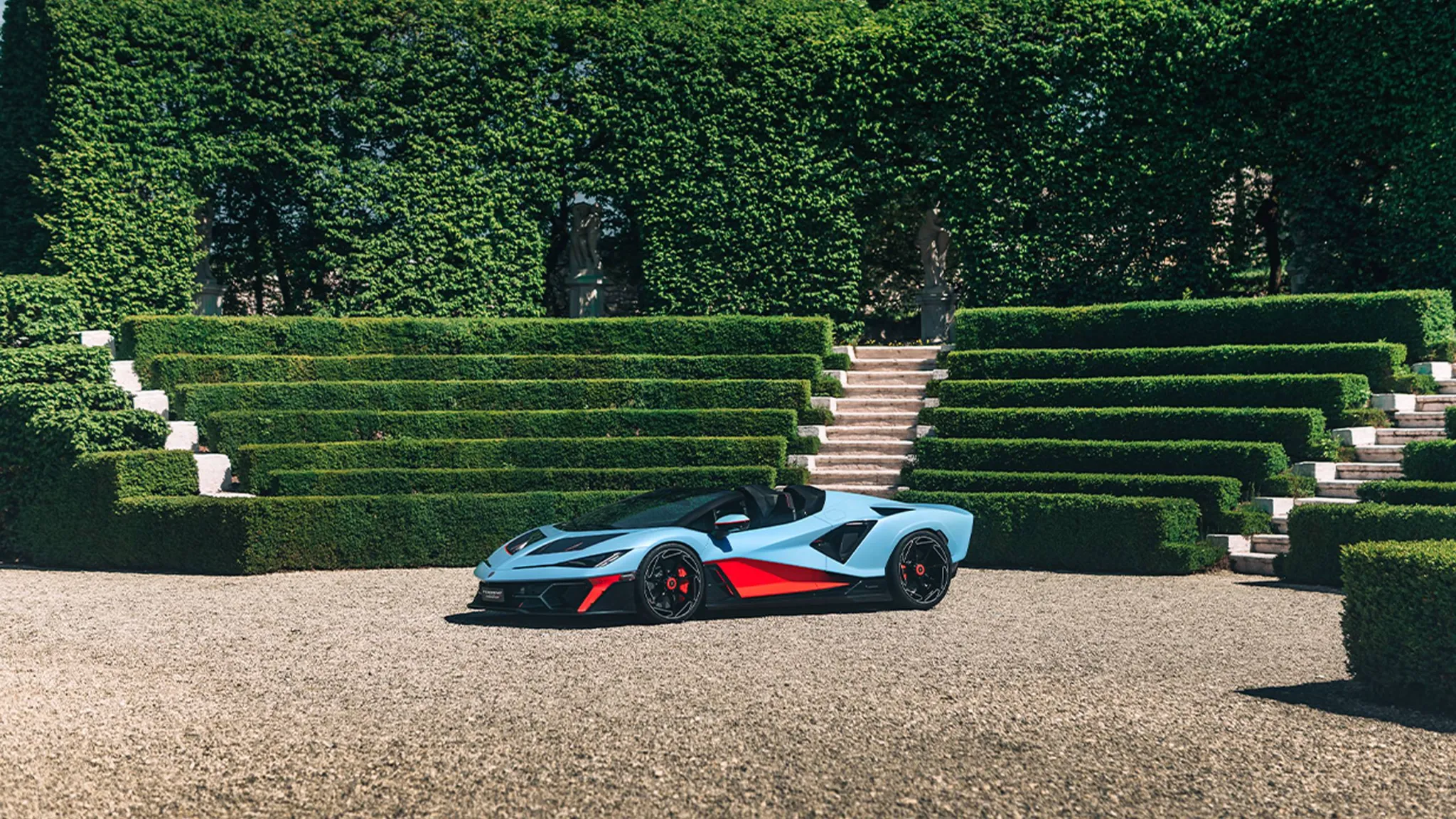
Only 15 will exist. With 1,080 CV, an open cockpit and a design conceived as a manifesto, Lamborghini’s Fenomeno Roadster pushes the supercar beyond performance and into the territory of contemporary collecting.

There was a time when performance alone could define an extraordinary automobile. More horsepower, greater speed, a lower acceleration figure: the language of the supercar was written largely in numbers.
Today, that distinction has become more complicated.
In a market where extreme performance is increasingly attainable across multiple manufacturers, the ultimate expression of automotive luxury may no longer be speed itself. It may be scarcity.
The new Lamborghini Fenomeno Roadster makes that argument almost impossible to ignore. Only 15 examples are scheduled to exist.
That number immediately changes the way the car can be understood. This is not simply another open-top Lamborghini designed to occupy the upper edge of the performance hierarchy. It belongs to the company’s tradition of Few-Off automobiles: machines positioned somewhere between transportation, engineering experiment, sculpture and collectible object.
And perhaps that is where the Fenomeno Roadster becomes most interesting.
Not because it can go extraordinarily fast, but because Lamborghini has created something very few people will ever be able to possess.

Fifteen Cars
Lamborghini unveiled the Fenomeno Roadster in May 2026 during the second edition of Lamborghini Arena. According to the marque, it is the most powerful open-top Lamborghini ever created, combining a naturally aspirated 6.5-liter V12 with three electric motors for a total output of 1,080 CV.
The specifications are appropriately extreme.
The car accelerates from 0 to 100 km/h in 2.4 seconds, reaches 200 km/h in 6.8 seconds and has a maximum speed exceeding 340 km/h. The combustion engine alone develops 835 CV, complemented by the hybrid system.
Yet these numbers may actually be the least surprising aspect of the car.
A modern Lamborghini is expected to be fast.
What distinguishes the Fenomeno Roadster is the deliberate restriction surrounding it. Fifteen automobiles transforms production into selection. Ownership becomes less about simply purchasing the latest model and more about entering an extraordinarily small circle.
In luxury, quantity has always carried meaning.
A material can be expensive because it is difficult to obtain. An haute couture garment becomes exceptional because of the labor invested in a single piece. A work of art acquires part of its cultural value because another identical object cannot simply emerge from a production line.
The Few-Off supercar increasingly occupies similar territory.

The Car as a Design Object
The name Fenomeno follows Lamborghini’s long tradition of drawing inspiration from legendary fighting bulls, but the design itself is concerned less with history than with what comes next.
The original Fenomeno Coupé was introduced in 2025 as a design manifesto marking 20 years of Lamborghini Centro Stile. The Roadster develops that language into an open structure, removing the roof while preserving the extreme geometric character of the body.
For Lamborghini Design Director Mitja Borkert, the Roadster has already been positioned as a reference point for future open-top supersports cars. Lamborghini describes its design philosophy around the project through the idea of making the driver “feel like a pilot.”
Look at the car from a distance and the strategy becomes clear.
There is very little visual softness.
The nose sits exceptionally low. Air channels, carbon elements and sharply defined surfaces interrupt the body. The side profile appears stretched between the front and rear wheels, while the absence of a traditional roof gives the upper architecture an almost mechanical transparency.
This is not an attempt at anonymous elegance.
A Lamborghini has rarely wanted to disappear into its surroundings.
The Fenomeno Roadster instead embraces presence as part of its function. Its shape communicates that something exceptional has arrived before the driver has even touched the accelerator.

Removing the Roof Changes More Than the Silhouette
Converting an extreme supercar into a Roadster is not merely a question of removing its roof.
It changes the relationship between machine, driver and environment.
The cockpit is no longer visually isolated from the landscape around it. Engine sound, wind and movement become part of the experience in a way that a closed cabin inevitably moderates.
For Fenomeno, Lamborghini has approached the rear section almost theatrically. Borkert has explained that particular attention was given to the engine area, creating the visual impression that the powertrain is suspended within the vehicle.
The effect turns mechanical engineering into something intended to be looked at.
That distinction matters.
In the conventional automobile, the engine exists primarily to provide movement. In an object such as the Fenomeno Roadster, the machinery itself becomes part of the aesthetic narrative.
It is performance transformed into display.

A V12 Survives — Through Hybridization
At the heart of the car remains something increasingly rare in contemporary automotive culture: a naturally aspirated V12.
Its displacement is 6,498 cc, and the engine works alongside three electric motors to produce the combined 1,080 CV output. Lamborghini’s official technical specifications place the hybrid architecture at the center of the Fenomeno Roadster rather than treating electrification as a separate identity.
That combination reflects an important transition taking place within the supercar.
Electrification does not necessarily mean abandoning the emotional architecture of the internal-combustion automobile. Here, electric motors enhance a V12 rather than replacing it.
The result is less a confrontation between the past and future than a temporary coexistence between them.
For collectors, that may eventually become one of the Fenomeno’s defining characteristics.
Cars produced during technological transitions often acquire significance precisely because they contain elements of two different eras.
The Fenomeno Roadster belongs to a moment when the naturally aspirated twelve-cylinder engine still survives, but only by sharing the stage with electrification.

Motorsport Beneath the Sculpture
The visual drama would mean little if the engineering beneath it were conventional.
The Fenomeno Roadster introduces technologies developed with direct reference to motorsport, including manually adjustable racing dampers and Lamborghini’s CCM-R Plus carbon-ceramic braking system. Bridgestone developed dedicated Potenza tires for the car, fitted to 21-inch wheels at the front and 22-inch wheels at the rear.
There is something almost paradoxical about this level of engineering.
Many Fenomeno Roadsters will undoubtedly enter serious private collections, where mileage may be measured cautiously and preservation can become almost as important as driving.
Yet Lamborghini has engineered the car to exist at the opposite extreme: speed, braking force, heat, movement and physical demand.
The collectible object has been designed to be used.
That tension has always been part of the appeal of the modern hypercar.
It can occupy a temperature-controlled garage like a sculpture and, minutes later, operate at speeds that would have belonged to racing machinery only a few decades ago.

Inside the Machine
The interior continues the same philosophy.
Carbon fiber is not hidden beneath upholstery but used as part of the visual language. Racing seats, the steering wheel, structural surfaces and digital displays create an environment closer to a cockpit than a traditional luxury cabin.
This is important because automotive luxury itself has changed.
For decades, luxury inside a car often meant insulation: thick carpeting, quiet cabins, polished wood and separation from the mechanical world outside.
The Fenomeno proposes nearly the opposite.
Here, luxury means proximity to the machine.
The driver is not meant to forget that an engine, electric motors, aerodynamic systems and immense mechanical forces are operating around them. The architecture continuously reminds them.
It is a different definition of refinement — not comfort through detachment, but experience through intensity.
From Reventón to Fenomeno
Fenomeno Roadster also belongs to a very particular Lamborghini lineage.
The company’s modern open-top Few-Off history began with the Reventón Roadster in 2009, followed over the years by extremely limited machines that transformed scarcity itself into part of Lamborghini’s identity. The broader Few-Off family has included models such as the Sesto Elemento, Veneno, Centenario, Sián and Countach LPI 800-4.
Each served a slightly different purpose, but collectively they established something important.
Lamborghini no longer needed every new automobile to function primarily as a conventional series-production model.
Some could instead operate as statements.
They could experiment with materials, technology, proportion and visual identity at a level impossible when thousands of examples must eventually be built.
Fenomeno Roadster continues that idea but pushes exclusivity even further.
Fifteen.
Not fifteen thousand.
Not fifteen hundred.
Fifteen.

When an Automobile Becomes Collectible
This is where the Fenomeno Roadster becomes relevant beyond automotive enthusiasm.
The most exclusive cars increasingly behave like other collectible categories.
Provenance matters. Production numbers matter. Configuration matters. Historical context matters. And, increasingly, the story surrounding an automobile matters almost as much as the object itself.
A Fenomeno Roadster purchased today is therefore simultaneously several things.
It is a vehicle capable of extraordinary performance.
It is a representation of Lamborghini design in 2026.
It is an artifact from the transition toward electrified high-performance automobiles.
And it is one of only fifteen examples produced.
The owner is acquiring the possibility of driving it, certainly.
But they are also acquiring a position within its history.
That is something horsepower alone cannot provide.

Beyond Speed
There will always be another faster car.
Engineering virtually guarantees it.
Another vehicle will eventually accelerate harder, generate more power or achieve a more dramatic performance statistic.
Scarcity works differently.
There will never suddenly be a sixteenth Fenomeno Roadster if Lamborghini keeps the production run it has announced.
And perhaps that is the more revealing definition of contemporary automotive luxury.
Performance can be surpassed.
Technology can become obsolete.
But rarity cannot be recreated once the production line has stopped.
With Fenomeno Roadster, Lamborghini has produced an automobile whose most significant specification may therefore be neither 1,080 CV nor 340 km/h.
It may simply be:
15.


Editorial Note
The Lamborghini Fenomeno Roadster was unveiled in May 2026 and is scheduled for production in a series of 15 examples. Technical information referenced in this article is based on official materials published by Automobili Lamborghini.
Discover the Lamborghini Fenomeno Roadster and explore Lamborghini’s official Fenomeno Roadster presentation.
QEditorial — Mobility · Design · Culture · Identity

Images: Courtesy of Automobili Lamborghini S.p.A. / Official Lamborghini media materials.



Leave a Reply