
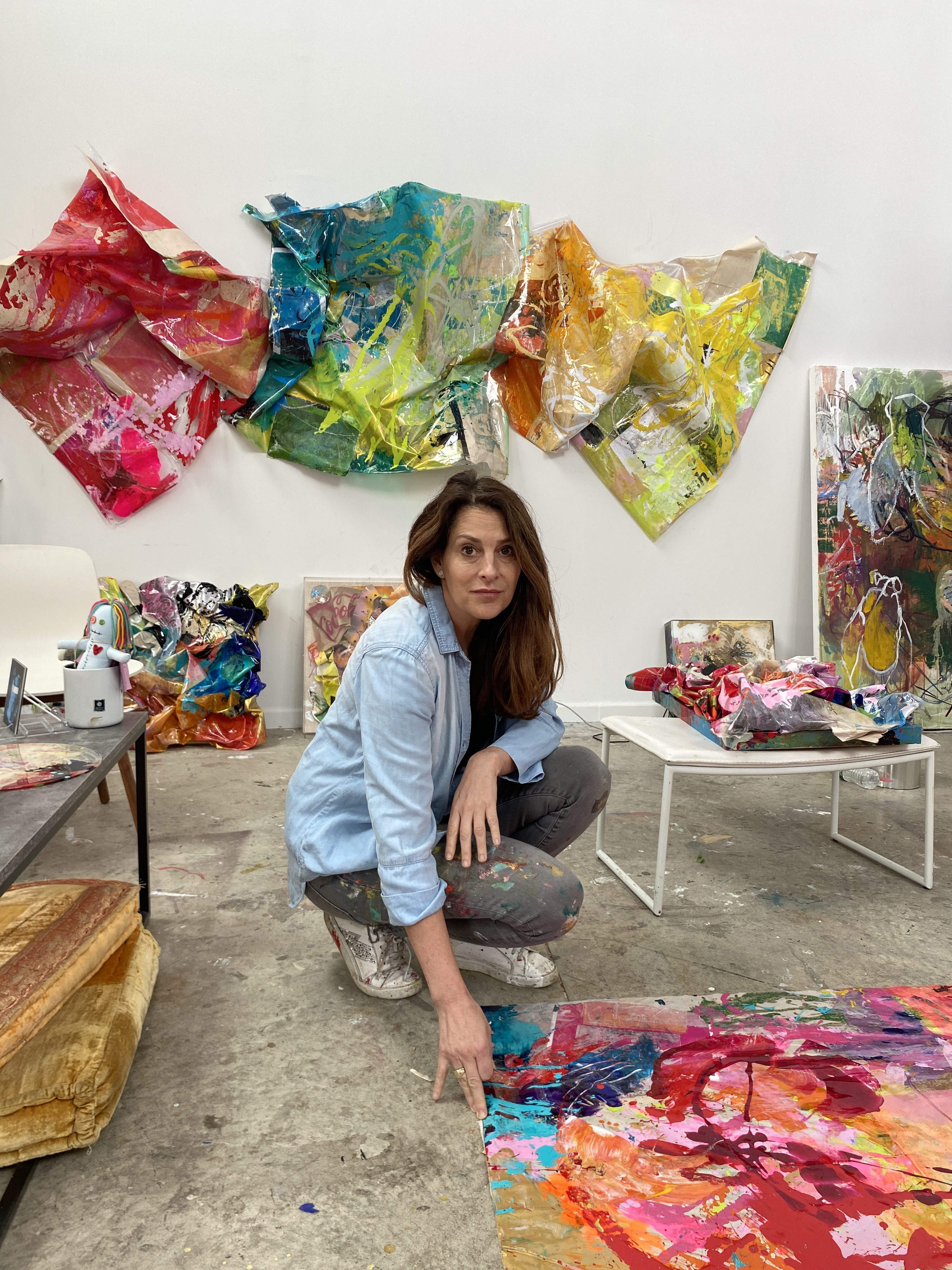
Some artists make objects. Others seem to alter the atmosphere around them. In the work of Jenny Flexner Reinhardt, color, plastic, memory and light become forms of energy — and perhaps a way of understanding how we move through the world.
QEDITORIAL ART | Artist Profile
There are artists whose work asks to be understood, and then there are artists whose work asks first to be felt. Jenny Flexner Reinhardt belongs to the second category.
Before speaking about exhibitions, materials, education or the extraordinary physicality of her sculptures, there is something else that feels necessary to acknowledge: Reinhardt’s work possesses presence. It does not sit quietly on a wall. It folds outward, catches light and changes as one moves around it. Colors collide and retreat beneath glossy surfaces; fragments disappear into creases before emerging somewhere else; what initially appears joyful can suddenly reveal tension, complexity or interruption.
The result exists somewhere between looking at an artwork and entering an atmosphere.
And perhaps that is where the story of Jenny Flexner Reinhardt should begin.
An Artist You Feel Before You Understand

I first encountered Jenny not through one of her exhibitions, but through conversation. There are moments in editorial work
when a scheduled telephone call unexpectedly becomes something more human, and within minutes I sensed an unusual openness in her — an energy that went beyond optimism and felt instead like an instinctive generosity toward the world.
Then, during our conversation, Jenny spoke about frequency.
The word stayed with me because I had already begun to perceive her work in precisely that way. There is a frequency to color, a frequency to light and, sometimes, a frequency to another person’s presence. There are occasions when the invisible relationship between these things becomes almost tangible. Jenny’s work seems to exist precisely at that threshold.
— Nicolò Di Stefano, Founder & Editor-in-Chief, QEditorial
Reinhardt is a multidisciplinary artist whose practice includes wall-hung plastic sculptures, resin and paint-based works and LED-integrated light boxes. In her plastic works, sheets are painted on the underside and adhered to her prints, allowing imagery to become embedded within the physical structure of the work rather than simply resting on its surface. Her stated intention is to create an immersive experience by drawing the viewer first toward a glossy, intensified field of color and then forcing attention into smaller, more concentrated spaces.
This process immediately complicates the traditional distinction between painting and sculpture. A painting usually presents an image through a relatively stable plane. Reinhardt disrupts that stability. Her surfaces buckle, wrinkle, compress and expand; imagery becomes partially concealed by folds; paint is encountered beneath rather than merely upon the material; and light passes through translucent areas before being stopped by denser ones. The picture is no longer simply something one looks at. It becomes something one navigates.
Painting That Refuses to Stay Flat
Perhaps the most compelling element of Reinhardt’s sculptural language is that the fold does not feel decorative. It feels necessary.
A fold conceals something while simultaneously producing something new. The underlying image may become impossible to see in its entirety, but that disappearance creates volume, shadow and movement. The image sacrifices certainty in order to acquire another kind of life.
This gives Reinhardt’s work particular relevance within a contemporary visual culture increasingly dominated by flatness: screens, advertisements, photographs, feeds and digital interfaces. Reinhardt gives the image physical resistance again. Her works cannot be consumed in a second. The glossy surface may seduce the eye initially, but that seduction becomes only the entry point. The viewer is then directed inward, toward areas where imagery has been compressed, interrupted, fragmented or partially hidden.
Surface becomes depth, color becomes structure and looking becomes an act of investigation.

Color Is Never Innocent
It would be easy to describe Reinhardt primarily as a colorist. Certainly, color is immediate in her work: electric pink, turquoise, acid yellow, deep black, orange, green and violet collide across surfaces with remarkable intensity.
Yet calling these works colorful is insufficient.
Color here operates psychologically. The brightest passages are often surrounded by compression, darkness or visual interruption, allowing pleasure and disturbance to occupy the same object. Joy and instability coexist without cancelling one another.
That tension is important. Reinhardt’s work suggests that beauty does not require simplicity, just as positive energy does not require the absence of difficulty. Color becomes a means of carrying contradiction rather than escaping it.
This may be one reason her work feels so emotionally immediate. The brightness is not passive decoration; it is active, insistently present and frequently surrounded by resistance.

The Intelligence of the Fold
A Reinhardt sculpture can resemble fabric, skin, discarded packaging, a flower, an exploded painting, a collapsed stage set or even a memory that refuses to remain organized. This ambiguity is one reason the work remains alive.
In Peggy Sue Has Never Seen the Ocean, language, imagery and saturated color become temporarily accessible before disappearing again inside folds. Even the title opens a psychological space. Who is Peggy Sue? Why has she never seen the ocean? Is the ocean distance, possibility, freedom, absence or something else entirely?
The work does not need to resolve those questions. Its strength lies precisely in leaving them suspended.
Like memory, Reinhardt’s compositions reveal and conceal at the same time. The fold therefore becomes more than a formal device. It can be read as a structure through which experience is stored, distorted, fragmented and partially recovered.

From Surface to Space
Reinhardt’s work becomes especially revealing when encountered within architecture. Outside the neutral environment of documentation, the sculptures begin interacting with furniture, windows, wall surfaces and natural light. They become almost spatial instruments.
Her professional practice currently includes representation by RAM Gallery and Teal Canvas, and her ongoing commissions through Teal Canvas place her work within contemporary oversized residential environments.
The distinction between artwork, architectural intervention and experiential surface consequently becomes increasingly porous.

In the Short Hills installation, Reinhardt’s work operates not merely as decoration but as interruption. Saturated color enters an otherwise controlled architectural environment and immediately alters its emotional temperature.
The effect helps explain why physical irregularity matters so much in her work. Reinhardt does not simply create objects that complete an interior. She introduces something the interior cannot fully control. An immaculate room encounters a wrinkle; architecture encounters spontaneity; order encounters color.
The artwork does not disappear into the space.
It activates it.
Energy Made Material
The language of energy can become imprecise when discussing art, but in Reinhardt’s work there is a physical basis for it. Energy is visible in compression, tension, folding, transparency, reflected light and the pressure of one material against another.
Her works retain evidence of their making. They have been handled, manipulated, layered, painted, folded, pressed and assembled. This physicality distinguishes them from the seamless surfaces that increasingly dominate contemporary visual culture.
They retain evidence of process, and because of that they retain evidence of the artist herself.

The current untitled works are particularly revealing when viewed together. Warm yellows, reds and pinks move toward turquoise, blue and violet before giving way to darker compositions. What appears individually spontaneous begins to reveal a more deliberate emotional register when presented as a group.
The works suggest an abstraction capable of functioning as narrative without relying upon conventional representation. Color carries emotional information; texture provides rhythm; the fold introduces hesitation, interruption and movement.
Before the Fold: A Painter’s Eye
Understanding Reinhardt only through her sculptural plastic works would overlook an essential part of her development.
She holds a BA in English Literature from the University of Michigan, completed in 1993, and an MFA, cum laude, from the New York Academy of Art, completed in 1997. Her academic formation is accompanied by a substantial teaching history: she taught drawing and figure studies at the New Jersey Center for Visual Arts, painting, drawing and AP Art History at Blair Academy, and painting, drawing and art history at The Lawrenceville School.
In 1997 she received the Elizabeth Greenshields Foundation Award for Figure Drawing and Painting, as well as a merit scholarship and cum laude recognition at the New York Academy of Art.
These details are important because they complicate any reading of Reinhardt’s work as spontaneous gesture alone. Beneath the physical freedom of the surfaces is a foundation in drawing, painting, visual history and language.
Freedom here is informed rather than accidental.

In Framed Painting, a road cuts forcefully through the composition as landscape, architecture and fragments of visual culture accumulate around it. The ornate frame is itself absorbed into the painted field rather than functioning as a neutral boundary.
The gesture is revealing. In Reinhardt’s practice, boundaries rarely remain untouched. A frame can become painting; a sheet of plastic can become sculpture; a print can disappear inside a fold; a light box can become an atmospheric object.
Categories continuously dissolve.
The larger subject may therefore not be material at all.
It may be transformation.
A Practice Built Across Time
Reinhardt has exhibited widely in solo and group presentations across New Jersey, New York City, Los Angeles, San Francisco and Italy. Recent venues include RAM Gallery in Summit, Shit Art Club in Los Angeles, 81 Leonard Gallery in Tribeca, Marquee Projects in Bellport and Zepster Gallery in Brooklyn. She has also developed large-scale public installations for Lackawanna Train Station in Montclair.
Her solo history traces a particularly interesting progression. In 2018 she presented The Price of Sugar at the Milly and Herb Iris Gallery at SOPAC; subsequent projects included Palimpsests, Drive Like Your Kids Live Here!, Not Your Average, Everything Must Go!, See You at the Movies, Well Behaved Woman, and the 2024 Los Angeles exhibition Exit Wounds. In 2025, her trajectory included a solo residency at Lackawanna Station and I Was One of a Crowd at La Storta in Venice, Italy.
Her group exhibition history is equally broad. Recent presentations include Surface Tension, curated by Karen Gutfreund at ARC Gallery in San Francisco in 2026; Fall Into Winter at Marquee Projects; Have a Heart at Zepster Gallery; Inertia at 81 Leonard Gallery in Tribeca; Folding Time with Antoinette Wysocki; and Colorful Abstraction: The Light Within in 2025. Earlier exhibitions include Joy, COOL OFF, LADIES to the FRONT, Sanctum, and Agency: Feminist Art and Power at the Museum of Sonoma County.
The continuity matters because artistic careers rarely develop as simple, uninterrupted narratives. Experience accumulates over time and eventually alters the language of the work. Reinhardt’s evolution from academically grounded painting toward increasingly hybrid, sculptural and spatial forms demonstrates that development clearly.
Today she works full-time from her studio in the Valley Arts District in Orange, New Jersey.
The Person Behind the Objects
There is always a risk when writing about an artist one genuinely likes: affection can make criticism disappear. Yet serious criticism does not necessarily require emotional distance. Sometimes an encounter with the person who made the work allows us to notice qualities that formal analysis alone might miss.
After speaking with Jenny, I returned to her work differently.
I noticed its generosity.
There is often more color than strictly necessary, more material, another fold, another possibility. The work does not ration itself. And yet generosity should not be mistaken for simplicity. Inside these exuberant surfaces are fragmentation, interruption, compression and instability.
That combination feels important because genuine positivity is rarely the absence of difficulty. More often, it is the capacity to move through complexity without allowing complexity to determine the final emotional register.
And that brings us back to one word.
Frequency.
When Jenny used it during our conversation, the term seemed to open another way of understanding her practice. Not as something mystical that needs to be proven, but as a way of speaking about the parts of perception that resist measurement.
A room can feel different after someone enters it. A color can alter our mood. A voice can produce trust before we understand why. An artwork can stop us before we have language for what we are seeing.
Art has always lived in that interval between material fact and subjective response.
Reinhardt appears entirely comfortable there.
Light as Material
Her LED-integrated light boxes and recent lighting works make this relationship explicit. Reinhardt’s broader practice already includes LED-integrated works, extending her interest in painted and constructed surfaces into illuminated objects.
Once illumination enters the equation, color is no longer simply reflected from a surface. It passes through it. Plastic becomes membrane, paint becomes filter and sculpture begins to behave like atmosphere.

There is something almost inevitable about Reinhardt arriving at light.
Her work has long been concerned with surfaces that reveal and conceal information. Illumination introduces another variable: perception itself changes according to viewpoint, architecture, ambient conditions and time.
The object becomes less fixed.
Art becomes an event.
That transformation reflects the larger trajectory of Reinhardt’s practice. She does not move toward the intangible by abandoning material reality. She moves toward it through matter: plastic, paint, print, resin, wood and light.
The immaterial begins with something that can be touched.
What Remains After Looking
Contemporary culture often encourages artists toward immediate recognition: one signature style, one recognizable image, one repeatable gesture.
Jenny Flexner Reinhardt’s practice proposes something more expansive.
Painting can become sculpture. Sculpture can enter architecture. An image can disappear inside a fold. An object can alter the atmosphere of a room. Light can become material.
Perhaps this is ultimately why her work feels so alive. It does not demand that the viewer decode it correctly. Instead, it asks the viewer to become conscious of response.
Where did your eye stop? Which color stayed with you? What disappeared inside the fold? Did the work change the room around it? Did it change something in you?
What frequency did you enter — and were you exactly the same when you left?
QEDITORIAL PERSPECTIVE
Perhaps we spend too much time asking what an artwork means.
Some encounters happen before meaning. A color reaches us before language does. A human presence can change the emotional temperature of a room before a conversation has truly begun. Certain works produce an instinctive response long before we are able to construct an intellectual explanation for it.
Jenny Flexner Reinhardt’s practice occupies this territory beautifully.
Her works are grounded in physical materials, rigorous artistic training and decades of practice, yet they continually point toward something less tangible: perception, memory, emotion, movement, connection and presence.
When Jenny spoke to me about frequency, I understood why the word belonged to this story.
Because after encountering her work — and after encountering her — what remains is not simply an image.
It is energy.
Editor’s Note
Meeting Jenny Flexner Reinhardt, even first through conversation, changed the way I looked at her work. There is a rare coherence between the energy she carries as a person and the energy that moves through her practice: color, light, folded surfaces, sculptural painting and material transformation all seem to operate on the same frequency. What stayed with me most was not simply her optimism, but the generosity of her presence and the way she spoke about connection, perception and frequency with complete naturalness.
For QEditorial, this feature is more than a profile of a contemporary artist. It is an encounter with Jenny Flexner Reinhardt’s multidisciplinary art practice, where contemporary sculpture, painting, mixed media and light become tools for exploring something deeply human: how we feel before we fully.
— Nicolò Di Stefano
Founder & Editor-in-Chief, QEditorial


Leave a Reply