
Paolo Portoghesi: Architecture, Memory and Postmodernism | QEditorial
From Borromini to Postmodernism, the Italian architect spent a lifetime asking whether architecture could move forward without forgetting its past.
What happens when an architect refuses to choose between history and the future?
For Paolo Portoghesi, the question was never theoretical in the abstract. It became the foundation of an architectural career that moved continuously between scholarship and construction, between the Baroque city of Rome and the debates surrounding Postmodernism, between buildings conceived as cultural statements and, later in life, a deeper investigation into architecture’s relationship with nature.
Born in Rome in 1931 and active until his death in Calcata in 2023, Portoghesi occupied an unusual position within Italian architecture. He was simultaneously an architect, historian, critic, professor and cultural figure. He wrote extensively on Renaissance and Baroque architecture, directed architectural publications, taught generations of architects and became the first director of the autonomous Architecture sector of the Venice Biennale.
Yet reducing Portoghesi to a list of titles or buildings misses what made his work distinctive.
At the center of his thinking was an idea that now feels unexpectedly contemporary: progress does not necessarily require erasure.
The Architect Who Studied Architecture
Portoghesi’s career developed simultaneously through historical research and architectural practice. Treccani describes his work as an attempt to reintegrate collective memory into the tradition of modern architecture — an idea that provides perhaps the clearest key to understanding him.
His fascination with Francesco Borromini was particularly important.
Portoghesi did not simply admire the Baroque architect as a historical figure. He studied Borromini’s architecture as a language: the bending wall, the concave and convex surface, the refusal of the predictable right angle, the ability of geometry to create movement rather than merely enclose space.
His books included Roma Barocca and Borromini. Architettura come linguaggio, alongside studies devoted to Guarino Guarini, Victor Horta, modern architecture and eventually the relationship between architecture and nature.
This distinction matters.
History, for Portoghesi, was not a catalogue from which decorative quotations could simply be extracted. It was closer to a living vocabulary — something that could be understood, transformed and spoken again in another time.

Casa Baldi: Breaking the Box
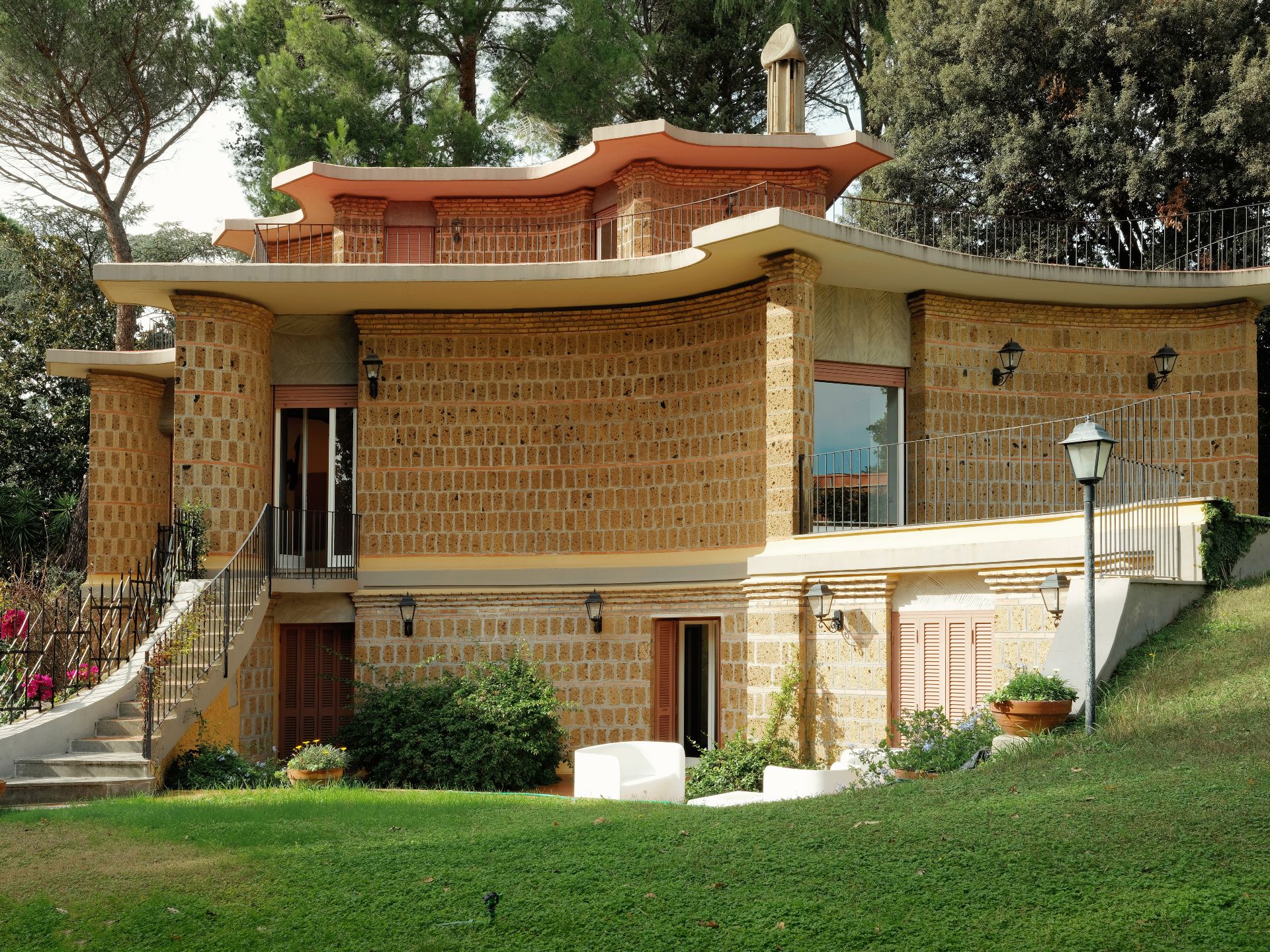
One of the earliest demonstrations of that thinking emerged with Casa Baldi, designed in Rome in 1959.
It remains one of the key works associated with Portoghesi’s early career.
The house immediately separates itself from the rigid architectural box associated with much postwar Modernism. Its walls bend. Surfaces expand and contract. Brickwork becomes more than construction material; it participates in the visual rhythm of the building.
The architecture feels less composed from independent planes than shaped by movement.
It is tempting to see Borromini behind those curves, but Portoghesi’s significance lies precisely in the fact that Casa Baldi is not a reproduction of Baroque architecture.
It belongs unmistakably to the twentieth century.
What Portoghesi recovered from history was not its appearance, but its capacity to make architecture dynamic.

The tension between those two worlds — the inherited city and the contemporary one — would remain present throughout his career.
Geometry, Movement and the Sacred
That investigation became particularly visible in Portoghesi’s religious architecture.
QEditorial previously explored his Church of the Holy Family in Salerno, built between the late 1960s and early 1970s, as a building organized through intersecting circles rather than the conventional longitudinal logic of the church.
Seen independently, the project is remarkable for its geometry.
Seen within Portoghesi’s wider career, however, it becomes something more important: another chapter in his search for architectural space capable of producing movement, participation and perception rather than simply containing them.
Read QEditorial’s previous feature:
Paolo Portoghesi and the Church of the Holy Family in Salerno
Here, history again operates without becoming historical reconstruction.
The circle becomes structure, symbol and spatial experience simultaneously.

The building helps reveal something fundamental about Portoghesi: his architecture was rarely about the isolated object.
It was about relationships.
Between one space and another. Between structure and the person moving through it. Between the memory of architecture and the conditions of the present.
But perhaps nowhere did that idea become more culturally complex than in Rome.
The Mosque of Rome: Architecture as Dialogue
The Mosque and Islamic Cultural Centre of Rome became Portoghesi’s best-known architectural work. The project originated in an international competition held in 1975 and involved Portoghesi, Vittorio Gigliotti and Iraqi architect Sami Mousawi, alongside a wider team of collaborators. Construction began in the 1980s and the complex was inaugurated in 1995.
Its importance extends well beyond scale.
Portoghesi faced a particularly delicate architectural question: how could a major Islamic place of worship belong simultaneously to Islamic architectural tradition and to Rome?
His solution was not to treat those cultures as opposites.
According to Italy’s official Atlas of Contemporary Architecture, Portoghesi approached the project through what he called the “listening to places” — adapting the building to the Roman landscape and using materials rooted in the local architectural tradition, including travertine, peperino stone and exposed brick.
At the same time, the mosque incorporates architectural ideas associated with Islamic traditions.
The most striking appears inside.
Columns divide and branch upward, producing what the Italian Ministry of Culture describes as a forest-like effect. The reference connects with precedents in Islamic architecture while also recalling the complex geometries that fascinated Portoghesi in Borromini and Guarini.
Architecture becomes dialogue rather than stylistic ownership.

The result is significant because it complicates the idea that Portoghesi was simply an architect looking backwards toward the Italian Baroque.
He was interested in something broader: how architectural identities encounter one another.
That question would soon move from individual buildings into one of the most influential architectural exhibitions of the late twentieth century.
When the Past Entered the Biennale
In 1980, architecture became an autonomous department of the Venice Biennale, with Paolo Portoghesi serving as its director.
The first International Architecture Exhibition was titled La presenza del passato — The Presence of the Past.
Even the title sounds almost like a manifesto for Portoghesi himself.
The exhibition challenged one of Modernism’s central assumptions: that architectural progress depended on continually producing the new while distancing itself from historical languages.
At the center of the exhibition stood the now-famous Strada Novissima.
Twenty architects were invited to design full-scale façades inside the Corderie of the Arsenale, producing an imaginary architectural street. Participants included figures such as Frank Gehry, Michael Graves, Hans Hollein, Rem Koolhaas, Arata Isozaki, Robert Venturi and Denise Scott Brown.
For Portoghesi, architecture was no longer being exhibited exclusively through drawings, photographs or models.
The exhibition itself became architecture.
And history was not placed behind glass.
It was brought directly into the debate about what architecture might become next.
That distinction helped make The Presence of the Past a defining moment in the international discussion surrounding Postmodernism.
Portoghesi’s own architecture cannot be entirely reduced to that movement, but his role in establishing the cultural discussion around it is impossible to ignore.
He had transformed the question underlying his own buildings into an international debate.
Beyond Postmodernism
Yet stopping at Postmodernism would also misunderstand Portoghesi.
During the later decades of his life, his attention increasingly moved toward the relationship between architecture and the natural world.
Treccani identifies history, nature and dwelling among the recurring themes of his work and connects his later architectural thinking with environmental sustainability and what Portoghesi described as geoarchitecture.
The progression is interesting.
An architect who had spent decades asking buildings to listen to history increasingly asked them to listen to place.
Those two ideas were perhaps never truly separate.
The same resistance to universal architectural solutions that allowed Portoghesi to rediscover historical identity could also lead toward architecture shaped by climate, landscape, materials and natural form.
And nowhere did those ideas become more personal than at Calcata.
Calcata: When Architecture Becomes Landscape
In the landscape surrounding the medieval town of Calcata, north of Rome, Portoghesi developed over many years a collection of spaces associated with his residence: house, studio, garden, museum and other architectural interventions.
Treccani places this body of work, developed largely between 1990 and 2003, among the significant projects of his career.
Here the boundary between architecture and landscape becomes increasingly difficult to define.
Architecture no longer appears simply as an object placed against nature.
Nature becomes part of the design vocabulary itself.
Trees, paths, geometry, structures and ornament participate in a single environment.

There is something particularly appropriate about this becoming one of the final chapters of Portoghesi’s architectural life.
The young architect who once challenged the rigid box of Modernism with the curved walls of Casa Baldi eventually arrived at an architecture in which the boundaries themselves seemed less important.
The Right to Remember
Paolo Portoghesi died in Calcata on May 30, 2023, at the age of 91.
His legacy remains difficult to confine to a single movement.
He was an architectural historian fascinated by Borromini who became one of the leading voices in the emergence of Postmodern architectural debate. He was a designer capable of moving from a private Roman house to one of Europe’s most significant Islamic cultural complexes. He was an academic who eventually turned his attention toward architecture’s relationship with ecology and the natural world.
The common thread may be simpler than all of those labels.
Portoghesi believed architecture had the right to remember.
Not in order to reproduce the past, but to prevent modernity from becoming detached from culture, place and human experience.
That question carries particular weight today.
Architecture is now produced within a world of rapidly circulating references, digital modelling, globalized aesthetics and increasingly sophisticated generative technologies. Images can be created and replicated almost instantly. Styles move across borders at extraordinary speed.
Within that context, Portoghesi’s insistence on memory feels less nostalgic than cautionary.
The important question is no longer whether architecture can access the past.
It can access almost everything.
The question is whether it understands what it is remembering.
And perhaps that is where Paolo Portoghesi remains unexpectedly contemporary.
QEditorial Editor’s Note
This feature continues QEditorial’s exploration of Paolo Portoghesi and his architectural legacy. In August 2026, QEditorial examined one of his most distinctive religious projects, the Church of the Holy Family in Salerno, focusing on its circular geometry, movement and relationship with light.
Read the previous feature: “Paolo Portoghesi and the Church of the Holy Family in Salerno”
https://qeditorial.com/2026/08/25/paolo-portoghesi-church-holy-family-salerno/
QEditorial — Architecture · Culture · Identity




Leave a Reply