
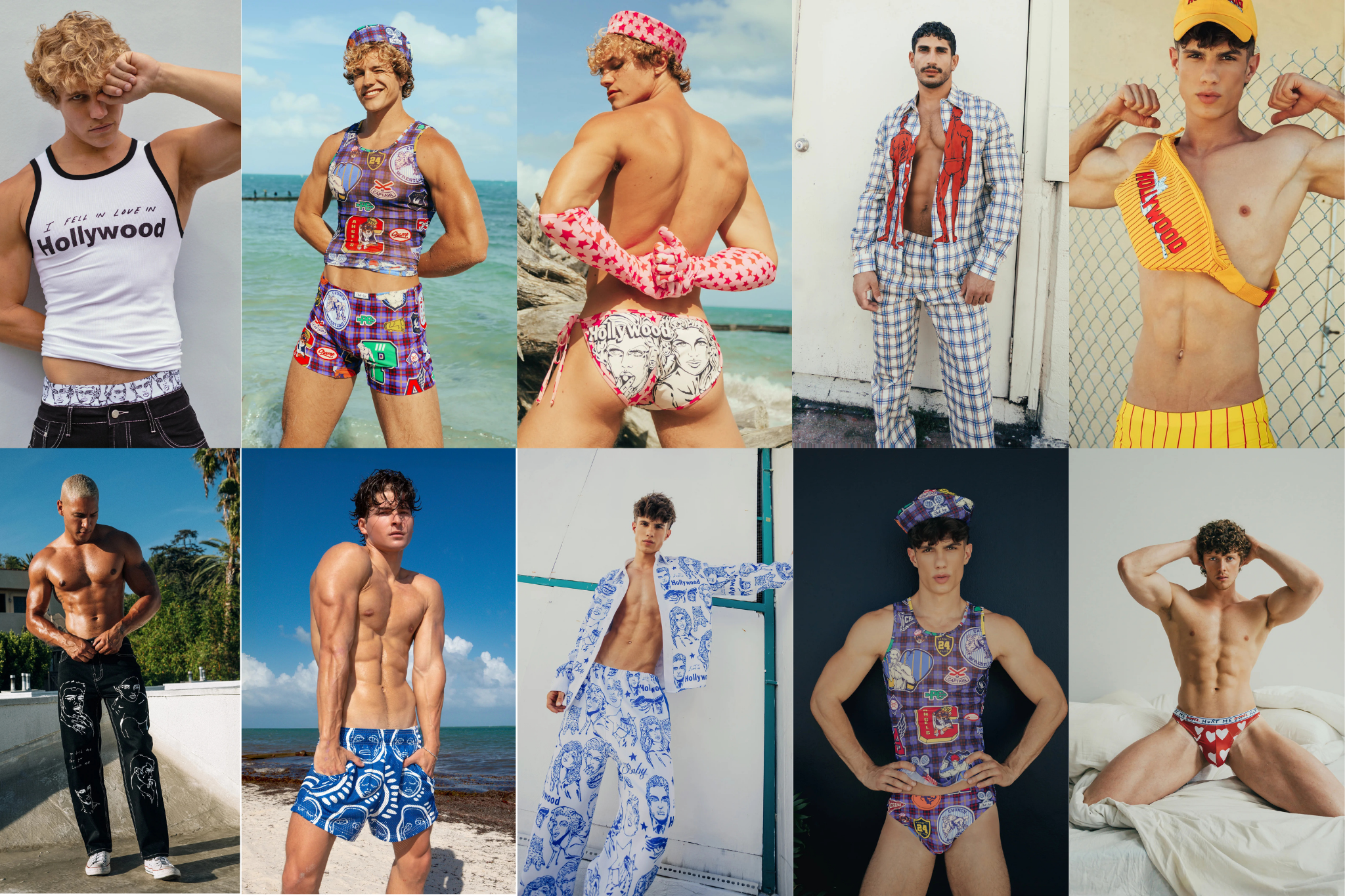
Patrick Church turns the male body into an emotional language, where desire, strength and vulnerability no longer need to contradict one another.

There is a man lying on a bed. His body conforms almost perfectly to one of fashion’s most persistent constructions of masculinity: lean, muscular, exposed and controlled. His arms are raised above his head and his gaze meets the camera without hesitation. There is little about the image, at first, that suggests vulnerability. Then you read his underwear: HURT ME. DON’T. HURT ME. Suddenly, the photograph becomes something else. The body continues to communicate confidence, sexuality and physical strength, while the garment communicates uncertainty. What appears visually invulnerable is carrying a request not to be hurt.
That contradiction offers an unusually revealing way into the work of British-born, New York-based artist and designer Patrick Church. Church has long occupied the territory between painting and fashion, moving expressive faces, handwritten phrases and erotic figures from canvas onto jackets, trousers, dresses and underwear. His imagery is deeply autobiographical: recurring faces function as forms of self-portraiture, while relationships, sexuality, fear and vulnerability repeatedly enter his visual language. In an earlier reflection for Them, Church described making work from personal experience and the emotions surrounding his identity and relationships. What becomes particularly interesting, however, is what happens when those emotions leave the canvas and enter clothing. Church is not simply putting art onto garments; he is giving clothes an emotional vocabulary.
The Body Says Strength. The Clothes Say Don’t Hurt Me.

Menswear has historically been exceptionally good at communicating outward. A suit can communicate profession or authority; a watch can signal wealth; denim rebellion; sportswear physicality; a logo membership in a particular cultural or economic tribe. Clothing has helped men tell the world who they are — or at least who they want the world to believe they are. Church’s clothes frequently perform a different function. They do not simply announce identity; they disclose emotion.
“Don’t Hurt Me” and “Handle With Care” are not descriptions of the wearer but requests addressed to somebody else. The distinction matters. “Don’t Hurt Me” tells us nothing about whether someone is powerful, successful, masculine, feminine, queer, wealthy or fashionable. It tells us that there is something capable of being wounded. Church places that admission precisely where conventional representations of masculinity have so often resisted putting it: directly against the body.

The language appears throughout Church’s current work, including intimate pieces on his official collection. There is humor in the proposition and unmistakably sexuality, but there is also an emotional tension: a physically strong body does not need to stop looking strong in order to admit that it can be hurt. Church allows those seemingly contradictory ideas to occupy the same image.
Underwear makes the proposition even more interesting because fashion is ordinarily constructed around visibility. We dress knowing that clothing will be seen; branding, logos and much of fashion’s social language depend upon recognition. Underwear complicates that transaction because much of the time nobody sees it. So who is “Don’t Hurt Me” written for — the stranger, the lover, the person who might eventually remove the clothes, or the person wearing them? Perhaps all of them.
There is something quietly powerful about putting an emotional message on the layer of clothing closest to the body. The phrase can remain underneath trousers, invisible to everyone else, and still retain its meaning. The garment becomes less like an advertisement and more like a private note. This relationship between intimacy and clothing is not new to Church. As early as 2017, Out documented his hand-painted garments and underwear, already populated by faces, bodies and romantic language. What we see today therefore feels less like a graphic trend than the continuation of an emotional vocabulary he has been developing for years.
The Body Becomes the Page

Across Church’s more densely illustrated garments, bodies overlap bodies. Faces, fragments of language, cigarettes, mouths and gestures cover fabric with the restless density of a sketchbook. The garment stops behaving like a neutral object designed merely to frame the person wearing it. Instead, another body has been drawn over the body.
Church has explained in an Interview Magazine conversation that the faces appearing throughout his work repeatedly return to himself: even when a figure appears to represent somebody else, an element of self-portraiture remains. That makes the relationship between artwork and wearer particularly compelling. The person wearing Patrick Church carries fragments of the artist’s identity while simultaneously presenting his or her own. Artist, garment and wearer become layered identities rather than separate things.
The effect becomes especially provocative when Church’s work is placed on the male body. Fashion imagery has historically permitted male beauty to be erotic, but that eroticism has often depended on certainty: strength, confidence, control and sexual availability without visible emotional consequence. Church disrupts that certainty without eliminating desire. The men remain beautiful and sexual; their bodies are not hidden or neutralized in order to make an intellectual argument about vulnerability. Instead, strength, desire and emotional exposure are permitted to coexist.
This is where Church’s work becomes more interesting than the familiar idea of fashion as self-expression. Clothing has always operated as a language, but much of its vocabulary consists of adjectives: elegant, successful, rebellious, sexy, conservative, expensive, masculine. Church introduces something closer to verbs and requests: hurt me, don’t hurt me, handle with care. Suddenly the garment requires another person. Once another person enters the sentence, fashion becomes relational.
The Masculine Body After Certainty

There is a temptation when discussing contemporary menswear to say that masculinity is being “redefined.” The phrase has become so common that it risks losing its meaning. Perhaps something subtler is happening. Masculinity may not need another definition so much as it needs fewer requirements. A man should not have to exchange strength for sensitivity, surrender sexuality in order to express tenderness, or treat masculinity and femininity as opposite ends of a scale where possessing more of one automatically means possessing less of the other.
Church confronted those restrictions relatively early in his fashion practice. Discussing his Dearly Beloved collection with Interview Magazine in 2019, he spoke about gendered clothing, his own relationship and the idea of male brides. The collection was intensely personal, drawing on his love story with his husband and creative partner Adriel Church-Herrera while questioning why particular clothes should determine how masculinity, femininity or desirability are understood.
This approach has continued to develop beyond conventional collections. In 2026, Church and Church-Herrera released Prayer Book, a limited-edition project bringing together poetry, photography and Church’s illustrations around themes of love, devotion and partnership. KALTBLUT Magazine described the project as an intimate collaboration between the couple. Its existence reinforces something already visible throughout Church’s clothing: romance is not incidental decoration in his universe. It is part of the structure.
The masculine body therefore becomes particularly useful territory for Church because it arrives carrying cultural expectations before he has painted or written anything onto it. Physical strength, sexuality, beauty and confidence remain visible, but the garments introduce another register. Vulnerability does not replace masculinity; it sits beside it. That difference matters. The argument is not that a masculine body must become softer in order to become emotionally articulate. It is that physical strength and emotional vulnerability were never inherently contradictory in the first place.
When Clothing Stops Describing Us

Perhaps this is where Church’s work points toward something larger than fashion. We have become accustomed to thinking of clothes as statements about identity: who we are, where we belong, what we can afford, what subculture we understand, what gender codes we accept or reject. Church suggests another possibility. Clothing can communicate not only who we are, but what we feel — what we desire, what we fear, how we want to be touched, how we want to be loved and, occasionally, what we cannot bring ourselves to say aloud.
That possibility changes the relationship between garment and body. A painted face becomes more than decoration; it can function as another identity carried across the skin. A handwritten sentence becomes more than branding; it can resemble confession. Underwear becomes more than something designed for seduction; it can contain a message intended for the most private possible audience.

This may be why “Don’t Hurt Me” feels more significant than an ordinary slogan. Printed against a body constructed by fashion photography to appear almost invulnerable, the words create a small fracture in the image — not enough to destroy the fantasy, but enough to reveal the person inside it.
Patrick Church’s work has frequently been discussed through queerness, gender fluidity, autobiography and the intersection of art and fashion, all of which are central to understanding his practice. Yet the clothes also raise a quieter question about what fashion is capable of communicating. If clothing has traditionally helped us construct the person we want the world to see, perhaps it can also expose something we have been taught to conceal.
The body can still communicate strength. It can remain beautiful, erotic, masculine, feminine or somewhere outside those definitions entirely. None of that has to disappear.
The clothes can simply say what the body cannot.
Editor’s Note
Patrick Church’s work interested me not simply because it exists between fashion and art, but because of what happens when his words are placed directly against the male body. Fashion has spent decades teaching men how to project strength, status, sexuality and control. It has been far less comfortable giving them a vocabulary for vulnerability.
In Church’s work, those languages can exist together. A body can appear strong while the clothes say Don’t Hurt Me. Desire does not cancel sensitivity, and masculinity does not require emotional silence. For QEditorial, that tension is where this story begins: not with another attempt to redefine masculinity, but with the possibility that men may simply need fewer rules about what they are allowed to reveal.
— Nicolò Di Stefano, Founder & Editor-in-Chief, QEditorial




Leave a Reply