
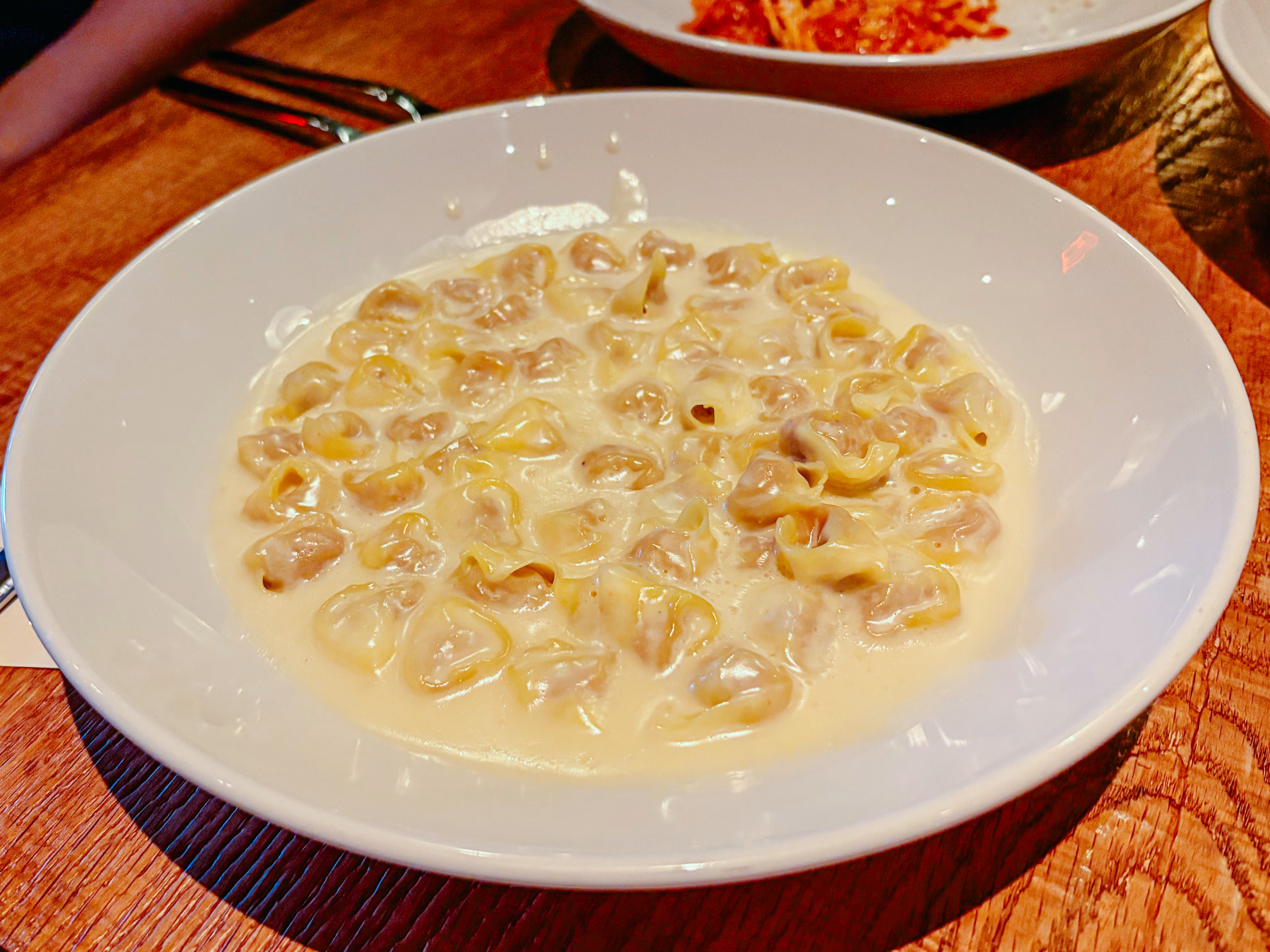
Inside UOVO, where pasta is handmade in Bologna every day, flown overnight to America and served as part of a hospitality model built around refusing compromise.

There is something almost unreasonable about UOVO’s approach to making pasta. Rather than attempting to reproduce Bologna in Los Angeles, the restaurant decided that one essential part of its operation simply had to remain in Italy. The solution was not to import a recipe, hire an Italian consultant or recreate an Italian kitchen in California. UOVO built its own kitchen in Bologna, staffed it with sfogline, and began sending fresh handmade pasta across the Atlantic. For the original Los Angeles restaurants, that means a journey of roughly 6,000 miles before a plate ever reaches the dining room.
That logistical complication is precisely what makes UOVO interesting as a hospitality story. In an industry frequently built around replication, scalability and localization, UOVO has created a restaurant group around the opposite proposition: some things should not be adapted simply because adaptation would be easier. Its success suggests that consistency does not always have to come from simplifying production. Sometimes it can come from making the difficult process repeatable.
The Kitchen That Stayed in Bologna

According to UOVO, the original search for the pasta it wanted to serve eventually led the team to Bologna, one of Italy’s great centers of fresh pasta. Attempts to reproduce the same result in the United States were unsuccessful, so the company created a dedicated production kitchen in Bologna instead. It is led by the head chef and sfoglina from what UOVO describes as one of its favorite restaurants in the city.
The word sfoglina matters here. In Bologna and Emilia-Romagna, it traditionally describes women who have developed the craft of preparing sfoglia: rolling dough into extraordinarily thin sheets before cutting, folding or filling it by hand. UOVO’s team uses these traditional sheeting and cutting methods rather than extrusion. The distinction is both technical and cultural. The restaurant argues that the method creates a texture particularly suited to holding sauce, but it also anchors the production process within a form of knowledge that is learned through repetition rather than simply programmed into machinery.
Every day, fresh pasta is produced in that Bologna kitchen and sent overnight in temperature-controlled conditions to UOVO’s American restaurants. The company has even incorporated the flight into the production logic: according to UOVO, the hours spent in transit form part of the pasta’s required resting period. What could have been treated as a weakness in the supply chain becomes part of the process itself.
It is an unusual inversion of modern restaurant logistics. Instead of moving the know-how to the customer, UOVO moves the product from the place where the know-how already exists.
Why Not Just Make It in America?

The answer UOVO gives begins with something remarkably basic: eggs.
Fresh pasta can require little more than flour, eggs and, depending on the preparation, salt. Yet simplicity makes individual ingredients more visible rather than less important. UOVO says the Italian eggs used in its Bologna kitchen create the deeply yellow pasta it was unable to duplicate in the United States. The company also regularly sources other ingredients from Italy, including tomatoes grown in Basilicata and 24-month-aged Parmigiano-Reggiano from Parma.
There is an interesting idea of luxury hidden inside this insistence. UOVO does not present itself through the conventional visual vocabulary of fine dining: elaborate plating, theatrical service or an encyclopedic menu. The luxury is more difficult to see because much of it occurs before the guest arrives. It exists in the decision to maintain a kitchen thousands of miles away, preserve a hand-intensive process and construct a supply chain around ingredients that could have been substituted.
That makes the restaurant particularly relevant to contemporary hospitality. As luxury increasingly moves away from obvious excess, provenance and process can become the experience. A guest does not need to watch the pasta cross the Atlantic to understand that its journey matters.
Recipes With Addresses

UOVO’s relationship with Italy extends beyond the dough. The restaurant acknowledges Italian chefs and restaurants that helped shape several dishes, including Danilo and his mother from Rome’s Trattoria da Danilo, Rosalba and the team at Bologna’s Antica Trattoria della Gigina, and Anna and her family from Antica Osteria del Mirasole. UOVO says members of its team worked with some of these chefs directly in their kitchens.
The result is a menu divided partly through regional identity. Bologna appears through dishes such as ragù and tortellini, while Roman traditions enter through carbonara, amatriciana and cacio e pepe. The current menus continue to emphasize that every noodle is handmade in Italy and shipped overnight rather than extruded.
That connection to individual restaurants is significant because Italian cooking is often reduced internationally to national categories that scarcely exist in Italy itself. Pasta is not merely “Italian”; preparations belong to cities, regions, families and techniques. UOVO’s strongest dishes acknowledge those distinctions rather than trying to create a generalized image of Italian food.
The restaurant is therefore transporting more than an ingredient. It is attempting to transport a system of references.
Designing the Restaurant Around the Pasta

The physical restaurants follow the same principle of restraint. For several UOVO locations, architecture and design firm Marmol Radziner developed interiors using warm woods, blackened steel, reclaimed red brick and stone. Rather than hiding production behind a dining room, bar seating faces the pasta makers and kitchen activity, while smaller table areas provide a more intimate counterpoint. Marmol Radziner describes the objective as evoking the casual elegance of the classic trattoria.
The spaces avoid competing with the food. There is no attempt to reproduce an imaginary Italian village, and little need for visual clichés announcing Italia. Materials carry much of the atmosphere: timber, brick, steel, stone, low light and the repeated movement of the kitchen.
That restraint is important because UOVO’s story is already theatrical enough. The spectacle is not fabricated scenery; it is the idea that the pasta in front of you was made by hand in Bologna the previous day.
For hospitality, this creates a useful relationship between visible and invisible design. The restaurant interior is controlled and relatively simple because an extraordinarily complex system already exists behind it.
From Los Angeles to New York

UOVO began building its American presence in Southern California and now operates restaurants in Santa Monica, Marina del Rey, Mid-Wilshire, Pasadena and Studio City. In 2026, the concept crossed the country with its first New York location in NoMad, at 13 West 28th Street.
New York changes the geography but not the proposition. The NoMad restaurant still identifies its pasta as handmade by UOVO’s team in Italy and shipped overnight. Its arrival in Manhattan is especially interesting because New York hardly suffers from a shortage of Italian restaurants. The challenge, therefore, is not introducing Americans to pasta. It is establishing why this particular process matters in a city already saturated with interpretations of Italian cooking.
UOVO answers through specificity rather than breadth. The menu remains concentrated, the company describes itself as food-centric, and the New York restaurant does not take reservations, seating guests on a first-come, first-served basis. It is also a no-tipping restaurant, with hospitality incorporated into menu pricing in New York.
These details reinforce a broader sense of discipline. UOVO does not appear interested in becoming all things to all diners. Even the menu advises guests to eat dishes as served and says modifications are politely declined.
That confidence can be read as rigidity, but it is also part of a hospitality model built around a clear point of view. The restaurant knows what experience it wants to produce and removes decisions that might dilute it.
The Cost of Refusing the Shortcut
Restaurants often speak about authenticity, a word so frequently used that it can lose much of its meaning. UOVO is more interesting when considered through another concept: commitment.
Whether pasta made in Bologna is objectively superior to pasta that could be made by an excellent team in New York or Los Angeles is ultimately something diners will decide for themselves. What is undeniable is the extent to which UOVO has constructed its business around a belief about where and how that pasta should be made.
Building an international supply chain around fresh pasta introduces complexity that most restaurant operators would normally try to eliminate. Temperature, time, transport and daily production become operational variables. Yet UOVO has turned those variables into part of its identity.
There is also a contradiction worth acknowledging. Flying fresh pasta across an ocean is not the romantic image of hyper-local dining that dominates much contemporary food culture. UOVO instead proposes another form of provenance: if the desired craft exists somewhere else, distance should not necessarily require replacing it.
That tension is part of what makes the restaurant worth discussing. Hospitality does not always evolve through convenience. Sometimes a compelling concept emerges from deciding which compromises a business is unwilling to make.
When Distance Becomes Part of the Experience
The most memorable element of UOVO may ultimately be invisible.
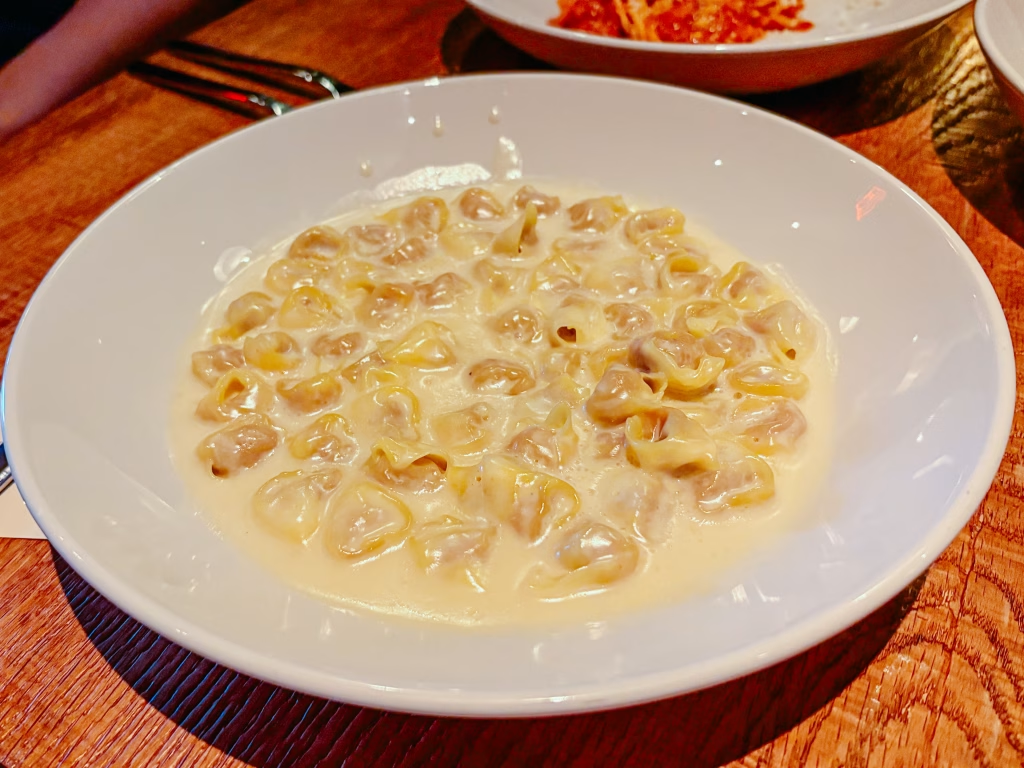
A guest enters a warm, relatively understated dining room. Pasta is cooked, sauced and served. Nothing about the physical plate immediately reveals the infrastructure connecting that table to a kitchen in Bologna. Yet once the journey is understood, distance itself becomes another ingredient.
UOVO has effectively divided the restaurant into two places. Bologna preserves production, technique and a relationship to specific ingredients; Los Angeles and New York provide the dining rooms in which that work is completed. Thousands of miles separate them, yet operationally they function as parts of the same restaurant.
That is what distinguishes UOVO within hospitality. It did not simply export the idea of an Italian pasta restaurant. It created a system in which part of the restaurant never left Italy at all.
And perhaps that is the more interesting definition of authenticity: not recreating somewhere else perfectly, but recognizing the part that you believe should never have been moved in the first place.
Discover more about UOVO, its restaurants and its Bologna pasta kitchen at the official UOVO website.
Editor’s Note
What interested QEditorial about UOVO was not simply the promise of handmade Italian pasta, but the infrastructure created to protect an idea. At a moment when hospitality is increasingly optimized for speed, replication and expansion, UOVO demonstrates another possibility: growth without requiring every part of a concept to become geographically interchangeable. A kitchen in Bologna and dining rooms across America may appear operationally excessive. In this case, that excess of effort is precisely where the identity begins.
Continue Reading QEditorial Hospitality
If UOVO explores what happens when culinary tradition travels across continents without losing its origin, our recent feature on GODUNK NYC looks at a very different expression of hospitality: Thai street food, cinematic atmosphere and a distinct sense of place on New York’s Bowery.
Read: GODUNK NYC: Thai Street Food and Cinematic Soul on the Bowery
QEditorial Magazine — Hospitality · Culture · Identity

Image Credits & Copyright Notice: All images featured in this article are sourced from UOVO’s official website and official brand materials and are used for editorial, informational, and educational purposes only. All image rights remain with UOVO and/or their respective photographers and copyright holders. QEditorial Magazine does not claim ownership of these images.


Leave a Reply