
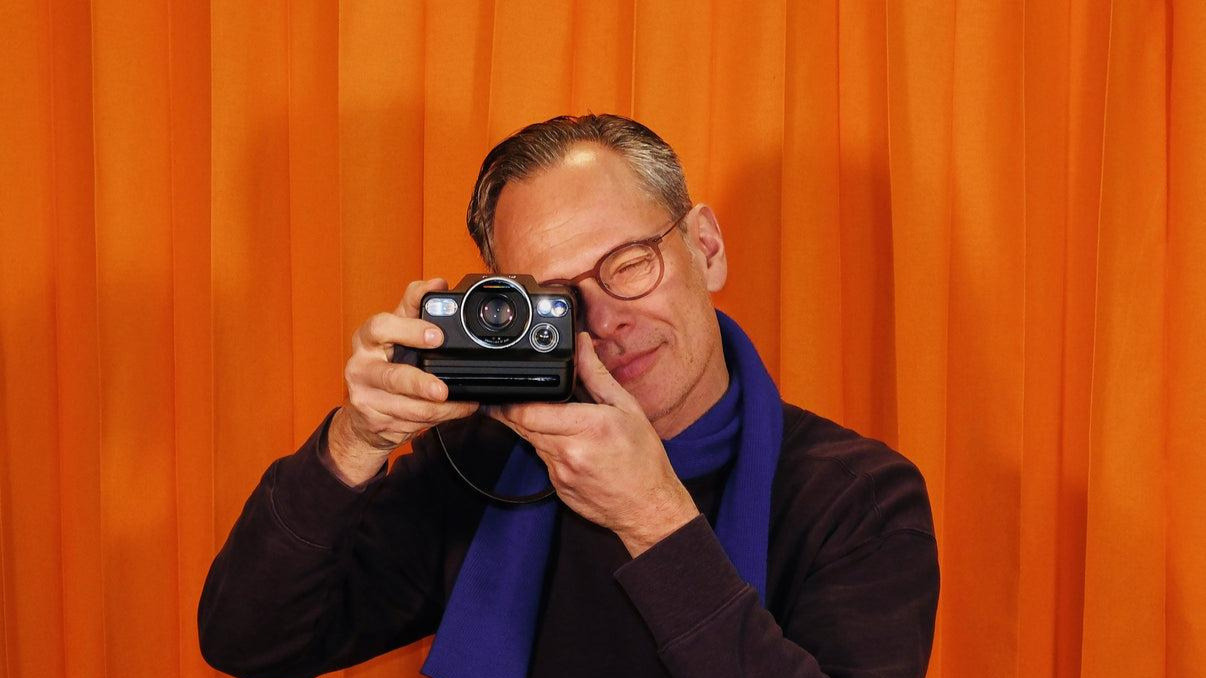
Behind the saturated colours, immaculate women and cinematic interiors of Miles Aldridge’s photography lies a darker question: what happens when beauty becomes too perfect to believe?

There is almost always something wrong in a Miles Aldridge photograph. Not visibly wrong. Quite the opposite. The lipstick is immaculate, the kitchen gleams, dresses sit perfectly against the body and colours appear almost chemically intensified. Yellows become radioactive, reds impossibly red and skin porcelain-smooth. Every object seems to occupy precisely the position intended for it. And yet the people inside these pictures rarely appear completely comfortable within the worlds constructed around them. A woman stares through a perfectly furnished domestic interior as though she has mentally left it; another is surrounded by the symbols of abundance but appears strangely disconnected from them. Faces that advertising might ordinarily use to communicate desire instead suggest boredom, anxiety, detachment or the aftermath of something the viewer has not been allowed to witness.
This tension is what makes Aldridge far more interesting than the label “fashion photographer” suggests. Born in London in 1964, he studied illustration at Central Saint Martins before moving through graphic design, music video and eventually photography. His practice has developed at the intersection of fashion, cinema, painting and Pop culture, with references ranging from Hitchcock and Fellini to religious imagery, advertising and the artificial domestic worlds of the postwar period. His official biography describes a career in which fashion photography repeatedly becomes a vehicle for larger ideas about desire, beauty and the contradictions hidden beneath immaculate surfaces. Perhaps the most useful way to understand his work, however, is simpler: Aldridge photographs perfection until perfection begins to look suspicious.
The Beautiful Image as a Trap

Fashion photography has historically been built around aspiration. The clothes are desirable because the person wearing them appears desirable; the room surrounding them is desirable; the body, the lifestyle and ultimately the fantasy itself are desirable. Photography brings all these elements together into a single proposition: perhaps, by acquiring the object, we can move closer to the life represented by the image.
Aldridge understands this mechanism exceptionally well, but rather than rejecting it, he exaggerates it. His women are beautiful, but beauty rarely resolves anything. Luxury surrounds them without necessarily offering comfort. Domestic spaces promise security but can feel strangely claustrophobic. The more perfect the environment becomes, the more visible the emotional distance between the person and the world around her appears.
This idea became especially clear around his 2013 exhibition and monograph I Only Want You to Love Me. In an interview with British Vogue, Aldridge discussed the title in relation to consumer desire and the things people purchase in the hope of becoming more attractive, more desirable or perhaps more loved. Advertising promises fulfilment through objects; his photographs often seem interested in what happens once those objects have already been acquired and fulfilment still fails to arrive.
That tension between exterior control and interior disturbance is one of the defining characteristics of his work. In a conversation with the Victoria and Albert Museum, Aldridge spoke about memories of his mother during the breakdown of his parents’ marriage and the contrast between domestic routine and private emotional complexity. Those memories help explain why domestic interiors appear so frequently in his photography. The woman in the kitchen becomes more than a model. She becomes a character, while the kitchen itself becomes a psychological set.
A Photograph That Behaves Like a Film

Cinema is fundamental to Aldridge’s visual language. Hitchcock, Fellini, Antonioni, Bergman and David Lynch have all been associated with his way of constructing images, and Aldridge has repeatedly described the importance of cinema to his visual memory. In an interview with Vogue Italia, he discussed the influence of film and the way photographic images can suggest narratives that exist beyond the boundaries of the frame.
That distinction is important. A conventional fashion photograph often explains itself quickly: the viewer sees the model, understands the garment and absorbs the atmosphere. An Aldridge image frequently feels like a single frame removed from a longer film. Something appears to have happened before the photograph was taken and something else may happen immediately afterwards. The viewer is denied both explanations.
One of the clearest examples is Red Marks #1 from 2003. A lipstick-stained cigarette has been extinguished in a fried egg. The photograph is absurdly beautiful considering the unpleasantness of the action it represents. Yellow glows against a controlled composition, while the lipstick becomes an almost synthetic red accent. What could have been a conventional beauty or cosmetics image turns instead into a fragment of an unexplained story.
Aldridge has connected the photograph to a memory of Alfred Hitchcock’s Rebecca, in which a cigarette is extinguished in cold cream. Speaking to the V&A, he explained how cinematic memory was transformed into an editorial concept. The product does not need to occupy the centre of the photograph; instead, Aldridge builds a world around it. The commodity becomes less an object of desire than evidence left at the scene.
Franca Sozzani and the Freedom to Make Fashion Strange

One relationship was particularly important in developing this visual language: Aldridge’s collaboration with Franca Sozzani at Vogue Italia. Their relationship began in the mid-1990s, at a time when Aldridge’s work was still considerably simpler. He later recalled that many of his earlier photographs used relatively clean or white backgrounds, while the creative freedom provided by Sozzani encouraged him to experiment with darker environments, stronger shadows and increasingly elaborate narratives.
Their collaboration was documented by Vogue Italia, and its significance extends beyond a successful relationship between photographer and editor. Sozzani understood that fashion imagery did not always need to flatter fashion. It could disturb the reader, borrow from cinema and fine art, make social observations or deliberately complicate the object it had ostensibly been commissioned to sell.
Aldridge’s photographs from this period helped reinforce an idea of fashion editorial as psychological theatre. The clothing remains important, but it exists inside a constructed narrative rather than functioning as the entire narrative. This also explains why many of his images continue to work after their original editorial context has disappeared. Once the magazine issue becomes history, the photograph remains capable of producing tension.
Women Who Refuse to Explain Themselves

The women in Aldridge’s photographs deserve particular attention. At first they belong to a familiar fashion vocabulary: beautiful, immaculately styled, glamorous and often eroticised. Yet they are strangely unavailable to the viewer. They stare past us, appear distracted or maintain expressions so controlled that their emotional condition becomes almost impossible to read.
His 2008 Home Works series is one of the clearest examples. An immaculate blonde woman occupies an aggressively yellow domestic environment whose visual language recalls postwar advertisements promising idealised domestic prosperity. Everything is polished and everything is apparently correct, yet her expression dismantles the fantasy.
The series demonstrates what Aldridge does particularly well: instead of destroying the visual language of advertising, he exaggerates it. The kitchen becomes more colourful, the woman more polished and the lighting more controlled. Perfection is pushed past credibility, and once that happens aspiration begins turning into unease. Aldridge therefore avoids simple nostalgia. He borrows from the visual culture of the 1950s and 1960s — Hollywood melodrama, Technicolor cinema, domestic advertising and Pop graphics — but does not ask us merely to admire the past. He destabilises it. The supposedly perfect home becomes a stage upon which loneliness, boredom, fantasy and emotional isolation can coexist with impeccable surfaces.
Colour Is Never Innocent
It is impossible to discuss Aldridge without discussing colour, yet describing his palette simply as saturated misses its function. Colour in his photographs is psychological. Yellow can become suffocating, pink synthetic, green poisonous, while red moves between desire, cosmetics, violence and warning. Colour attracts the viewer but simultaneously increases the artificiality of the world being represented.
His father, illustrator and art director Alan Aldridge, was an important early influence. The elder Aldridge’s psychedelic graphics and connection to the visual culture of the 1960s exposed Miles to Pop Art, comics, music, religious imagery and highly graphic colour from childhood. Miles Aldridge has spoken about that inheritance in interviews including one published by The Guardian and archived through his official site.
Yet the younger Aldridge uses colour differently. It does not simply make the photograph more seductive. It makes reality appear less reliable. The more intense the palette becomes, the more clearly we recognise that this world has been constructed.
That construction extends to his working process. Aldridge has remained closely associated with analogue photography, using film and Polaroid as part of an elaborate method of pre-visualisation. Lighting, composition, gesture and the position of the model can be tested before the final exposure. Even images that appear spontaneous are therefore highly engineered. Artificiality is not something Aldridge attempts to conceal; artificiality is part of the subject itself.
From Fashion Photograph to Cultural Object
The institutional position of Aldridge’s work demonstrates how dramatically the status of fashion photography has changed. His photographs have entered major public collections, including the Victoria and Albert Museum and London’s National Portrait Gallery. The latter holds portraits of figures including Lily Cole, Zaha Hadid, P.J. Harvey, Cara Delevingne, Gilbert & George and Maisie Williams.
The distinction between fashion photograph, editorial image and artwork consequently becomes difficult to maintain. A photograph created inside the commercial ecosystem of a magazine may later hang in a museum. An image commissioned to accompany fashion can ultimately reveal far more about the culture that produced it than about the garment originally pictured.
Aldridge’s work makes this transition particularly convincingly because clothing is rarely its final subject. The photographs are about desire, performance, femininity, consumer culture, domesticity, fantasy and the distance between how a life appears and how it might actually feel.
Why Miles Aldridge Matters Now
There is another reason Aldridge’s photographs feel increasingly relevant. Contemporary visual culture is moving towards almost frictionless perfection. Faces can be filtered instantly, bodies reshaped, rooms digitally cleaned and products rendered before they physically exist. Artificial intelligence can now generate people, clothes and environments that have never existed at all. The perfect image is becoming easier to manufacture.
Aldridge’s work proposes a more uncomfortable question: what happens once perfection has already been achieved?
His photographs repeatedly suggest that visual perfection does not necessarily produce emotional fulfilment. Sometimes control becomes confinement; sometimes luxury becomes isolation; sometimes beauty becomes so complete that we instinctively begin searching the image for evidence of what has gone wrong.
That may ultimately explain why Miles Aldridge’s photographs remain so compelling. They seduce the viewer first and then make the viewer suspicious of the seduction. Their surfaces promise everything that fashion imagery traditionally promises — beauty, glamour, colour, control and desire — while the characters inside them quietly undermine that promise.
Somewhere between those two reactions, the fashion photograph becomes something else. It becomes a portrait not simply of a woman, a dress or a room, but of the fantasy itself.
Editor’s Note
Miles Aldridge’s photography has always fascinated me because it operates in that difficult space between attraction and discomfort. His images are immediately seductive — saturated colour, immaculate styling, cinematic composition — yet the longer we look, the less perfect those worlds begin to feel. In this feature, QEditorial examines how Miles Aldridge photography transforms fashion imagery into something more psychological: a study of desire, artificiality and the uneasy expectations hidden behind visual perfection. At a moment when contemporary culture is producing increasingly polished images through filters, digital manipulation and AI, Aldridge’s work feels particularly relevant. His photographs remind us that perfection can attract the eye, but it is often the imperfection beneath the surface that keeps us looking.
QEditorial — Fashion · Culture · Identity

Image Note
All images featured in this article are used for editorial, educational and critical commentary purposes in connection with the work and career of Miles Aldridge. Copyright remains with Miles Aldridge and/or the respective rights holders. QEditorial does not claim ownership of the images. No commercial ownership or transfer of rights is implied. If any rights holder wishes to request an updated credit, correction or removal, please contact QEditorial.


Leave a Reply