

Inside Lambwolf Collective, where pet products begin with behavior, movement and the relationship between animals and the people who live with them.
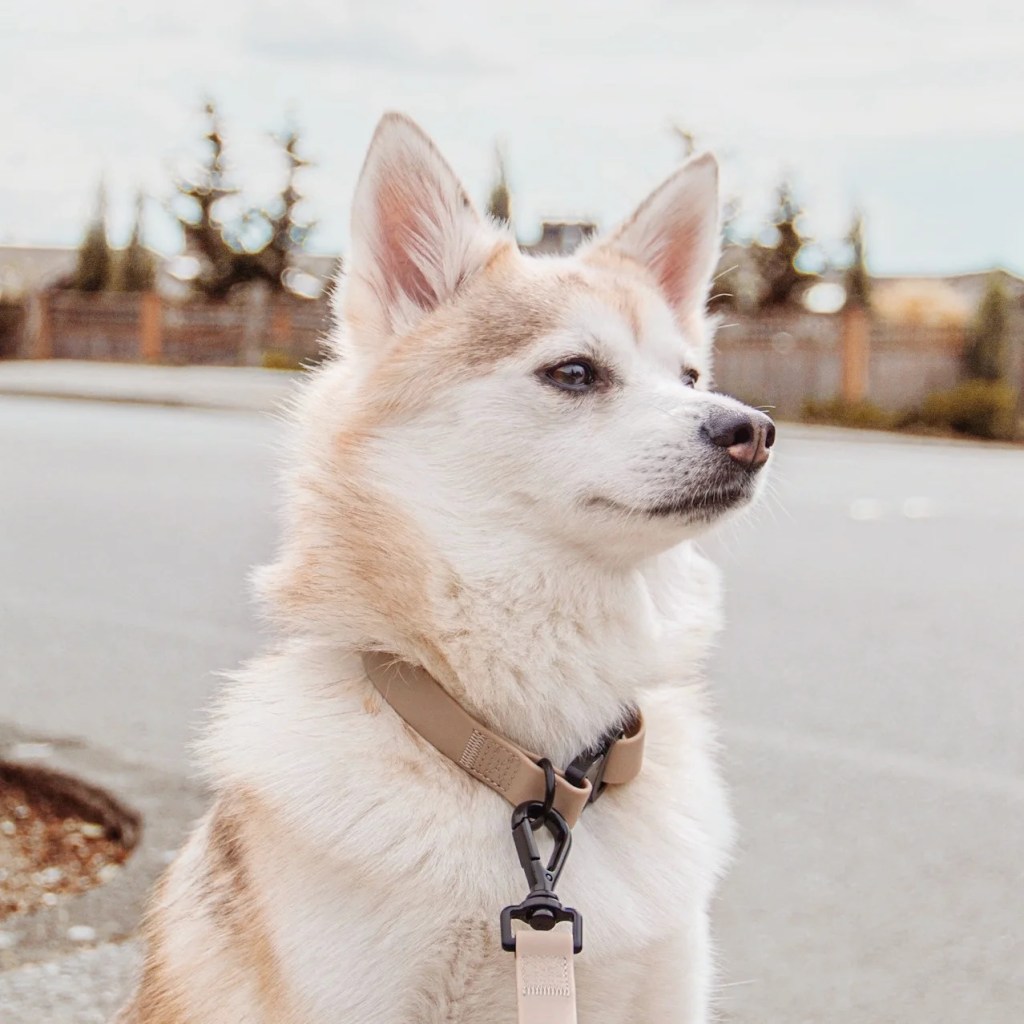
There is a particular contradiction at the center of contemporary pet design. As dogs have moved further into the emotional and physical center of domestic life, the objects created for them have become increasingly sophisticated. Collars are styled like leather goods. Beds resemble furniture. Bowls are designed to sit comfortably beside carefully selected ceramics and lighting. Toys arrive in palettes that would not feel out of place in a design store.
Much of this evolution has been driven by us.
We want objects for our dogs that work inside our homes, reflect our tastes and perhaps say something about the kind of people we are. But an increasingly interesting group of designers is beginning with another question: what happens when the object is designed not primarily for the person looking at it, but for the animal using it?
That distinction sits at the heart of Lambwolf Collective.
The pet lifestyle company describes its philosophy in three deceptively simple words: “Let Dogs be Dogs.” Rather than approaching the animal as an accessory to a human lifestyle, Lambwolf says its mission begins by attempting to see the world through the dog’s eyes. The result is a collection that moves between walking equipment, enrichment objects, travel accessories, apparel and domestic products while maintaining an unusually controlled visual language.
But the aesthetic may actually be the least interesting part.
What Does a Dog Need From Design?
Good product design traditionally begins with the user. How does someone hold an object? How often is it used? What problem does it solve? What happens when the body moves?
Apply those questions to a dog and the conversation changes immediately.
Dogs smell before they understand many of the things humans understand visually. They bite, pull, paw, chase, tug and investigate. Play is rarely static. An object can be thrown across a room one minute and become something to dissect with the nose the next. A walk is simultaneously exercise, communication, stimulation and exploration.
Lambwolf’s approach is particularly visible in its PLAY collection. The company says these objects take inspiration from Montessori principles, emphasizing open-ended play rather than a single predetermined activity. Instead of producing something intended to be used in exactly one way, the idea is to allow the dog — and frequently the person — to alter the experience.
The NOU enrichment toy is perhaps the clearest expression of the idea.
At first glance, NOU is remarkably simple: a long textile object that can be tied and rearranged. Yet its shape is intentionally unfinished. It can become a knot, a ball, a tug object or a more complicated puzzle. Treats can be hidden between its folds, turning the act of untying it into nosework and problem solving. Combine several pieces and the difficulty can change again.
What Lambwolf is selling, then, is not simply the object.
It is selling possibility.
That is a surprisingly significant distinction in a category still dominated by products designed either around novelty or around human ideas of what an animal should find appealing.
The End of the Ugly Pet Object

There is another reason Lambwolf feels particularly relevant now.
Pet ownership has become structurally embedded into contemporary domestic culture. Dogs are not simply living in houses; increasingly, homes are being organized around the reality that animals share them.
And yet for decades pet products seemed to exist in a completely separate aesthetic universe.
Bright synthetic colors, cartoon graphics and bulky plastic objects were accepted almost by default. The implicit assumption was that pet equipment belonged to a category where visual design did not particularly matter.
That assumption has collapsed.
Lambwolf belongs to a generation of companies treating the pet object with the visual discipline ordinarily associated with contemporary furniture, fashion accessories or industrial design. Its restrained palettes, simple forms and carefully controlled proportions make the objects noticeably easy to integrate into a modern interior.
But there is an important difference between making a dog toy look like an interior object and designing a dog toy that deserves to occupy the interior.
Lambwolf’s strongest work sits in that space.
Its objects are visually quiet enough for humans and functionally complicated enough for dogs.
That balance may explain why contemporary pet design is increasingly moving away from the idea of disguising animal products altogether. The goal is no longer necessarily to make the dog bed look like something other than a dog bed. It is to acknowledge that a dog bed, a leash or a feeding object can itself be worthy of considered design.
The Walking Kit as Everyday Equipment
The same thinking extends beyond play.
Lambwolf’s WALK collection treats the daily walk almost as a system. Harnesses, collars, leashes and related pieces can be combined into modular configurations rather than treated as isolated accessories. The company describes its walking sets as adaptable to both the needs of dogs and the humans accompanying them.
This is where pet fashion increasingly begins to overlap with technical design.
A collar is worn on the body. A harness must respond to anatomy and movement. A leash becomes a physical connection between two bodies moving at different speeds and reacting to different stimuli.
These are fashion objects only in the broadest sense.
They are also equipment.
The most interesting contemporary pet brands appear to understand that distinction. The aesthetic decision cannot be separated from questions of weight, flexibility, adjustability, cleaning and comfort. A beautiful harness that restricts movement is ultimately poorly designed. A leash that photographs well but performs badly during a three-mile city walk has failed its primary purpose.
The hierarchy matters: function first, visual language second.
Lambwolf’s restraint makes that hierarchy particularly visible.
A Home Shared With Another Species

The broader cultural shift behind all of this is perhaps more significant than any individual toy or leash.
For much of modern design history, the home has been imagined almost exclusively around human bodies. Chairs accommodate our proportions. Door handles respond to our hands. Kitchens correspond to our height and movement. Architecture itself is fundamentally anthropocentric.
The growing pet economy is quietly challenging that assumption.
What does domestic space become when another species is not merely permitted inside it, but understood as a permanent member of the household?
A travel mat such as Lambwolf’s ORII, for example, is ostensibly a simple pet accessory. Yet conceptually it represents something larger: the idea that an animal should have a recognizable personal space that can move between home, restaurant, car, hotel or outdoor environment.
The product is compact, portable and water-resistant, designed to create a temporary resting surface wherever dog and human happen to be.
That may sound small. But design is often most revealing in precisely these ordinary objects.
They expose how relationships are changing.
Design as a Form of Attention
Lambwolf Collective also frames itself explicitly around community. According to the company, a portion of purchases supports organizations connected to animal welfare and other social causes. As of its current published figures, the business says it has donated more than $86,000 to nonprofit organizations, operates as a 100 percent women-owned and operated company, and is carried by more than 500 retailers across over 30 countries.
Those numbers suggest that what once appeared to be a niche category is becoming considerably less niche.
The sophisticated pet object is no longer an eccentric indulgence on the margins of design culture. It is part of a much larger redefinition of domestic consumption: people are increasingly willing to apply the same criteria of material, function, longevity and visual coherence to products made for animals that they already apply to products made for themselves.
There is, however, a useful tension here.
The better pet products become at satisfying human aesthetic expectations, the easier it is to forget who they are actually for.
That is why “Let Dogs be Dogs” is more than an effective slogan.
It offers a useful design test.
Does the object merely look good beside the sofa?
Or does it make the dog’s experience of the world richer?
The strongest contemporary pet design should probably do both. But if forced to choose, perhaps the second question should always come first.
Because designing well for animals requires something more interesting than projecting our tastes onto them.
It requires paying attention to how they move, investigate, rest, play and understand the environments we have asked them to share with us.
And perhaps that is where pet design becomes genuine design: not when the dog accessory begins to resemble a human luxury object, but when we become sophisticated enough to design an object around the needs of a completely different species.
Editor’s Note
Pet fashion is often discussed through the language of luxury, but luxury alone is becoming an increasingly limited way to understand the category. Lambwolf Collective points toward something more compelling: a design culture in which the animal is treated as an actual user rather than an extension of human style. That shift — from decoration to observation — may ultimately be where the future of pet design begins.



Leave a Reply