

Inside Pocketbook Hudson, a former textile factory where bathing, art, nightlife, food and community are redefining what hospitality can become.
There is something increasingly predictable about contemporary luxury hospitality. The restored building, the carefully scented lobby, the destination restaurant, the spa, the local ceramics, the promise of an experience rather than simply a room. Pocketbook Hudson contains many of those ingredients, yet what makes the project interesting is the way it attempts to dissolve the boundaries between them.
Occupying a historic textile factory built in 1885 in Hudson, New York, Pocketbook presents itself not simply as somewhere to sleep but as a place for what it calls “care, creativity, and transformation.” Inside the old industrial structure are guest rooms, communal baths, a restaurant centered on live-fire cooking, a café and bar, galleries, retail spaces and a subterranean nightclub. The result is closer to a small cultural ecosystem than to a conventional boutique hotel.
That distinction matters because hospitality is changing. For decades, the hotel was fundamentally organized around the traveler: arrive, check in, sleep, eat, leave. Pocketbook proposes something more porous. A person might enter for dinner without staying the night, spend an afternoon bathing without booking a room, attend a performance, shop for fashion or collectible design, or descend underground for music after dark. The overnight guest becomes only one participant among many.
And that may be the most radical thing about the project: the hotel is no longer necessarily the destination. The community forming inside it is.
An Industrial Building Given Another Life
Hudson itself makes the experiment possible.
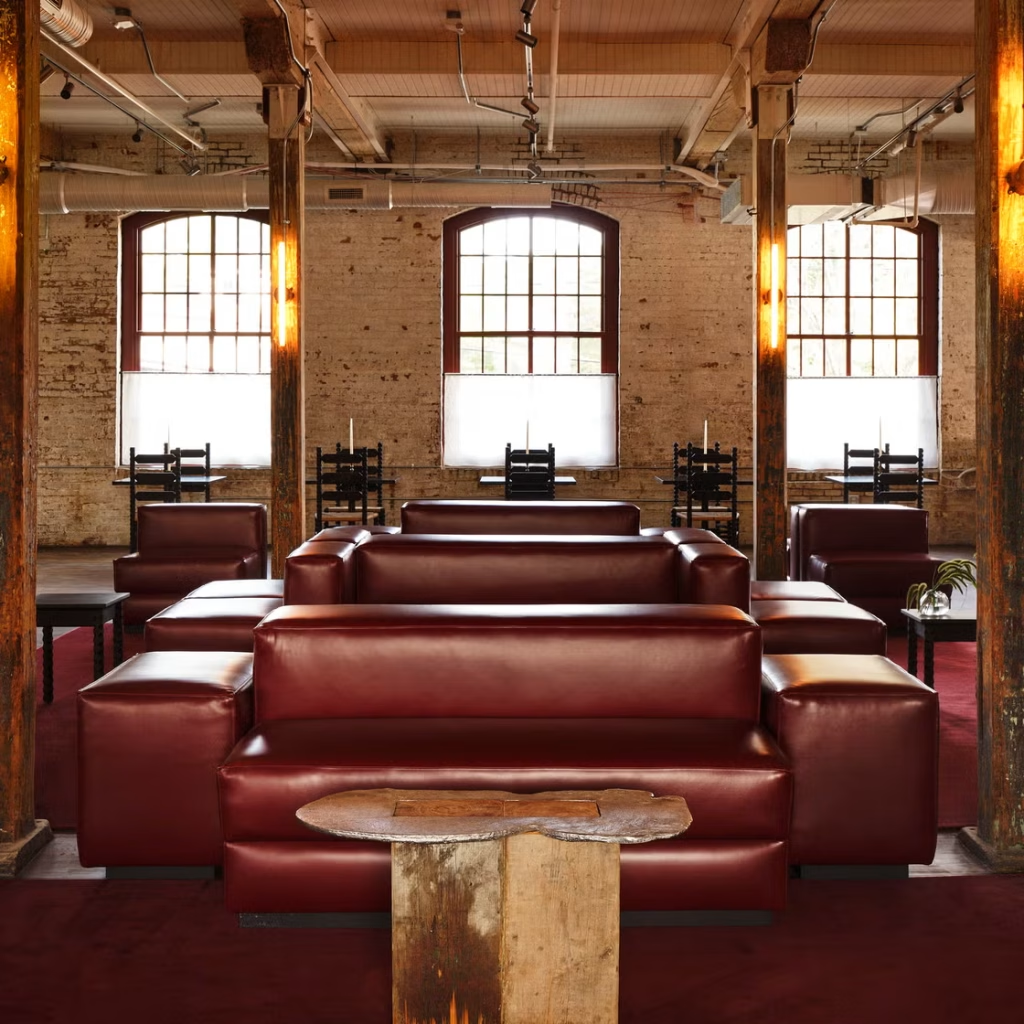
Around two hours north of Manhattan by train, the small city has spent years developing an unusual cultural density. Antique dealers, galleries, restaurants, designers, artists and former New Yorkers coexist inside a compact urban fabric of 18th- and 19th-century architecture. Pocketbook occupies a massive former factory on Washington Street, preserving exposed brick, timber and oversized industrial windows while introducing a contemporary interior language around them.
The transformation was undertaken by architecture and design studio Charlap Hyman & Herrero, whose approach resists making the industrial past either excessively polished or theatrically nostalgic. The scale of the factory remains legible. So do the brick walls and structural elements. But stainless steel, custom furniture, textiles, lighting and contemporary objects interrupt the historical envelope.
The contrast gives the rooms their character. Rather than disguisging the fact that guests are sleeping inside a former industrial building, Pocketbook frequently emphasizes it. High ceilings and unusually large windows coexist with built-in furniture, natural woods, metal surfaces and handcrafted details. Some room categories include soaking tubs, while even smaller Weekend Studios incorporate oversized windows, custom millwork and projectors.
It is a useful lesson in adaptive reuse. Preservation does not always have to mean freezing architecture at a particular moment in history. Sometimes an old structure survives because it is given permission to behave differently.
The Bathhouse as the New Lobby

The most compelling space at Pocketbook may not be a bedroom at all.
Its communal bathhouse shifts one of hospitality’s most private rituals — bathing — into a shared environment. Thermal pools, steam, sauna and treatment spaces create a setting designed around slowing down rather than simply consuming another service. Overnight guests receive access, but the baths are also available through day visits and membership, further blurring the distinction between hotel amenity and neighborhood institution.
The wellness program extends beyond conventional massage treatments. Pocketbook lists bodywork, facials, strength training, somatic meditation and consultations involving creative, intuitive and herbal practices, while its studio hosts programming that can include sound immersion, dance, breathwork, yoga, Pilates and other forms of creative practice.
What is interesting is not simply the breadth of the offering. It is the social architecture behind it.
Hotels traditionally make privacy aspirational: the private suite, private pool, private dining room, private transfer. Pocketbook introduces another proposition. Luxury might also mean having enough time and space to participate in a ritual with other people.
The communal bath becomes, in that sense, another kind of lobby — one without laptops, luggage or transactional introductions.
Art That Refuses to Behave Like Decoration
Art hotels are hardly new. Contemporary hospitality has become so saturated with commissioned paintings and curated objects that art can sometimes function as another specification on an interior-design checklist.
Pocketbook attempts to move beyond that model.
The hotel describes art as a form of infrastructure rather than adornment, imagining it as something capable of producing relationships between people rather than merely completing a room. Its artistic program has included work by contemporary artists including Tschabalala Self, Maryam Hoseini and Martine Gutierrez, with artist WangShui involved in its curatorial program.
That philosophy is revealing.
If art is infrastructure, then the important question is no longer whether a painting matches a sofa. It becomes: what does the artwork allow to happen around it?
The distinction makes Pocketbook particularly relevant at a moment when hotels increasingly present themselves as cultural institutions. The strongest examples are beginning to understand that purchasing art and building cultural relevance are not the same thing. One fills walls. The other requires artists, audiences, programming, disagreement, experimentation and time.
Pocketbook appears interested in the second possibility.
A Restaurant Built Around Fire

Food plays a similarly independent role.
At Ambos, chef Norberto Piattoni draws on his Argentine heritage alongside fermentation and live-fire cooking techniques, working with local meats, seafood, produce and fresh pasta. The restaurant does not exist solely to feed hotel guests; it functions as its own destination within the building.
That independence is important. Historically, a hotel’s restaurant, bar and spa were amenities supporting the bedroom business. Increasingly, the hierarchy is reversing. A visitor may encounter the restaurant first, return for an exhibition months later, attend a party and only eventually become an overnight guest.
Hospitality becomes a sequence of relationships rather than a reservation.
From Bathrobe to Nightclub

Then there is Ether, Pocketbook’s subterranean nightclub.
Its presence fundamentally changes the rhythm of the building. A place that begins the morning with bathing and wellness can end the night with DJs, performers and dancing underground.
Programming has drawn artists and performers from both the Hudson Valley and farther afield, reinforcing an idea that runs throughout the property: culture should not be separated from hospitality into a decorative side program. It should participate in shaping who enters the building and why.
Brand Director Shanekia McIntosh described the ethos succinctly to Wallpaper: each person entering the property is treated as a guest, regardless of whether that person has booked a bedroom.
That single idea dismantles one of the oldest boundaries in hospitality.
Traditionally, the local community existed outside the hotel while travelers existed inside it. The great urban hotels occasionally became exceptions — their bars and restaurants turning into genuine city meeting places — but contemporary luxury has often moved toward increasing separation.
Pocketbook runs in the opposite direction.
Shopping Without the Gift Shop
Even retail avoids the predictable hotel boutique.
The building houses Show: Room, a 6,000-square-foot gallery-like environment devoted to collectible and functional design, as well as KASURI, another 6,000-square-foot space focused on directional Japanese, European and American fashion. At street level, Pocketbook Market mixes branded merchandise with independent collaborators and a maker-owned cooperative.
Again, the scale is significant. These are not shelves next to reception stocked with candles and logo tote bags. They constitute another reason to enter the building entirely independent of sleeping there.
The effect is cumulative: bathhouse, fashion, collectible design, food, art, nightlife, accommodation. Pocketbook begins to resemble an urban neighborhood compressed inside a factory.
The Risk of Becoming Too Much
There is, of course, a tension embedded in this new model.
Hotels increasingly want to become everything: gallery, private club, wellness center, cultural platform, restaurant group, retail destination and social hub. At some point, abundance can become another form of branding.
What separates an authentic cultural space from a hotel that simply borrows the appearance of one is ultimately participation. A genuine community cannot be designed into existence through furniture or described into existence through marketing language. It has to include people who have reasons to return when they are not traveling.
Pocketbook seems unusually aware of this problem.
Its baths offer discounted Community Days on Tuesdays and Wednesdays. Cultural programming draws on local as well as visiting creatives. Retail gives significant space to makers and designers. The hotel consciously encourages interaction between Hudson residents and visitors.
Whether that relationship remains convincing over time will be more important than any particular design object inside the building.
The Hotel After the Hotel

Perhaps Pocketbook Hudson is still a hotel after all.
There are rooms. There are keys. People arrive with suitcases and leave after breakfast.
But the most interesting parts of Pocketbook begin where that definition stops being useful.
It belongs to a generation of hospitality projects challenging the assumption that a hotel should primarily organize itself around accommodation. Instead, the room becomes one element inside a larger network of experiences: bathing, eating, listening, dancing, shopping, looking at art and encountering other people.
That model also changes what luxury means.
Luxury here is not expressed principally through isolation. It is found in generous space, adaptive architecture, craftsmanship, time, access to creative work and the possibility of participating in something larger than one’s own stay.
Inside a textile factory in Hudson, the hotel has effectively been turned inside out. The private room remains, but much of the energy exists beyond its door.
Perhaps that is why Pocketbook is most interesting when it stops behaving like a hotel.
Because the future of hospitality may not be about creating ever more extraordinary places to sleep.
It may be about creating places where people have a reason to stay awake.
QEditorial Hospitality
Hudson, New York · Hospitality · Interior Design · Architecture · Art · Culture
 Image Note: All images featured in this article are sourced from the official Pocketbook Hudson website and are used for editorial reference. All image rights remain with Pocketbook Hudson and/or the respective photographers and rights holders.

Leave a Reply