
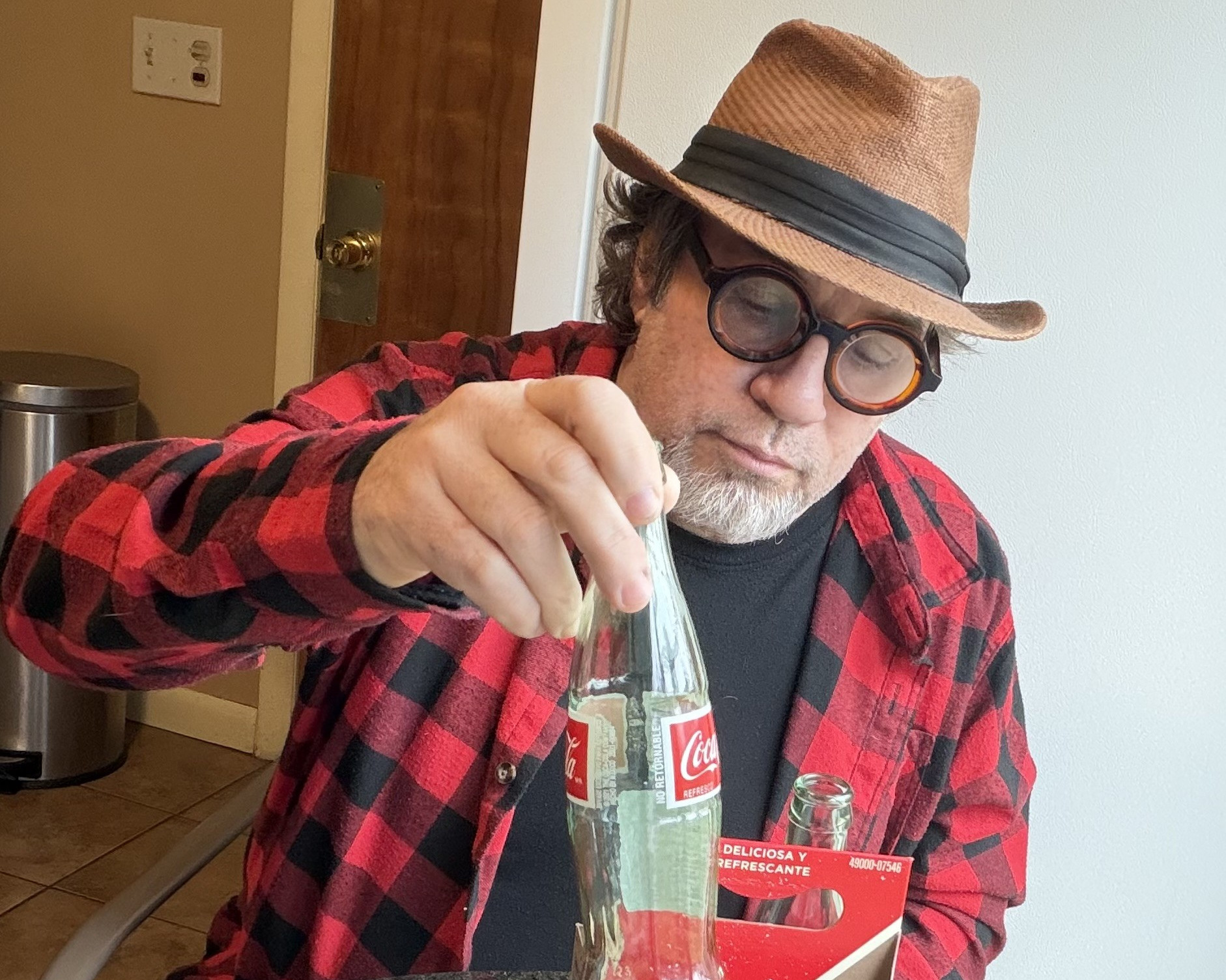
From Havana to the United States, the Cuban artist has developed a visual language in which harlequins, consumer objects, animals, digital devices and familiar symbols become instruments for examining memory, migration and contemporary life.

A harlequin stretches across a dark field while pale, mask-like heads hover around him. Elsewhere, an elongated Pinocchio stands beneath a pair of patterned legs; in another composition, a figure raises a smartphone toward its own face, surrounded by a corporate logo, a Cupid and the unmistakable choreography of the selfie. Orlando Boffill Hernandez builds images from things we already know, then rearranges their familiarity until it begins to feel unstable.
That instability is central to the Cuban-born artist’s work. Everyday imagery, fragments of popular culture and references inherited from art history coexist with political and autobiographical concerns. The images can initially appear playful: primary colors, simplified figures, circles, theatrical costumes and objects reduced almost to pictograms. Yet Boffill’s pictures operate through accumulation. Symbols are placed beside one another until they begin to form sentences.
Born in Havana in 1964, Boffill began studying painting and drawing in 1980 at the Taller de Artes Plásticas in San Miguel del Padrón, then located at the Ernest Hemingway Home and Museum and directed by painter and sculptor Orestes Vergel. The experience contributed to the formation of the artists’ group La Vigía, with which Boffill participated in collective exhibitions. He later studied Art History at the University of Havana before working from 1991 as a specialist in visual arts at the Galería de Arte in Havana’s 10 de Octubre municipality, where his activities included curatorial work and cultural promotion. He became an independent artist in 1996, as documented in his official curriculum and artist biography.
The combination of artist and art historian remains important to understanding his practice. Boffill approaches an image with an awareness of the histories already attached to it. A harlequin arrives carrying centuries of theatre and painting. Pinocchio carries ideas of truth, fabrication and transformation. A smartphone brings an entirely different archive: self-presentation, surveillance, aspiration, communication and the circulation of images. The Apple logo, Coca-Cola packaging or other consumer objects introduce another vocabulary, one formed by commerce and global recognition.
Boffill’s own description of his practice identifies two recurring territories: the intimate, approached as a space for poetic exploration, and socio-political commentary, particularly in relation to Cuba. His recurring imagery has included the sea, fish and boats as signs connected to insularity and emigration, while questions of power and economic existence extend the work beyond a specifically Cuban narrative, themes he has discussed in relation to works presented through Saatchi Art.
A recent profile accompanying his work in Guernica situates those concerns within a broader conceptual practice. The publication describes Boffill’s use of the island both as physical geography and metaphorical space, alongside recurring references to migration, passports, economic struggle and power. It also notes his use of irony and of visual languages associated with social media, as well as his appropriation and reinterpretation of historical and cultural symbols.
Images That Behave Like Language

The works reproduced here reveal how effectively this system operates.
In one composition, a monumental dark head occupies a turquoise ground. Its features have been assembled from objects rather than conventionally painted: arrows form horizontal accents, red cords descend like tears or tendons, and a baseball occupies the centre of the face. Beside it, a framed red silhouette introduces another figure into the scene. The work sits somewhere between painting, assemblage, diagram and theatrical construction.
The objects retain their individual identities, yet their relationships alter them. A baseball is simultaneously a ball and an eye-like form; an arrow remains an arrow while becoming part of a face. Boffill allows recognition to occur before interpretation. The viewer sees first, then has to decide how the pieces belong together.
Another work presents long patterned legs descending onto a yellow, wheeled Pinocchio-like form. A stretched nose points decisively across the composition. Red curtains at either side imply a stage, while the severe geometry of the upper field creates the sensation of a constructed room. Fairy tale, theatre and physical imbalance occupy the same pictorial space. The image has the clarity of an illustration and the ambiguity of an allegory.
That tension becomes increasingly contemporary in the work centred on a gold figure holding a smartphone. The body is flattened into an emblem against an intense blue background. A smiling circular face replaces individualized identity. Cupid appears on the chest, while a large Apple symbol occupies the torso. The figure simultaneously performs affection, technology, branding and self-image.
The smartphone matters because it changes the traditional logic of the portrait. The subject is both person and image-maker, looking outward while manufacturing an image of itself. Identity becomes mediated through an object already associated with desire, status and constant visual exchange. Boffill’s reduction of the scene to elementary shapes makes its contemporary rituals appear almost archaeological, as though the habits of digital culture were being catalogued as symbols.
Harlequin, Pinocchio and the Survival of the Archetype

Boffill repeatedly returns to figures that already possess a cultural memory.
The harlequin is particularly productive. In the work shown here, a multicoloured figure occupies much of the composition, its costume built from triangular fragments of red, orange, yellow, green, blue, white and black. Several circular faces surround it. Below, a pale profile with an extended nose recalls Pinocchio, while a small animal balances on a brick structure.
The picture reads as a cast of characters whose precise narrative remains unresolved. Theatre offers Boffill a structure without obliging him to tell a conventional story. Masks, performers and fabricated identities can move between humour and unease, spectacle and vulnerability.
His interest in the harlequin continues in recent production. A work titled Infinite Harlequin, presented through Saatchi Art, demonstrates the persistence of the figure within his current practice and connects it to his continuing exploration of intimacy, Cuban experience and socio-political themes.
Pinocchio performs a related function. The character is universally recognizable, but the extended nose immediately transforms physical form into an ethical sign. Truth acquires a shape. In Boffill’s compositions, that familiar association can collide with economics, identity, technology or political language without needing literal explanation.
The resulting paintings resist a single symbolic dictionary. Their strength comes from the friction between signs.
Cuba as Geography and Memory

Boffill’s biography inevitably informs this vocabulary, although his work cannot be reduced to biography.
His career developed within the Cuban art environment of the 1980s and 1990s, and his exhibition record traces an extensive path through Havana galleries before expanding internationally. According to his official exhibition history, his work has appeared in more than sixty collective exhibitions and thirteen solo exhibitions in and outside Cuba, including projects in Spain, Portugal, Germany, Colombia, Italy, Mexico, South Korea and the United States.
Among the early exhibitions were La Vigía in Our Time at Havana’s 10 de Octubre Gallery in 1984; exhibitions associated with Havana’s young-art scene during the following decade; Cuba 97 in Colombia; Made in Cuba and End of Century Cuban Painting in Barcelona in 1999; and a substantial sequence of projects in Cuban galleries during the 2000s, all recorded in the artist’s published curriculum.
Mexico became another important point in the trajectory. Boffill presented solo projects in San Miguel de Allende in 2012, followed by a move into the New York exhibition circuit. In 2013 his work appeared at the Fountain Art Fair in New York and in the solo exhibitions Fantasy, Cuba Zagat and Sprout Out Exhibition. Subsequent projects included Portrait of a Space in 2015 and several Art Mora presentations in 2016.
His international activity continued through the Gongju International Art Festival in South Korea, Art Busan, the Gwangju International Art Fair, exhibitions in New Jersey and New York, and Flight of Butterfly at Van der Plas Gallery in New York in 2022. His long-standing relationship with Art Mora places him within a network that has helped extend his work beyond Cuba and into the United States and Asia.
The artist now lives and works in the United States, according to his current biographical information.
Migration, in this context, is neither decorative background nor isolated subject. It affects the vocabulary through which belonging can be represented. Guernica’s recent account of Boffill’s practice identifies the sea, fish, boats and passports among the recurrent signs through which he addresses movement away from the island.
A work by Boffill, Acupuntura, accompanied Rolando Kattan’s poem Insomniac’s Cartography in Guernica in February 2026. The pairing is striking: the poem circles migration, lineage, displacement and exile, while Boffill’s image enters the page as another visual register for questions that have long occupied his work.
Color as a Character

One of the earlier critical observations located during research comes from a 2009 text on Boffill by critic Goyo Vigil. In his commentary on the artist, Vigil focuses on Boffill’s ability to bring concealed systems of meaning toward the surface and describes color as an active presence within the work rather than background decoration.
The observation remains useful when looking at Boffill’s recent images.
His colors seldom behave naturalistically. Turquoise, cobalt blue, scarlet, yellow and green divide the surface into zones. Bodies can be gold; horses can approach white; landscapes become bands and curves. Color distinguishes objects, controls hierarchy and establishes visual tempo.
In the composition containing a horse, green bands sweep across a largely pale field while blue and red circles interrupt their movement. A large red curved form dominates the lower half. The horse is pushed toward the edge, enclosed by a yellow section filled with repeated circles. The image can be read through its figures, yet its energy comes just as strongly from the collision of color and geometry.
This is where Boffill’s apparent simplicity becomes useful. Removing atmospheric realism gives individual signs greater independence. A red circle can become sun, marker, target, punctuation or simply red circle according to its relationship with the rest of the picture.
Between the Personal and the Political
Political art frequently loses force when its meaning becomes too explicit. Boffill generally works through a more open mechanism. His social observations are embedded in symbolic arrangements that preserve ambiguity.
Money can appear beside an ordinary soft-drink bottle. A corporate emblem can occupy a human torso. A smartphone becomes part of an anatomy. Fairy-tale characters share space with contemporary objects.
The everyday world is already full of symbols; Boffill treats that condition as material.
His training in Art History helps explain the ease with which references migrate between visual registers. In statements accompanying his work on Saatchi Art, Boffill links his practice to postmodern strategies of appropriation and reinterpretation, using established imagery when an existing symbol can carry part of a work’s conceptual structure.
This also accounts for the stylistic variation visible across his production. Paintings, mixed-media constructions, geometric compositions and works incorporating physical objects can belong to the same practice because consistency resides in the system of thought connecting them.
The current works sharpen that system for a period in which almost every aspect of life is mediated by signs: corporate identities, avatars, emojis, interfaces, political emblems, advertising and endlessly reproduced images. Boffill’s paintings place these signs beside older archetypes and allow the centuries to coexist on the same surface.
A harlequin survives beside the smartphone. Pinocchio appears beside the logo. The theatrical mask enters the same symbolic field as the selfie.
Their meanings change because the world around them has changed.
Boffill’s work has spent decades assembling that evolving vocabulary. The paintings reproduced here suggest that his most compelling territory now lies in the way historical memory and contemporary visual culture occupy the same picture. Havana remains present, migration remains present, and so do the ordinary objects of American and global consumer life.
Everything can become a sign. What matters is what happens when the signs are forced to speak to one another.
Editorial Research Note
This article was prepared using Orlando Boffill Hernandez’s official curriculum and artist website, his exhibition history, statements accompanying his work on Saatchi Art, the February 2026 publication of Acupuntura in Guernica, and critical commentary by Goyo Vigil.
The exhibition chronology supplied to QEditorial included several apparent year-transcription errors. Dates referenced in this article have therefore been aligned with Boffill’s official published curriculum wherever possible.
Editorial Note
Orlando Boffill Hernandez’s work belongs to a visual tradition shaped by displacement, memory and the persistent reinterpretation of familiar symbols. His paintings and mixed-media compositions draw on the visual vocabulary of Havana, the experience of migration and the global language of contemporary consumer culture, allowing historical archetypes and present-day objects to occupy the same pictorial space.
Harlequins, Pinocchio, smartphones, logos, animals and fragments of everyday life become part of a personal system of signs through which Boffill examines identity, power, economic experience and the circulation of images. His background in Art History adds another layer to this process, giving familiar references a cultural weight that extends beyond their immediate appearance.
For QEditorial Magazine, Boffill’s work is especially relevant within a broader conversation around Cuban contemporary art, Latin American artists in the United States, migration, conceptual painting and the role of symbolism in contemporary visual culture. His practice shows how autobiography and collective experience can coexist without becoming literal, allowing the image to remain open, layered and unresolved.
This editorial feature has been developed through direct consideration of the works provided to QEditorial Magazine and research across the artist’s official curriculum and biography, his published statements and works on Saatchi Art, and recent editorial context provided by Guernica.
SEO keywords integrated: Orlando Boffill Hernandez, Orlando Boffill, Cuban contemporary art, Cuban artist, Latin American art, contemporary painting, conceptual art, migration in art, Cuban artists in the United States, Art Mora Gallery, contemporary symbolism.
QEditorial Magazine — Fashion · Culture · Identity – QEditorial.com



Leave a Reply