
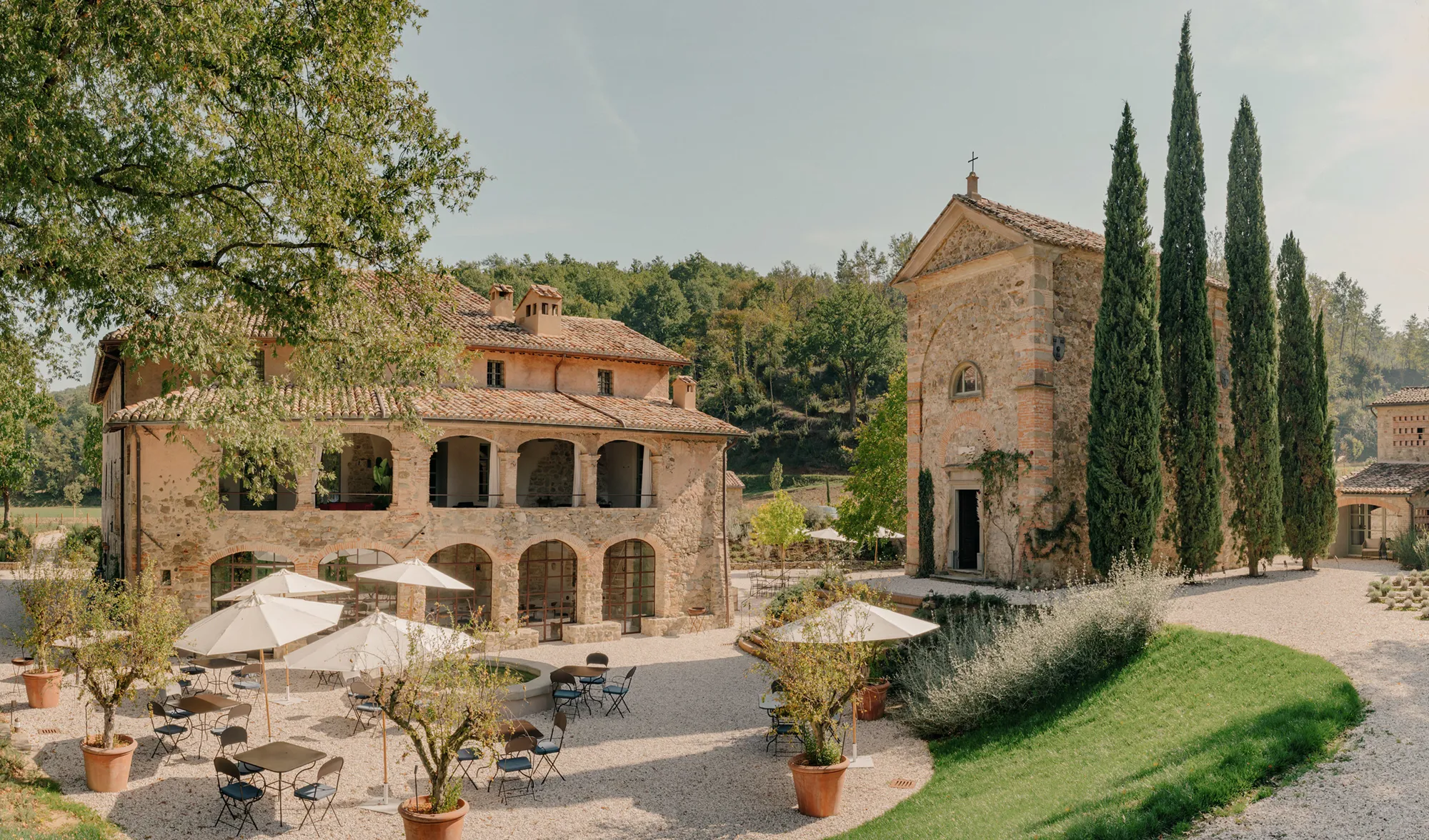
Near Umbertide, a former medieval monastery has been restored as a twelve-room hotel where ancient stone, Umbrian craftsmanship and mid-century references coexist with unusual precision.

There are buildings whose history remains visible even after restoration. At Vocabolo Moscatelli, in the countryside of northern Umbria, time is present in the thickness of the walls, the irregularity of the stone, the exposed timber beams and the proportions of a complex that began life as a monastery more than eight centuries ago.
Set outside Calzolaro, near Umbertide, the twelve-room hotel occupies a former monastery dating to the 12th century. Its transformation was led by architect Jacopo Venerosi Pesciolini of Studio Archiloop, who was entrusted with the restoration of the three historic buildings and the interiors. The project retained much of the original architectural fabric while introducing a distinctly contemporary vocabulary through furniture, colour, metalwork and art.
The building itself establishes the rhythm of the experience. Stone walls carry marks accumulated across centuries. Terracotta appears beside timber floors and old fireplaces. Arches open onto gardens and courtyards. Small windows puncture heavy masonry, while larger contemporary openings bring the Umbrian landscape into the rooms.
The architecture never feels frozen in its medieval past. Its history has been allowed to remain legible.
An Architecture Built Across Centuries

The origins of Vocabolo Moscatelli belong to the religious landscape that has shaped this part of Umbria for centuries. The central structure dates to the 12th century, while other elements of the complex were added later. Design Hotels records that the monastery once belonged to the Olivetan monks of Gubbio, whose bell marked the hours of prayer. A later church, dating from the 19th century, remains one of the most visible buildings on the property and today is used for cultural gatherings, exhibitions and events.
That sequence of additions matters. Vocabolo Moscatelli was never conceived as a single architectural gesture. It grew through use, religion, agriculture and changing needs, and the restoration respects that fragmented history.
When Frederik Kubierschky and Catharina Lütjens encountered the abandoned monastery, both had already spent years working within European luxury hospitality. According to the hotel’s own history, the opportunity to restore the property offered them the possibility of creating an independent project based around a building that already possessed a strong identity.
Their decision to involve Pesciolini became fundamental to the result. The architect approached the monastery through preservation and selective intervention, keeping original wooden ceilings, masonry, terracotta brick and stone while creating more open and functional interiors.
The distinction between old and new remains visible.
A historic stone wall is allowed to remain rough beside a precisely drawn metal bed. A centuries-old ceiling sits above furniture with the clean geometry of twentieth-century Italian design. Contemporary lighting is often reduced to thin black lines against plaster or timber. Brass catches the light in bathrooms and communal spaces without competing with the architecture.
It is this controlled friction between periods that gives Vocabolo Moscatelli much of its character.
Twelve Rooms, Twelve Interpretations

The hotel contains twelve rooms and suites: eight within the main monastery building and four in a neighbouring annex. Each has been treated individually, with differences in layout, furniture and colour determined partly by the architecture already present.
This is visible in the photographs provided by the hotel.
One bedroom opens beneath massive timber beams, its canopy bed reduced to a slender painted-metal structure. Another places a sculptural black bathtub directly within the room, close to a sequence of small geometric windows cut into the historic wall. Elsewhere, turquoise seating brings an unexpected density of colour into rooms otherwise dominated by lime plaster, exposed brick and old wood.
These choices prevent the monastery from becoming overly reverential.
The interiors acknowledge history without turning medieval architecture into theatre.
Pesciolini developed each area separately, from the rooms and suites to the restaurant, bar and pool, while repeating a group of materials throughout the property. Natural stone, exposed terracotta, timber, iron and brass establish continuity even when individual spaces have very different personalities.
Craftsmanship forms another layer of the project.
Several four-poster beds were forged by the Umbrian metalworking company Lispi & Co., while other bed frames came from Tuscan furniture maker Tosconova. Built-in wardrobes were produced by Samarreda. Bathrooms incorporate partially glazed terracotta tiles from Cotto Etrusco, whose workshop is located nearby in Montone, while decorative pieces by the Umbrian studio Endiadi Ceramics introduce handmade stoneware into the rooms.
The collaboration with local makers was deliberate. Kubierschky has explained that Pesciolini spent approximately a month and a half researching artisans and studios before proposing collaborators for the project.
That detail says a great deal about the hotel.
The interiors are not simply filled with objects that happen to have been produced in Italy. Their makers belong, in many cases, to the same geographical and cultural landscape as the building.
The Interior as a Collection of Details

Look closely at Vocabolo Moscatelli and its interiors reveal themselves through small decisions.
A brass tap against dark stone. A pale green wooden shutter set inside a thick masonry opening. A twentieth-century armchair placed beneath beams darkened by age. Ceramic surfaces interrupting neutral plaster. A black steel bathtub appearing almost as an independent object within a centuries-old room.
Art is equally integrated into the architecture.
The hotel currently presents works by artists including Edoardo Cialfi, Massimiliano Poggioni and Kossuth, while a bamboo installation by Matteo Mannini extends the collection into the gardens. Earlier curation involved Matteo Pacini and works by a wider group of artists, establishing art as part of the property from its initial development.
None of this attempts to erase the monastery beneath it.
The most successful rooms are those where the historic shell remains dominant. Stone carries more visual weight than decoration. Timber establishes the ceiling line. Windows frame fragments of vegetation. Furniture occupies the architecture rather than overwhelming it.
That restraint becomes especially evident in spaces such as the rooms with freestanding baths, where contemporary objects sit against walls whose surfaces retain irregularities, old openings and fragments of earlier decoration.
The building continues to show its age.
A Small Village Rather Than a Conventional Hotel

The arrangement of the complex contributes as much to Vocabolo Moscatelli’s character as its interiors.
Design Hotels describes the property as resembling a small Italian village. Buildings collect around a central piazza, with the historic church, terraces, gardens and outdoor dining areas forming a loose sequence of communal spaces.
The comparison is particularly convincing when seen from above.
The church stands independently beside the main building. Cypress trees rise vertically against the low stone architecture. Gravel paths connect gardens and terraces. Arches along the ground floor open the restaurant towards the courtyard, allowing interior and exterior spaces to overlap.
A thirty-metre iron pergola, custom-made by Lispi & Co., extends towards an orchard planted in collaboration with the Arboreal Archaeology Foundation, which works to conserve old fruit varieties associated with the region.
Landscape here is therefore part of the design programme.
The garden does not function simply as scenery around the hotel. It participates in the architecture, creating routes between buildings and establishing views from rooms, terraces and dining spaces.
Understanding Umbria

For international readers who know Italy primarily through Rome, Florence, Venice or the Amalfi Coast, Umbria can require a little geographical orientation.
The region sits in central Italy, between Tuscany, Marche and Lazio, enclosed by the Apennines and without a coastline. Its landscape is defined by wooded mountains, river valleys, agricultural land, olive groves and towns that frequently rise above the countryside on fortified hills. Italy’s official tourism portal has long described it as the country’s “Green Heart,” a name that refers as much to its geography as to the density of its rural landscape.
Vocabolo Moscatelli lies in the Upper Tiber Valley, close to Umbertide in the northern part of the region.
Umbertide sits in a fertile valley beneath Mount Acuto, shaped by the Tiber River. Archaeological evidence from the area reaches back to the sixth century BC, while surviving documentation records the town under the jurisdiction of Perugia from 1189. Its medieval Rocca, churches and surrounding castles place Vocabolo Moscatelli within a territory where religious, defensive and agricultural architecture has developed across many centuries.
Nearby are Montone, Città di Castello and the landscapes approaching the Tuscan border. The countryside surrounding the hotel remains strongly agricultural, with oak woods, fields and small settlements forming the visual structure of the valley. Kubierschky has described northern Umbria itself as an area that remains less intensively touristed than many of Italy’s better-known rural destinations.
That relative quiet is important to the architecture of Vocabolo Moscatelli.
Placed in a denser or more urban context, its heavy walls and monastic proportions would read differently. Here they remain connected to forests, cultivated land and long periods of silence.
A Personal Geography

Writing about Umbria carries a different weight for me.
It is the land my mother comes from, and it has gradually become part of a personal editorial journey through QEditorial: an opportunity to present places from a region whose beauty often reveals itself without the immediate spectacle associated with some of Italy’s most internationally familiar destinations.
Returning to Umbria through architecture, design, hospitality and culture also means looking at it with two perspectives at once. There is the familiarity inherited through family, and there is the curiosity required when presenting the region to readers discovering it for the first time.
Vocabolo Moscatelli fits naturally into that journey.
It shows an Umbria built from stone, craftsmanship, religious history and agricultural landscape, while demonstrating how those elements can remain relevant within contemporary hospitality.
The building has survived because it has changed function. Its monastery cells have become bedrooms; its communal spaces accommodate travellers; a church hosts cultural events; local craftsmen have introduced new objects into rooms shaped hundreds of years before their workshops existed.
The architecture records each of those transformations.
Preserving Character Through Change

Historic hotels often face a difficult architectural question: how much should be preserved, and how much should be transformed to make an old building useful again?
At Vocabolo Moscatelli, the answer is found in the visibility of both periods.
The medieval structure remains sufficiently present to define the property. Contemporary design is equally legible. Neither has been disguised as the other.
A forged metal canopy bed does not pretend to belong to the 12th century. A new bath does not imitate an antique object. The restaurant introduces modern furniture beneath old beams. Large glass doors open historic arches without concealing the intervention.
The result gives the monastery another period in its long architectural biography.
This may be the most interesting aspect of Vocabolo Moscatelli. Its history is not presented as something completed centuries ago and carefully placed behind glass. The building remains occupied, altered and used.
In the Umbrian countryside, among stone walls, cypress trees and the wooded slopes of the Upper Tiber Valley, eight centuries of architecture continue to accumulate.
And for a region whose character has always been written through monasteries, villages, churches, farms and landscapes shaped slowly by human hands, that continuity feels entirely at home.
Editor’s Note
Umbria occupies a particular place in my life. It is the land my mother comes from, and every time I return to it through QEditorial, I find myself looking at the region with a double perspective: one shaped by familiarity, the other by the responsibility of introducing it to readers who may be discovering it for the first time.
That is part of the reason I continue to present places like Vocabolo Moscatelli. Umbria has an extraordinary ability to hold history without turning it into spectacle. Its monasteries, villages, stone houses and landscapes often reveal themselves slowly, through details, materials and the way architecture sits within the land.
Vocabolo Moscatelli reflects that quality with particular clarity. Its restoration respects the memory of the building while allowing contemporary design and craftsmanship to become part of its continuing story. For me, writing about places like this is also a way of tracing a personal geography: one that connects family, landscape, architecture and the idea of preserving what makes a place distinct.
Through QEditorial, I want to continue that journey across Umbria, presenting the region through the people, spaces and cultural histories that give it its character.
Nicolò Di Stefano
Founder & Editor-in-Chief, QEditorial Magazine

Image & Copyright Notice
All photographs featured in this article have been sourced from the official Vocabolo Moscatelli website and are reproduced exclusively for editorial, journalistic, cultural, commentary and review purposes in connection with this feature. All images remain the property of Vocabolo Moscatelli and/or their respective photographers and copyright holders. QEditorial Magazine does not claim ownership of any photographic material. No commercial ownership or endorsement is implied. Rights holders may contact contact@qeditorial.com for additional credit information, corrections or removal requests.


Leave a Reply