
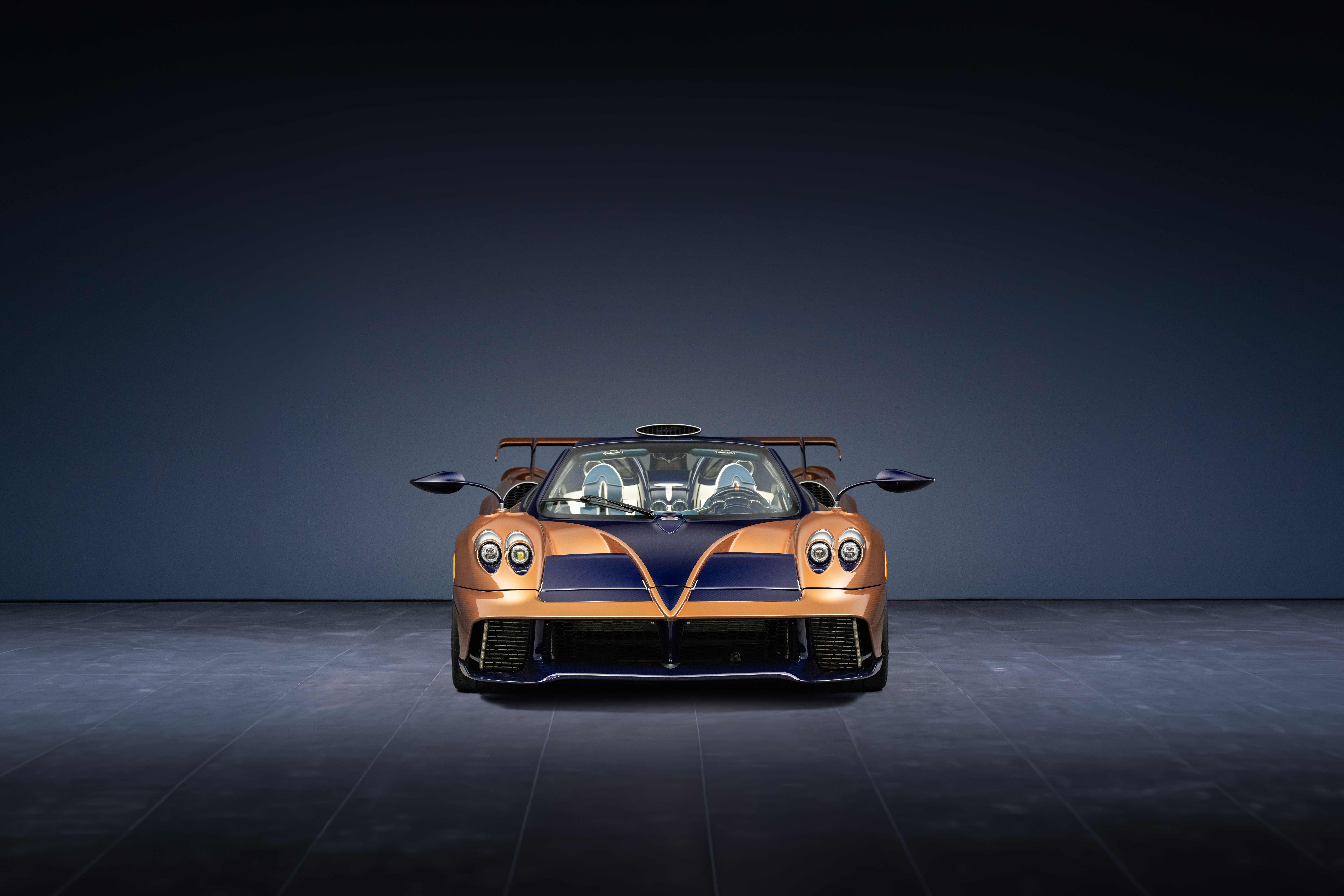
Unveiled in a world premiere at the 2026 Goodwood Festival of Speed, Pagani’s latest creation celebrates Horacio Pagani’s seventieth birthday through an 864-hp V12, a seven-speed manual transmission, and a carbon-fibre body crafted with the precision of high-end manufacturing.

The Pagani Huayra 70 Derecho first appears motionless, composed beneath the studio lights, yet every surface suggests movement. Pearl Orange runs across the carbon fibre with metallic and golden reflections, while Inky Blue defines the lower section of the body, frames the air intakes, and guides the eye toward a rear dominated by aerodynamics, central exhausts, and mechanical components deliberately left exposed.
Presented at the 2026 Goodwood Festival of Speed, the Derecho is the second of three Huayra 70 models developed by Pagani’s Grandi Complicazioni division to celebrate Horacio Pagani’s seventieth birthday. The project belongs to the category of “few-off” creations: cars produced in extremely limited numbers, in which the technical platform becomes the starting point for a level of personalisation closer to an artistic commission.
A Name Born from the Wind

“Derecho” refers to a rare and powerful weather system capable of producing intense, sudden, and sustained straight-line winds. Pagani selected the phenomenon as the defining image of the car: a force moving along a precise trajectory, transforming pressure, speed, and energy into a single motion.
The atmospheric reference continues a tradition central to the history of the Huayra, whose original name recalls Huayra-tata, the Andean god of wind. In the Derecho, however, the theme takes on a more physical presence. The large front openings, rear wing, channels along the flanks, and complex architecture of the tail describe a car shaped around the movement of air.
Viewed from the front, the Huayra retains the four circular headlights that have defined the model since its introduction. The central section assumes a more aggressive presence through the blue contrast, while the aerodynamic elements extend outward with almost surgical precision. The roadster configuration opens the cockpit and reduces the separation between driver, machinery, and the surrounding environment.
Carbon Fibre, Colour, and Handcraft

The bodywork uses exposed carbon fibre enhanced by two translucent finishes. Pearl Orange dominates the upper surfaces, while Inky Blue wraps around the lower part of the car and the monocoque, visually lightening the silhouette. Pagani treats the carbon weave as an element to be observed at close range: the alignment of the fibres, the depth of the paint, and the transition between colours all contribute to the overall composition.
The aluminium components, machined from solid blocks, receive a Glossy Titanium finish and interact with forged wheels developed specifically for the project. The metallic surface is not used as simple decoration. It appears across supports, connections, and functional components, translating the language of engineering into visual detail.
This relationship between structure and ornament has long formed part of Pagani Automobili’s identity. Bolts, hinges, levers, and mechanical elements are designed to be seen. The Huayra 70 Derecho intensifies this principle: at the rear, the suspension, exhaust system, grilles, and supports create a complex mechanical landscape that remains almost entirely exposed.
The V12 and the Return of the Manual Transmission

Beneath the body sits a 60-degree twin-turbo V12 developed specifically by Mercedes-AMG. The engine produces a claimed 864 hp at 6,000 rpm, with maximum torque of 1,100 Nm available between 2,800 and 5,900 rpm. Top speed is electronically limited to 350 km/h.
The most significant technical decision concerns the transmission: a seven-speed transverse manual gearbox developed by Pagani and Xtrac. Power is sent to the rear wheels through an electromechanical self-locking differential.
In a hypercar market dominated by automatic transmissions and hybrid systems, the manual gearbox restores direct responsibility to the driver. Every acceleration requires coordination, and every gear change introduces a physical gesture into a car producing more than 800 horsepower. Finished in Pearl Orange, the gear lever becomes one of the focal points of the interior.
The monocoque combines Carbon-Titanium HP62 G2 and Carbo-Triax HP62, supported by front and rear subframes in chrome-molybdenum steel. The independent suspension uses double wishbones, coil springs, and electronically adjustable dampers.
The Brembo CCM braking system features 398-millimetre carbon-ceramic discs at the front and 380-millimetre discs at the rear. Pirelli P Zero Trofeo R tyres measure 265/30 R20 at the front and 355/25 R21 at the rear.
The official technical information can be accessed through the Technical Specifications link available at the bottom of the Pagani press release.
An Interior Tailored Like a Bespoke Garment

Inside, Ceramic White leather brightens the seats and panels, while Tricolore Blue echoes the darker sections of the bodywork. Bespoke stitching defines the volumes and emphasises the handcrafted construction. The twelve-o’clock marker on the steering wheel and the gear knob repeat the Pearl Orange exterior finish, creating chromatic continuity between the driver’s experience and the form of the car.
The term “tailor-made,” often used throughout the automotive industry, finds a tangible expression here. Leather is cut and stitched to follow complex geometries; metal components are milled, polished, and assembled individually; colours and materials are developed for a specific configuration. Personalisation extends far beyond the selection of upholstery and shapes the entire visual character of the car.
The Huayra Legacy
The original Pagani Huayra arrived as the successor to the Zonda, introducing a more fluid body, active aerodynamics, and a different interpretation of the high-performance grand tourer. Years later, the platform continues to generate radical variations, including track-focused models, roadsters, long-tail versions, and special commissions.
The 70 Derecho occupies a distinctive place within this lineage. It retains the Huayra’s recognisable elements while recomposing them through proportions, colours, and details developed for an exceptional example. The analogue nature of the manual gearbox coexists with advanced materials, electronically controlled suspension, and the latest generation of composite construction.
During the presentation, Horacio Pagani referred to the teachings of Leonardo da Vinci and the search for harmony between form and function, intellect and manual skill. The statement helps explain the Derecho beyond its performance figures. The car belongs to the culture of engineering and to that of the atelier: a place where technical precision is considered alongside the quality of a surface, the continuity of a line, and the way light moves through carbon fibre.
The Pagani Huayra 70 Derecho celebrates the company’s founder through the principles that have defined his work: curiosity, artisanal discipline, and absolute attention to detail. The V12 establishes its performance. The manual gearbox shapes its character. Colour, carbon fibre, and exposed mechanics construct its visual identity. Together, these elements produce one of the most personal and theatrical interpretations of the Huayra.
Editor’s Note
The Pagani Huayra 70 Derecho represents a rare expression of contemporary automotive craftsmanship, where engineering, material research, and manual construction converge within a highly personal commission. Created to celebrate Horacio Pagani’s seventieth birthday, the car reflects the principles that have shaped the marque from its earliest years: technical precision, artistic discipline, and an uncompromising attention to detail.
This article examines the Derecho through its design, mechanical character, and place within the Huayra lineage, presenting the model as both a high-performance machine and a significant object of Italian industrial culture.
QEditorial Magazine — Fashion · Culture · Identity QEditorial.com

Official source and press materials:
Pagani Huayra 70 Derecho — Official Press Release
This article was produced by QEditorial Magazine for editorial and cultural purposes. All trademarks, names, images, and referenced materials remain the property of their respective owners. Information was reviewed using official sources and materials available at the time of publication. Any updates, corrections, or additional credits may be submitted to the QEditorial editorial team.


Leave a Reply