
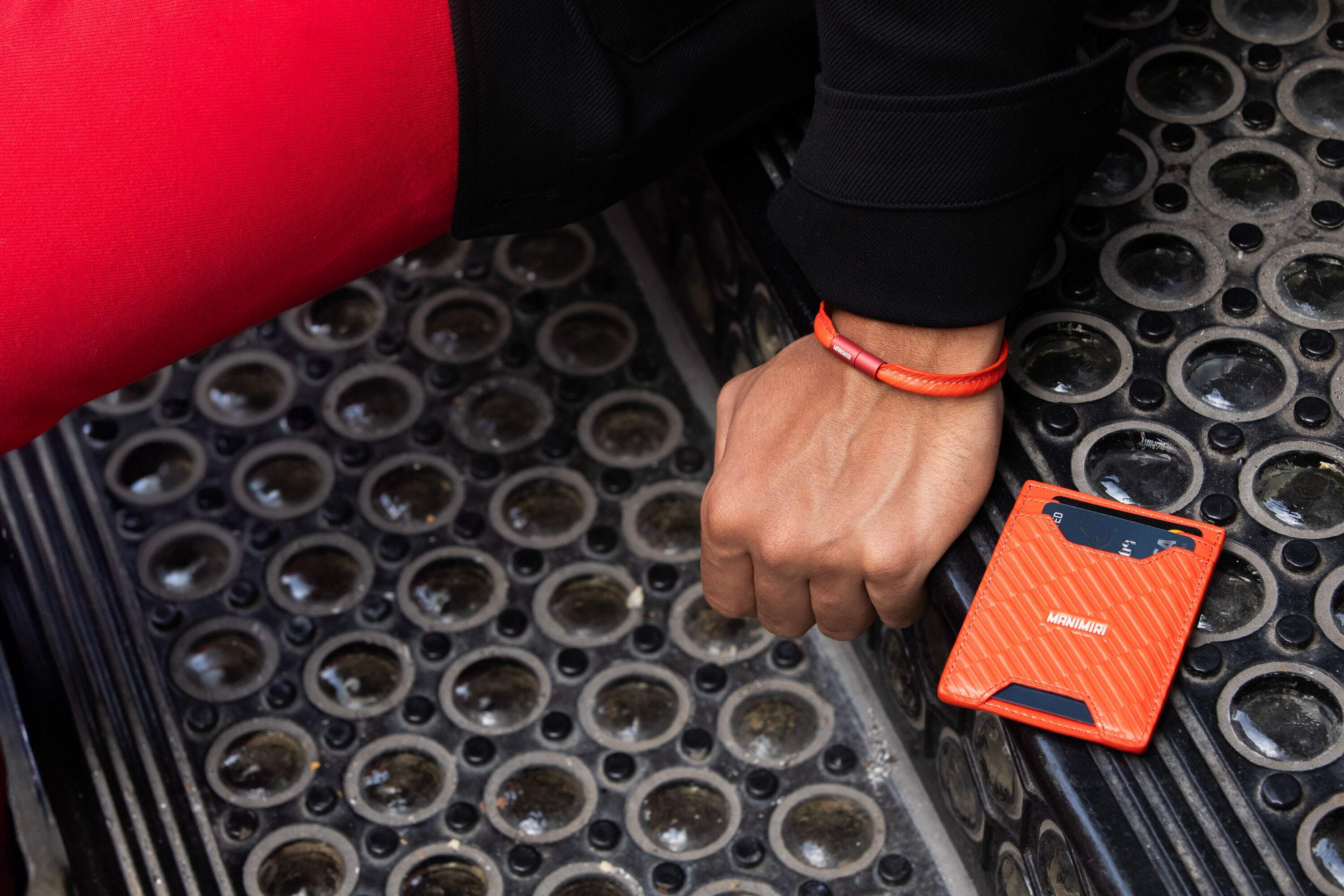
A bridge between New York’s contemporary energy and the enduring craftsmanship of Italy’s Marche region.
By QEditorial Magazine

There are objects we carry because we need them, and there are objects we carry because they quietly become part of who we are.
A wallet. A card holder. A bracelet.
They live in our pockets, our hands, our routines. They age with us. Their value is rarely measured by how often they are seen, but by how naturally they become part of everyday life.
It is within this intimate relationship between people and objects that MANIMIRI finds its identity.
Not simply as a leather goods brand, but as a dialogue between two places that could hardly be more different yet unexpectedly complement one another: the centuries-old artisan traditions of Italy’s Marche region and the creative momentum of New York City.
Growing up in Tolentino, in the heart of Marche, founder Mani Miri was surrounded by leather craftsmanship long before he imagined building his own brand. Marche is internationally recognized as one of the world’s most important districts for luxury leather goods and footwear, where generations of artisans have refined techniques that continue to define the global reputation of Italian manufacturing.
For Mani, this heritage was never an abstract idea.
It was part of everyday life.
One of the workshops producing MANIMIRI today is a family-owned leather manufacturer in Tolentino that he has known for more than twenty years. He grew up knowing the family behind the workshop, long before the first sketch of MANIMIRI existed. Today, that relationship has evolved into something far deeper than a supplier partnership. It is the continuation of a friendship built on trust, mutual respect, and a shared belief that craftsmanship begins with people before it begins with products.
Every MANIMIRI piece is still handcrafted there, in the town where the story first began.
That decision says as much about the brand as the products themselves.
Luxury today often celebrates heritage as a marketing narrative. MANIMIRI treats it as a living relationship.
When Mani later moved to New York, another influence entered the conversation.

New York offered a completely different creative language—dynamic, multicultural, and constantly evolving. Here, design is expected not only to be beautiful but also functional, expressive, and able to keep pace with modern life.
Rather than choosing between Italy and America, MANIMIRI was conceived as a bridge connecting both worlds.
Italian craftsmanship provides precision, patience, and material intelligence.
New York contributes energy, experimentation, and contemporary design culture.
Together, they shape a collection that feels timeless without becoming nostalgic, modern without chasing trends.
This balance reflects the philosophy at the heart of MANIMIRI.
The brand is built upon a series of carefully balanced dualities:
heritage and innovation. Simplicity and character. Function and emotion.
Rather than treating these ideas as contradictions, MANIMIRI allows them to coexist naturally within every object.
The result is a design language that avoids unnecessary excess while never becoming anonymous.
Every stitch, proportion, and surface has intention.
Every object is designed to be lived with.
This point is central to understanding why MANIMIRI chose to reinterpret precisely these familiar accessories. Wallets, card holders, and bracelets are not distant or ceremonial objects. They accompany some of the most repeated gestures of daily life: reaching into a pocket, presenting a card, opening a wallet, fastening something around the wrist.
Because they are handled so often, they gradually absorb traces of the person who owns them. They become connected to movement, habit, and memory.
MANIMIRI approaches these accessories not as minor necessities, but as intimate elements of personal identity. By reconsidering their proportions, construction, texture, and function, the brand asks how an ordinary object might offer both utility and emotional presence—how something used every day can remain practical while also expressing character.
That philosophy extends naturally to materials.
MANIMIRI works with genuine Italian calfskin and premium leathers selected for both their durability and tactile quality. Small-batch production allows artisans to dedicate attention to every detail, while longevity itself becomes the brand’s most meaningful interpretation of sustainability.
Instead of designing products for seasonal replacement, MANIMIRI creates accessories intended to improve with time.
Objects that become more personal the longer they are carried.

An architectural geometric language unites the collection, creating continuity across pieces that respond differently to the gestures and demands of daily life. Structure, proportion, and precision form the recognizable vocabulary of MANIMIRI, while each design becomes an individual interpretation of the same philosophy.
The vertical construction of Miles, for example, reduces the card holder to a compact and deliberate form. Its geometry responds to the desire for simplicity without erasing personality.
Atlas expands that same vocabulary through a zip construction, introducing security and flexibility for someone whose everyday routine demands greater capacity. It is not a departure from the design philosophy, but another expression of it.
The horizontal silhouette of Sail explores space and organization through broader proportions, while retaining the visual restraint that connects it to the rest of the collection.
With Eos, the same attention to construction and geometry moves closer to the body. The leather bracelet transforms the brand’s architectural vocabulary into something worn rather than carried, shifting functionality toward a more personal form of expression.
Seen together, Miles, Atlas, Sail, and Eos are not simply separate products. They are variations within a coherent system—different answers to the same question: how can an everyday object balance function, emotion, structure, and individuality?
This shared language allows the collection to feel recognizable without becoming repetitive. Each piece serves a different purpose, yet all remain connected by a geometric motif that gives MANIMIRI its distinct visual identity.
Inspiration comes from both the urban environment and the natural world.
Contemporary sneaker culture informs proportions, color combinations, and attention to detail, while nature contributes unexpected references.
One of MANIMIRI’s most distinctive colorways, for example, draws inspiration from the iridescent blue-green shell of the jewel weevil, whose extraordinary coloring demonstrates how elegance often exists where few people think to look.
Across the collection, colors such as Warm Red, Ice Blue, Beetle Blue, Olive Green, Smoke Gray, Electric Blue, Mocha Mousse, and Jet Black become more than aesthetic choices.

They become emotional identities—different ways of allowing the same object to reflect the temperament and individuality of the person carrying it.
Another aspect distinguishes MANIMIRI from many contemporary luxury brands.
Its relationship with craftsmanship remains profoundly human.
For Mani, producing in Italy is not simply about manufacturing in the right place.
It is about preserving relationships with the people whose expertise gives each object its character.
The collaboration with the artisans of Tolentino is built on decades of trust, mutual respect, and a shared commitment to quality. Every accessory reflects not only technical excellence but also the care of everyone involved in its creation.
In an industry increasingly driven by speed and scale, this human dimension feels quietly radical.
Ultimately, MANIMIRI represents more than Italian leather goods.
It is a bridge between the Marche region and New York City.
Between generations of artisans and contemporary designers.
Between permanence and movement.
Between memory and modernity.
Its products remind us that the most meaningful luxury is often found in the objects we touch every day—the ones that quietly accompany our routines without asking for attention.
In a saturated market where visibility has become the measure of value, MANIMIRI chooses a different path.
One defined by authenticity.
By relationships.
By craftsmanship.
And by the belief that the objects we carry should carry meaning as well.
MANIMIRI is not just about what we carry. It is about what carries meaning.
Editor’s Note
Meeting Mani Miri offered an opportunity to understand the brand beyond its products. What stood out most was not simply his commitment to Italian craftsmanship, but the genuine respect he continues to show for the people, skills, and traditions that shaped his journey.
Listening to him speak about the artisans of Tolentino—many of whom he has known since childhood—it became clear that MANIMIRI is built on relationships before it is built on leather. His decision to continue producing in his hometown is not driven by nostalgia, but by the belief that experience, trust, and human expertise remain among the most meaningful expressions of luxury.
At QEditorial, we believe fashion is ultimately about people: the hands that create, the stories that endure, and the values that give meaning to what we choose to wear and carry. After meeting Mani personally, I understood that his passion lies not only in offering a beautifully designed product, but in honoring the experienced hands behind it and preserving the roots from which his vision emerged.
MANIMIRI is not simply protecting an Italian tradition. It is carrying that tradition forward with authenticity, respect, and a contemporary perspective shaped between Marche and New York.
QEditorial Magazine — Fashion · Culture · Identity QEditorial.com

Editorial Disclosure
This feature was created in editorial partnership with MANIMIRI. The article was written and curated by QEditorial Magazine to present the brand’s story, craftsmanship, design philosophy, and cultural identity.
Image Credits / Copyright Notice
Images courtesy of MANIMIRI. All product images, brand materials, and visual assets used in this article were provided by the brand and are published for editorial, cultural, and promotional purposes related to this feature. All rights remain with their respective owners.



Leave a Reply