
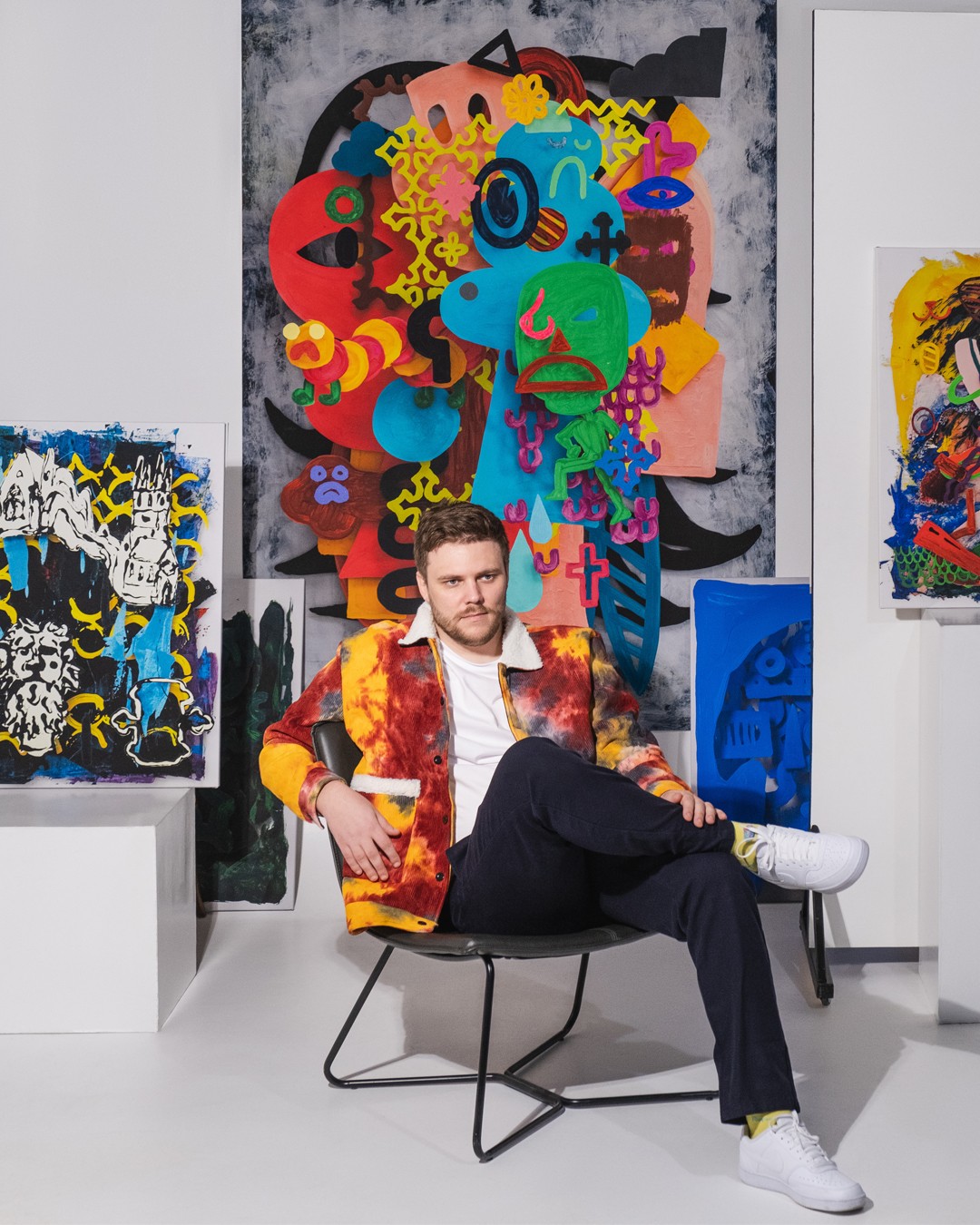
A visual language between painting, digital space, memory, and atmosphere.

Lev Roosileht’s artistic journey begins with space before it becomes image. Born in Tallinn, Estonia, in 1989, Roosileht developed his visual education through an art-oriented secondary school and later continued with a Bachelor’s degree in Interior Architecture and Design. Before fully defining his independent artistic voice, he moved through several visual disciplines: first as a 3D artist in the game industry, then within the world of architectural visualization, which remains his primary professional field today.
This background is essential to understanding his work. Roosileht does not approach the image as a flat surface alone. He approaches it as a constructed environment. His compositions are not only about forms, colors, or isolated painted objects, but about the space that allows those elements to exist. In his work, emptiness is never passive. Air, distance, pause, and white space become active parts of the image.

Roosileht’s evolution as an artist reflects a movement from technical image-making toward a more poetic and independent visual practice. The precision of architectural visualization gave him a deep awareness of composition, atmosphere, perspective, and spatial relationships. The experience of digital environment design gave him the ability to think of images as places — not simply as pictures, but as visual worlds where objects meet, separate, float, and speak to one another.
His process begins in a traditional way: with separate painted layers. Each element exists first as an independent painted object. These fragments are then scanned and transformed into digital material, entering a 3D environment where they are assembled into a final composition. What makes this process particularly compelling is that the completed image is not fully known to the artist until the end. The work reveals itself gradually, almost as if the composition has its own intelligence.
This creates a delicate tension between control and discovery. Roosileht builds the elements, but their final relationship emerges only when they are placed inside the digital space. The result is a body of work that feels precise yet open, architectural yet emotional, carefully composed yet quietly unpredictable.

His images carry the memory of painting, but they do not remain confined to painting. They carry the logic of digital construction, but they do not become cold or purely technical. Instead, Roosileht creates a language suspended between the handmade and the virtual, between object and image, between composition and atmosphere.
A central source of inspiration in his practice comes from childhood memories of magazine pages. Before learning to read, words and images were not yet fully understandable to him, but together with the page layout, the blank spaces, and the rhythm of the printed surface, they created complete emotional compositions. This early experience — the moment when feeling comes before meaning — remains fundamental to his work.
There is something deeply editorial in this memory. The page, before it becomes information, is already architecture. It has weight, silence, rhythm, tension, and balance. For Roosileht, this pre-verbal encounter with layout becomes a key to understanding the visual world: not everything must be explained to be felt. Some images arrive first as atmosphere, before they become language.
This is where his practice becomes especially contemporary. In an age where digital images often move quickly, Roosileht slows down the act of looking. His works ask the viewer to notice the spaces between things, not only the things themselves. They invite attention to emptiness, proportion, and the invisible relationships that hold a composition together.
Publicly, Roosileht has built a presence across digital art, 3D practice, and online art platforms. His profile on Saatchi Art identifies him as an Estonian artist born in Tallinn and connected to the Faculty of Design at Euroakadeemia. His professional profile in architectural visualization places him in Tallinn, where he works across interior and exterior visualization, animation, interactive environments, and original 3D artworks. His presence through Maria Shevchenko Gallery / MSH Art further situates his work within a contemporary gallery context, with pieces such as The Watcher presented for collectors.

Recent editorial attention has described his images as calm, clean, dreamy, and slightly hypnotic — a reading that aligns strongly with the quiet intensity of his process. The work is not loud. It does not depend on spectacle. Instead, it constructs a visual silence where objects appear to exist independently, yet remain connected by invisible spatial logic.
Roosileht’s art can be understood as a meeting point between interior architecture, digital composition, and emotional memory. His works are not simply digital paintings or 3D renderings. They are environments of perception. They ask what happens when separate objects are allowed to meet inside a space, and when the distance between them becomes as meaningful as the forms themselves.
In this sense, Lev Roosileht’s practice is not only about creating images. It is about creating conditions for images to happen. His work suggests that composition is not only a question of arrangement, but of atmosphere. It reminds us that the empty space around an object can be as expressive as the object itself, and that sometimes the most powerful visual experiences begin before we fully understand what we are seeing.
Editorial Note
With this feature on Lev Roosileht, QEditorial Magazine continues its exploration of contemporary art, digital art, and new visual languages. His practice brings together painting, 3D composition, architectural visualization, and memory, creating works where space, atmosphere, and emptiness become as important as the visual objects themselves.
QEditorial Magazine — Fashion · Culture · Identity QEditorial.com



Leave a Reply