
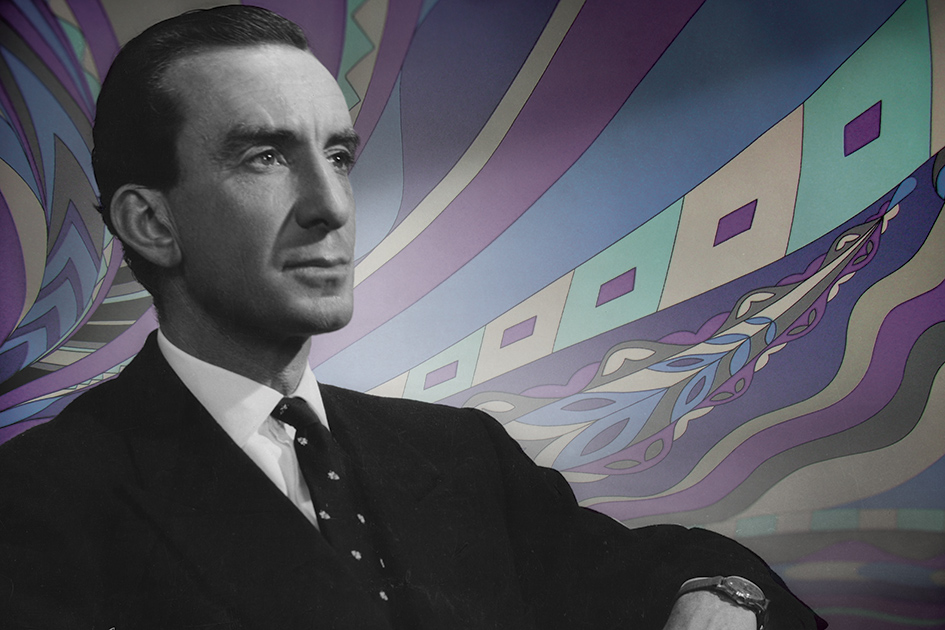
From wartime captivity to postwar modernity, Emilio Pucci transformed movement, color and aristocratic heritage into a new language of Italian fashion.
A new biography reveals the wartime courage, political danger, and unexpected reinvention behind one of Italy’s most recognizable fashion names.
How does a military pilot, political fugitive, and survivor of Fascist persecution become the founder of one of the twentieth century’s most celebrated fashion houses?
The familiar image of Emilio Pucci is defined by color: fluid silhouettes, geometric prints, Mediterranean light, and an instinctive understanding of movement. Yet before he became the designer known as the “Prince of Prints,” Pucci lived through a period shaped by military service, imprisonment, political intrigue, exile, and uncertainty.
Emilio Pucci: The Astonishing Odyssey of a Fashion Icon, written by Terence Ward and Pucci’s niece Idanna Pucci, with a foreword by fashion critic Suzy Menkes, brings this lesser-known history into focus. Drawing on family memories and archival records, the biography reconstructs a life whose most consequential chapters unfolded long before fashion brought Pucci international recognition.
The book expands the public understanding of a designer often remembered primarily for the joyful visual language of his work. Behind those prints was a man whose identity had been shaped by aristocratic tradition, international education, athletic discipline, war, and a series of moral decisions made under extraordinary pressure.
A Florentine Identity
Born in Naples in 1914 and raised within one of Florence’s distinguished aristocratic families, Emilio Pucci grew up surrounded by history, culture, and a powerful sense of responsibility. His identity was closely tied to Florence, a city whose artistic legacy and political complexity had shaped generations of the Pucci family.
He was raised alongside his older brother, Puccio, and younger sister, Nicoletta, in an environment where education and self-discipline were central. The children studied languages under the supervision of an English governess and were expected to move comfortably among Italian, French, and English.
This multilingual upbringing exposed Emilio to different cultural perspectives from an early age. The family’s international connections, including relationships with Russian aristocrats and intellectuals, further broadened his understanding of European culture beyond the boundaries of Italy.
His mother, Augusta, emphasized endurance and personal independence. His father, Orazio, encouraged resilience through a maxim that remained part of the family’s philosophy: “Everything has a remedy except death.”
These lessons would acquire far greater significance once Europe entered a period of political violence and war.
From Italy to America
Pucci was also an exceptional athlete. As a teenager, he traveled to Lake Placid with the Italian ski team for the 1932 Winter Olympics, an experience that connected his athletic abilities with a growing interest in the United States.
In 1935, he enrolled at the University of Georgia, where he studied cotton agriculture. His time there was brief, but the subject would later appear unexpectedly relevant to a career built around fabric, movement, and technological innovation.
Pucci subsequently attended Reed College in Oregon. After approaching college president Dexter Keezer for assistance, he received tuition, room, and board in exchange for establishing and coaching Reed’s first ski team. He later completed a master’s degree in social science.
The American years introduced him to a less formal social environment and to the developing culture of modern sportswear. They also demonstrated his ability to adapt. Despite his aristocratic background, Pucci worked on campus, coached athletes, and found ways to support himself while continuing his education.
This combination of European refinement, American practicality, and athletic experience would later become central to his approach to clothing.
War and the Ciano Diaries

When the Second World War began, Emilio and his brother served as military pilots. Pucci entered the Italian Air Force and was deployed during a conflict that would dismantle the political and social order in which he had been raised.
One of the biography’s most important contributions is its reconstruction of Pucci’s involvement in the events surrounding Galeazzo Ciano, the former Italian foreign minister and son-in-law of Benito Mussolini.
Ciano had kept extensive diaries and supporting papers documenting Fascist diplomacy and his interactions with Mussolini, Adolf Hitler, and senior officials of Nazi Germany. After voting against Mussolini in July 1943, Ciano was arrested and eventually sentenced to death by the newly established Italian Social Republic.
Ciano’s wife, Edda, attempted to use the diaries and supporting documents as leverage to save her husband. In January 1944, she sent Emilio Pucci to meet German General Wilhelm Harster and deliver part of the supporting material as the first stage of a proposed exchange.
The plan failed. Hitler learned of the attempt, and Galeazzo Ciano was executed by firing squad on January 11, 1944. Edda later crossed into neutral Switzerland with five volumes of the diaries concealed around her body.
Pucci’s participation placed him in grave danger. His role went beyond that of a passive witness to history: he had entered a network of secret documents, political betrayal, German intelligence, and resistance to the collapsing Fascist order.
The biography draws particular attention to archival material connected to Pucci’s account of these events. Preserved among American intelligence records, these documents help illuminate his wartime actions and the political consequences that followed.
Imprisonment and Exile
Pucci’s involvement with Edda Ciano made him a target. He was arrested, imprisoned, interrogated, and tortured. The future he had once imagined—shaped by military service, politics, and public life—became impossible.
War altered every dimension of his identity. His professional ambitions disappeared, his relationship with his homeland became uncertain, and the privileges of his upbringing offered little protection against political persecution.
After reaching Switzerland during the final phase of the war, Pucci sought political asylum. His application required him to explain his activities and establish the circumstances that had forced him to leave Italy.
The archival account at the center of the biography records this period in Pucci’s own voice. It allows the authors to present him as a participant in history rather than interpreting him solely through the mythology that later surrounded his fashion career.
This is where the book becomes especially compelling. It reveals that the optimism associated with Pucci’s designs emerged from a life that had already encountered violence, physical suffering, and the loss of certainty.
The Unexpected Beginning of a Fashion House
Pucci’s transition into fashion began with an encounter on the Swiss ski slopes in 1947.
While skiing with his friend Poppy de Salis, he lent her clothing that had been tailored according to his own ideas about movement and fit. American photographer Toni Frissell, who was working in Switzerland for Harper’s Bazaar, noticed the streamlined outfit and photographed it.
The images reached Diana Vreeland, then one of the most influential fashion editors in the United States. Their publication in Harper’s Bazaar in 1948 introduced Pucci’s designs to an American audience and opened an entirely new professional path.
The official history of the Maison dates the founding of the Pucci brand to 1947 and identifies the Swiss ski slopes as the unexpected setting in which his fashion career began. His first boutique followed in Capri in 1950.
The episode brought together nearly every formative element of Pucci’s life: skiing, tailoring, international travel, American editorial culture, and an understanding of how clothing should respond to the body.
His early designs offered women greater freedom of movement at a time when much of European fashion still depended on rigid construction. Pucci absorbed the comfort and functionality of American sportswear while retaining an Italian sensitivity to color, proportion, and luxury.
From Black and White Into Color
The contrast between Pucci’s wartime experiences and his later visual language is one of the biography’s most powerful themes.
His prints became synonymous with saturated color, geometric rhythm, and the pleasure of movement. They belonged to the cultural atmosphere of postwar Italy, when fashion, architecture, cinema, and industrial design helped communicate renewed confidence to the world.
Pucci’s clothes addressed a modern woman who traveled, moved freely, and rejected excessive formality. His designs were light, immediate, and technically sophisticated. They reflected the cosmopolitan life he knew personally, moving among Florence, Capri, New York, and the destinations favored by the emerging international jet set.
Within the narrative presented by Ward and Idanna Pucci, color can be understood as more than decoration. It becomes connected to survival and renewal. A designer who had experienced imprisonment and political darkness built a creative identity around energy, freedom, and optimism.
The biography does not suggest a simplistic transformation in which suffering directly produced beauty. Instead, it shows how the experiences, skills, and values accumulated throughout Pucci’s life converged when an unforeseen opportunity appeared.
His American education influenced his understanding of sportswear. His athletic background taught him to observe the body in motion. His Florentine heritage gave him a profound relationship with art and craftsmanship. His wartime experiences tested the resilience and moral conviction instilled during childhood.
Fashion became the space in which these elements could coexist.
A Biography Beyond Fashion
Emilio Pucci: The Astonishing Odyssey of a Fashion Icon is significant because it moves beyond the established image of Pucci as a charismatic aristocrat who introduced exuberant prints to the postwar world.
Terence Ward and Idanna Pucci recover the political, emotional, and historical dimensions of his life. Idanna’s position within the family gives the narrative access to personal memory, while the archival research provides a documentary foundation for its account of war, intelligence, and exile.
The result is a biography that often carries the tension of a political thriller. Secret papers move across borders. Alliances shift. Political power collapses. Individuals are forced to decide which loyalties they are prepared to defend.
Within that history, Emilio Pucci emerges as a more complex figure. His later success no longer appears as an isolated stroke of fortune on a ski slope. It becomes the next chapter in a life defined by movement among countries, professions, social worlds, and identities.
The book also offers a broader reflection on how public figures are remembered. Fashion history often reduces designers to a recognizable silhouette, print, object, or commercial legacy. By returning to the years before the establishment of the Maison, Ward and Idanna Pucci restore the human experiences that existed before the brand.
Culture, Identity, and Reinvention
Pucci’s life demonstrates how identity develops through inheritance, education, circumstance, and choice. His Florentine background gave him a cultural foundation, but it did not determine the full course of his life. America expanded his worldview. War dismantled his expectations. Exile forced him to confront an uncertain future. Fashion allowed him to assemble those experiences into a new creative language.
The exuberance of Pucci’s work becomes more meaningful when considered alongside the severity of his wartime past. His designs represented mobility after confinement, confidence after political collapse, and color after a period dominated by military uniforms and deprivation.
This is the lasting achievement of The Astonishing Odyssey of a Fashion Icon. The biography reveals that Pucci’s creative identity was built through a long process of adaptation. The fashion house that emerged in 1947 carried traces of Florence, America, the mountains, the military, and the experience of rebuilding a life whose original direction had been destroyed.
Emilio Pucci would become one of the defining figures of modern Italian fashion. His name remains attached to prints that communicate pleasure almost instantly. Behind that visual immediacy, however, lies a story of moral courage, political danger, and reinvention.
The book brings those hidden dimensions into view, allowing readers to encounter the man before returning to the icon.
Editorial Note
Emilio Pucci: The Astonishing Odyssey of a Fashion Icon offers a timely reassessment of the Italian designer’s life, connecting Emilio Pucci’s wartime history, the Ciano diaries, postwar Italian fashion, and the origins of the Pucci fashion house. Through archival research and family memory, Terence Ward and Idanna Pucci reveal how culture, resilience, and personal identity shaped one of the twentieth century’s most influential designers.
Written by Marina Khamuko, Books & Culture Editor
Thank you for reading. Join QLetter to stay connected with QEditorial’s latest stories and become part of a growing community supporting independent fashion and cultural journalism.
QEditorial Magazine — Fashion · Culture · Identity QEditorial.com




Leave a Reply