QEditorial / Mobility

Audi’s 987-hp hybrid supercar wears its engineering on the outside. From the upright front frame to the wing that carries the four rings, its strongest design ideas emerge wherever the air meets the body.

Front three-quarter studio view of the titanium-colored Audi Nuvolari prototype
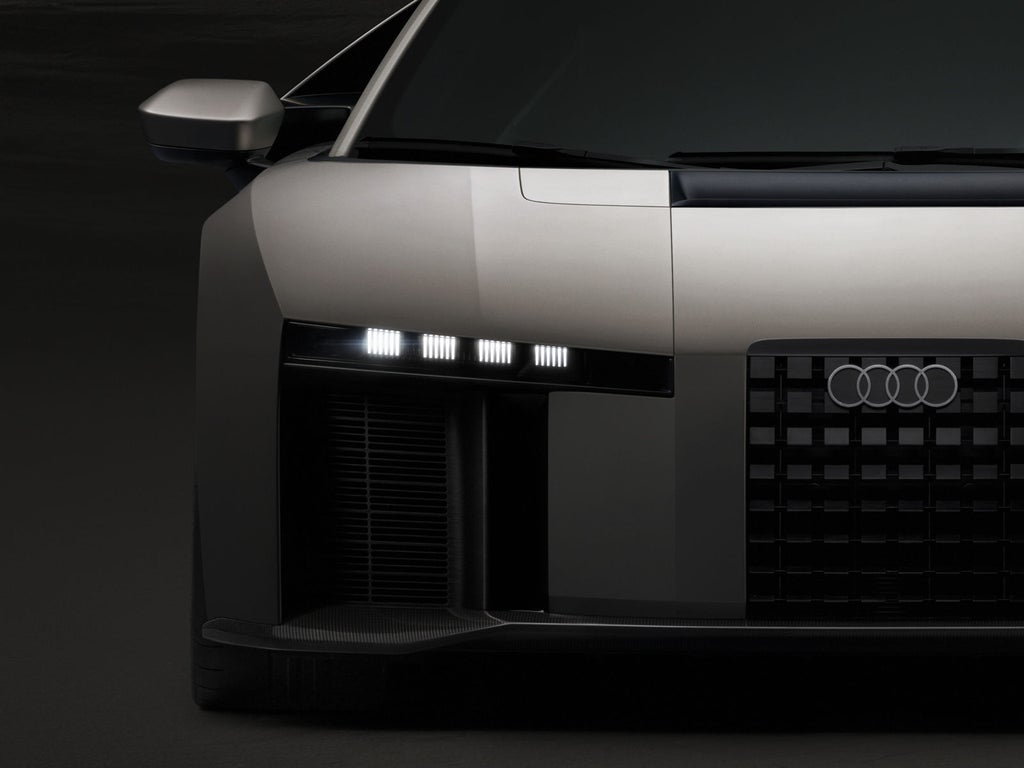
The new Nuvolari’s upright center sets off the width of its low front end. © AUDI AG · A263144
The four rings on the back of the Audi Nuvolari move. They are set flush into the rear wing, which rises and changes angle to suit what the car is doing. Watch the tail under braking and the piece that carries Audi’s signature becomes part of how the car slows and settles. It is a small decision with an unusually clear point of view. A badge normally tells you who made the object. Here it also tells you where to look to understand it. Audi unveiled the near-production Nuvolari on the French Riviera in June 2026, ahead of the Monaco Grand Prix. Its claims were substantial: 987 horsepower, a top speed above 217 mph and 499 cars for the world. But those numbers leave the most interesting question unanswered. How do you give a hybrid supercar a recognizable identity when so much of its behavior is governed by airflow, electric motors and software? Under chief creative officer Massimo Frascella, Audi’s answer begins with the parts a person can actually see and touch.

A front shaped by air

Viewed from the front, the Nuvolari is almost all width. The lamps sit in narrow horizontal strips, and the surfaces around them drop sharply toward the road. In the middle stands the Vertical Frame, the upright feature Audi has chosen to anchor its new design language. It looks small in relation to the broad openings on either side. That imbalance gives the nose its character. The eye catches the upright shape first and then follows the low line of the body out toward the wheels. The openings are working surfaces. Front intakes feed air toward the brakes and help manage the temperature of the combustion engine and hybrid components. A concealed passage called an S-duct helps manage lift at the front axle. Audi uses carbon-fiber-reinforced polymer for most of the exterior, which allows the company to shape the duct’s vertical elements with the precision needed to guide airflow. The nose has relatively few visible lines because the openings and the edges around them already do so much of the visual work.

Where the body opens up

Audi Nuvolari prototype in side profile beside the sea
In profile, the intake behind the door marks the shift from cabin to mid-engine bodywork. © AUDI AG · A263280
From the side, the packaging becomes clear. The cabin sits forward, with a deep interruption in the silver bodywork just behind the door and a broad section of body over the rear wheels. That opening makes the car’s mid-engine layout legible from the curb. Imagine the same profile with the opening covered and the body would lose the point where the passenger compartment gives way to the machinery. Audi calls the finish Titanium. In the outdoor photographs, light travels across the broad side panels and stops at the dark intake. That change in tone describes the shape more precisely than an extra crease could. The carbon outer panels are built around an Audi Space Frame, and the relationship between skin and structure is part of the car’s visual appeal. From a distance, the silhouette reads as a single low volume. Up close, the gaps and edges show where that volume yields to a specific job.

A cabin arranged around the driver

Audi Nuvolari cockpit, showing the steering wheel, dashboard and two-tone interior
The cockpit puts a dark dashboard ahead of the lighter upholstery. © AUDI AG · A264354
Inside, Audi uses color to set priorities. The forward section is dark and the lighter Shadow Dune tone appears farther back. In the cockpit photograph, the steering wheel and instruments occupy the first plane of the image, while the lighter surfaces around the seats make the rear of the cabin easier to read. The central screen sits in an anodized aluminum frame. Its crisp edge has the precision of a mechanical control even though the surface it contains is digital.
Close-up of the narrow ribs of an Audi Nuvolari cabin vent
A close look at the narrow ribs of an interior air vent. © AUDI AG · A263120
Details such as the closely spaced ribs of the air vent reward a closer look. At the wheel, they recede into a dashboard that keeps attention on the road and instruments. The steering wheel has a more tangible link to what happens outside. Its drag reduction button can lower the rear wing on a straight. One thumb movement changes the silhouette several feet behind the driver. It is an unusually direct relationship between a control you can put your finger on and a piece of bodywork you could recognize in a photograph. The seats show the same economy. Audi uses carbon fiber in the seat base and backrest, where rigidity and lateral support matter. The material plays a different role here than it does on the body. The exterior shows what carbon can do for a panel’s shape. In the seat, its value is in how securely the structure holds the driver through a bend.

A tail that changes shape

Rear studio view of the Audi Nuvolari prototype with the horizontal taillights illuminated
The tail stacks a retractable wing, narrow taillights and a diffuser in distinct horizontal bands. © AUDI AG · A263141
From behind, the slim red lamps sit between the upper body and the deep diffuser. The wing moves among a closed position and settings for lower drag or higher downforce. Under braking and in corners it can rise to help stabilize the car. On a straight it can take a shallower angle. Seen parked, the rear looks like a tightly arranged stack of horizontal elements. In motion, the top of that composition can change according to how much the car needs the air to do. The hybrid system follows a similar logic. A 4.0-liter twin-turbo V8 sits behind the cabin, with a third electric motor between it and the transmission. Two more electric motors work at the front axle, where torque can be varied across the front wheels. Audi quotes 2.6 seconds to 100 km/h under specified battery conditions. What makes the layout worth examining is the way those parts can work together. As the car approaches the limits of grip, the drive units, brakes and aerodynamics can all respond. The wing is simply the part of that exchange a spectator can see. The electric motors also recover energy during deceleration. Audi’s brake-by-wire setup can blend that regenerative effect with the hydraulic brakes. From the driver’s seat, both kinds of braking come through the same pedal.

What 499 cars can show

Audi says it took 405 days to go from the first sketch to a drivable prototype. During development, Formula 1 drivers Nico Hülkenberg and Gabriel Bortoleto tested the car and provided feedback. The most persuasive evidence of the track’s influence is there in the relationship between the controls, body and chassis. The rear wing changes its angle under braking. The front motors can vary the torque sent to each front wheel in a corner. Those systems make sense together because the car was designed around what happens as it enters, moves through and exits a turn. For American buyers, the figures are unusually specific. Car and Driver reported in November that 182 of the 499 cars are allocated to the United States and that pricing starts at $700,000 before destination charges. U.S. deliveries are expected in the first half of 2028. At that price and in those numbers, most people will experience the Nuvolari through photographs. That makes the design’s ability to explain the car from a still image matter all the more. Start at the front and the air openings stand out. Walk along the side and the inlet shows where the cabin ends and the engine begins. Look inside and the dark dashboard gives the driver a clear foreground. Then go back to the tail and find the four rings. They sit on the part that moves, which is exactly where they belong on a car whose identity is clearest when its design goes to work.  

Enjoy The Read? Subscribe To The Q Letter

Leave a Reply

Advertisements

Trending

Discover more from QEditorial Magazine

Subscribe now to keep reading and get access to the full archive.