
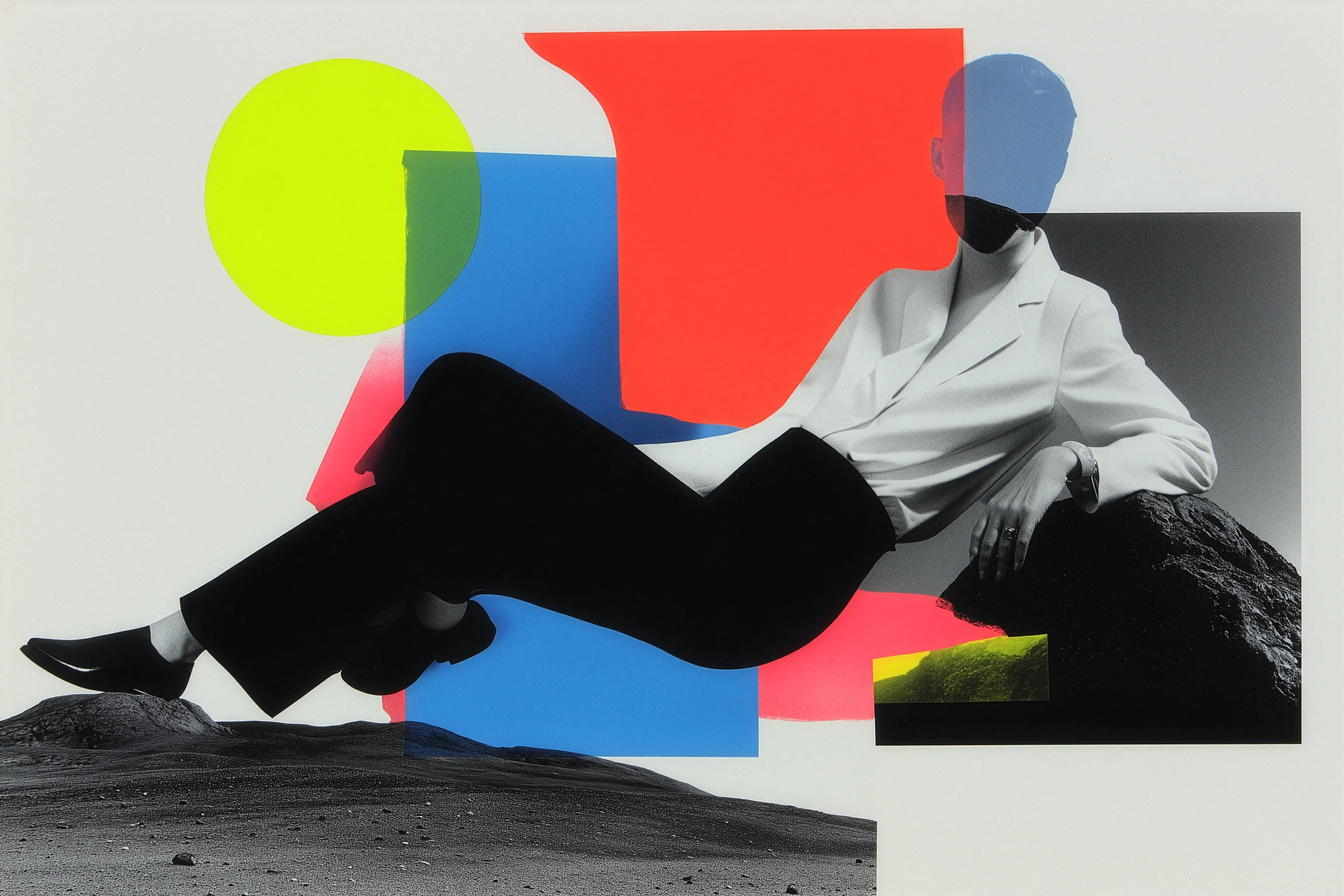
Where artificial intelligence, fashion, abstraction, and remembrance become a new visual language.

Some images capture a moment. Others linger long after they have been seen.The work of Berlin-based artist and designer Clemens Maurer belongs to the latter. Familiar faces, figures, and silhouettes move between photography, fashion, and abstraction, creating compositions that feel suspended between memory and imagination. Geometric forms intersect the body, archival references surface alongside AI-generated imagery, and bold fields of color reshape each scene with quiet precision. The result is a visual language that feels both contemporary and timeless.Maurer’s path into AI-assisted art began long before artificial intelligence entered the center of today’s creative conversation. Trained in graphic design at an art school in Hamburg, he spent more than two decades working as a freelance art director and designer, producing editorial layouts, book covers, brand identities, cultural publications, scientific magazines, and fashion media. Those years developed a disciplined understanding of composition, rhythm, typography, and visual storytelling that continues to shape his practice today.Artificial intelligence extends that foundation rather than redefining it. Each project begins with an idea, cultural reference, visual memory, or photographic inspiration before moving through a process of experimentation, selection, refinement, and editing. The technology generates possibilities; Maurer determines the direction.His work reflects many of the questions shaping contemporary visual culture. As images become increasingly generated, manipulated, and redistributed, the relationship between memory, identity, and authorship continues to evolve. Maurer’s practice explores that shifting landscape through carefully constructed compositions that balance digital experimentation with a distinctly human perspective.That approach has attracted growing international attention. His work has appeared in editorial and contemporary art publications including ITS LIQUID, Partfaliaz, L’Officiel Monaco, and Blue Marlin Ibiza, contributing to wider conversations surrounding AI-assisted creativity, surrealism, and the future of image-making.The title of his ongoing Instagram project, AI Made Me Do This, hints at one of the central ideas running throughout his work. It invites viewers to consider where authorship begins and where collaboration with emerging technology takes shape. The question remains intentionally open, encouraging interpretation rather than conclusion.That dialogue is explored with particular clarity in his 2026 series Geometry of Memory.

Across the series, monochrome portraits are interrupted by vibrant geometric forms, saturated planes of color, sculptural shadows, and architectural compositions. Elements that appear rooted in photography gradually shift toward abstraction, creating images that feel familiar without belonging to a specific place or time. Fashion photography, archival imagery, graphic design, and AI-generated visual language coexist within the same frame.Rather than presenting memory as a fixed record, Maurer approaches it as something continually reconstructed. Figures emerge through layers of color and shape that reveal, conceal, and redirect the viewer’s attention. The compositions suggest that recollection is shaped as much by imagination and emotion as by documentation itself.Geometry plays an essential role throughout the series. Rectangles, circles, shadows, and blocks of color establish visual rhythm while altering the relationship between figure and space. These interventions transform otherwise recognizable portraits into layered compositions that invite prolonged observation. Every element appears carefully placed, yet each image retains an openness that resists a single interpretation.The series also reflects Maurer’s longstanding relationship with design. Saturated color recalls aspects of Pop Art, while the compositions carry the clarity and balance associated with editorial image-making. Fashion remains present through silhouette, posture, styling, and proportion, but never dominates the image. Instead, clothing becomes one element within a broader visual structure where photography, abstraction, and geometry intersect.A cinematic stillness runs throughout the collection. Figures appear suspended in time, positioned somewhere between portraiture and performance. Stone, flowers, architectural fragments, and fields of color create environments that feel both tangible and imagined, reinforcing the sense that memory rarely exists as a complete picture.Artificial intelligence has become one of the defining conversations in contemporary art, often framed around automation, efficiency, or technological disruption. Maurer’s work takes a quieter approach. His images consider how new technologies influence perception, memory, and visual culture while remaining grounded in artistic direction, editorial judgment, and human experience.The series feels especially relevant at a time when personal archives increasingly exist across phones, cloud storage, and social platforms. Images can be edited, recreated, and redistributed almost endlessly, changing the way memory is preserved and experienced. Geometry of Memory reflects that condition through compositions that acknowledge both the permanence and instability of the visual record.
A Curated Selection from Geometry of Memory

For this feature, Q Editorial Magazine presents a curated selection from Geometry of Memory, a series in which Clemens Maurer explores remembrance through abstraction, fashion, and AI-assisted image-making.Across the selected works, figures recline, emerge, and disappear through carefully composed layers of color, shadow, architectural forms, flowers, and geometry. Each composition captures a moment in transition, suggesting that memory evolves with every act of recollection.Geometric forms move across the image with deliberate precision, revealing and obscuring different elements of the figure. Color shifts the emotional register of each composition while reinforcing the layered relationship between past and present. Together, these visual interventions create a body of work that remains open, inviting viewers to form their own interpretations.
The Artist and the MachineMaurer’s practice occupies an increasingly significant space within contemporary visual culture, where traditional artistic disciplines meet emerging technologies.Artificial intelligence functions as one part of his creative process, while authorship remains guided by decades of experience in design, publishing, photography, and editorial composition. The resulting images reflect both technical experimentation and artistic restraint, demonstrating how new tools can expand creative possibilities without replacing human vision.Rather than offering definitive answers about artificial intelligence, Geometry of Memory presents a thoughtful exploration of the relationship between technology, creativity, and perception. Fashion, photography, graphic design, and AI converge throughout the series, producing images that feel simultaneously familiar and newly imagined.The collection ultimately leaves space for uncertainty. That openness continues to distinguish Maurer’s work, inviting viewers to return to each image and discover something different with every encounter.For more about Clemens Maurer’s work, visit ck-maurer.com or follow @ai_made_me_do_this on Instagram.
Editorial Note
At QEditorial Magazine, we are drawn to artists who do not simply create images, but open a space for reflection. Clemens Maurer’s work moved us immediately for its ability to make artificial intelligence feel deeply human — not cold, not distant, but emotional, layered, and quietly poetic.
With Geometry of Memory, Maurer gives form to something we all experience but rarely see so clearly: the instability of memory, the beauty of fragmentation, and the way the past continues to change every time we return to it.
We are grateful to Clemens Maurer for sharing his work, his vision, and the selected images from this series with QEditorial Magazine. All images and artwork information are courtesy of the artist and are published with his permission. All image rights remain with Clemens Maurer.
feature.
QEditorial Magazine — Fashion · Culture · Identity
QEditorial.com



Leave a Reply