
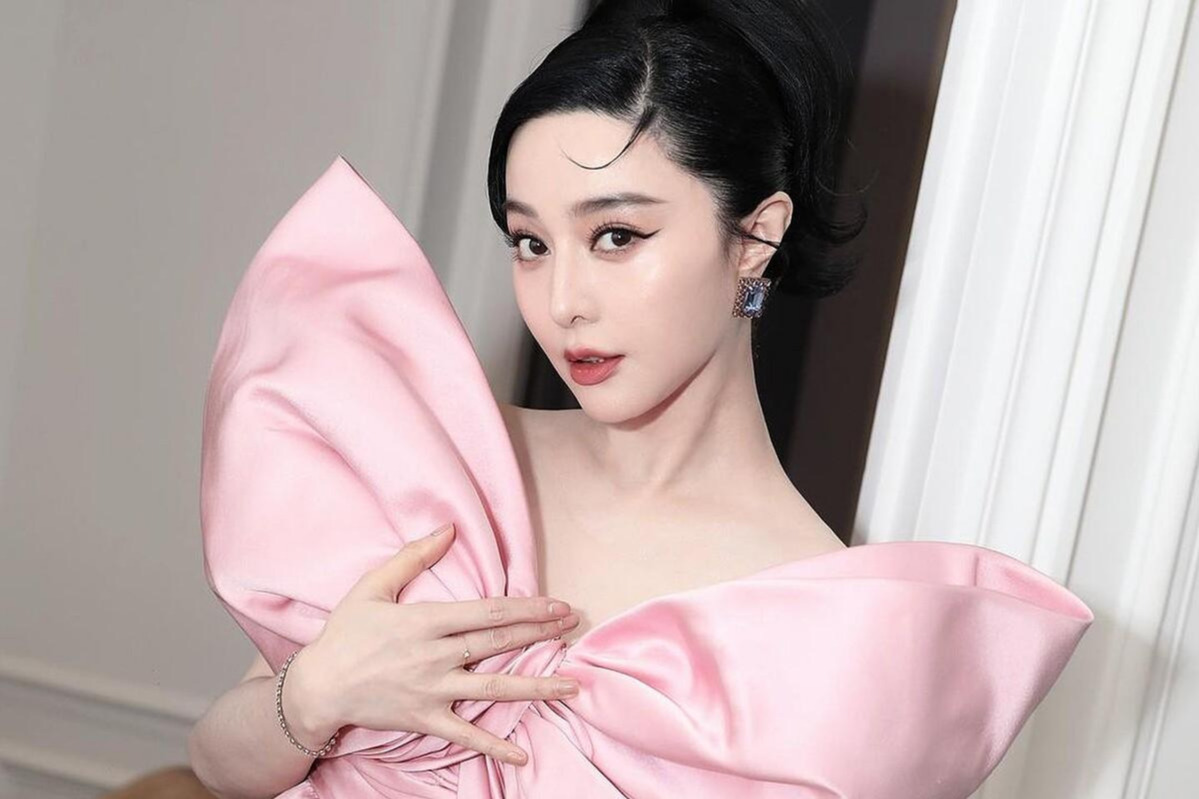
After her career in mainland China was abruptly interrupted, Fan Bingbing found in global fashion more than a front row — she found a new stage.

There are celebrities who attend fashion week to be seen.
Then there are those who understand that being seen can become a form of power.
During the Fall/Winter 2026–2027 Paris Haute Couture Week, Fan Bingbing appeared not simply as another famous guest, but as one of the season’s most persistent and visually commanding presences. Across several days in Paris, she moved between couture presentations, photographers, front rows, and private events wearing dramatic creations capable of dominating the visual conversation surrounding the shows.
Her appearance at the Georges Hobeika Haute Couture presentation, where she was photographed in Paris on July 6, was only one chapter in a wider succession of carefully orchestrated fashion moments. She was also present for Manish Malhotra’s official Paris couture debut, joining a front row that reflected the increasingly international geography of luxury.
But the deeper story is not really about the dresses.
It is about what those dresses now represent.
It is about a woman who once occupied a dominant position within Chinese cinema, lost access to much of the system that had built her fame, and then began constructing a different kind of cultural identity—one no longer dependent on a single national industry.
Before the Second Act
For years, Fan Bingbing was one of the most recognizable actresses in China.
She moved between film, television, advertising, beauty, and international red carpets with the kind of visibility reserved for only a few public figures. Her image became inseparable from spectacle: sculptural gowns, imperial silhouettes, elaborate embroidery, and an instinctive understanding of how fashion could transform a celebrity appearance into an event.
That trajectory was dramatically interrupted in 2018, when a major tax investigation led to substantial financial penalties and a prolonged retreat from public life. Her career in mainland Chinese entertainment was severely restricted, and the level of domestic visibility she had previously enjoyed did not return in the same form.
It is important to avoid simplifying that period into the claim that Fan Bingbing permanently stopped acting. She did not.
Her return, however, occurred largely through projects outside the mainstream mainland Chinese film system. She starred in the Hong Kong-produced thriller Green Night, which premiered in the Panorama section of the 2023 Berlin International Film Festival, and later took on a radically transformed role in the Malaysian production Mother Bhumi.
Her performance in Mother Bhumi was not a decorative celebrity cameo. The film presented her almost unrecognizably, without the polished glamour that had defined much of her public image. The role ultimately earned her the Best Leading Actress award at the 2025 Golden Horse Awards, proving that her acting career had not disappeared—it had moved into a different cultural and geographic space.
That distinction matters.
Fan Bingbing’s second act is not a story of an actress abandoning cinema for fashion. It is the story of someone rebuilding her relevance across several international platforms at once.
Fashion simply became the most visible of them.
Couture as a New Public Language

Haute couture offers something cinema cannot always provide: immediacy.
A film can take years to develop, finance, produce, distribute, and release. A couture image can circulate globally within minutes.
One photograph taken outside a Paris show can appear almost instantly across social media, entertainment platforms, fashion publications, and regional news outlets. It can reach audiences in Shanghai, Hong Kong, Seoul, Tokyo, Bangkok, Mumbai, Dubai, Milan, London, and New York before the show itself has ended.
Fan Bingbing appears to understand this system exceptionally well.
Her fashion-week appearances are rarely casual. They are constructed around impact. The silhouettes are dramatic, the beauty direction is precise, and the relationship between the woman, the garment, and the camera feels deliberate.
She does not merely wear couture.
She performs it.
This is why her presence resonates so strongly with photographers and digital audiences. Fan possesses the rare ability to make a garment appear larger than the event surrounding it. The clothes become part costume, part armour, part declaration.
During a couture season that included major presentations from established maisons as well as a growing group of internationally influential guest designers, Fan’s appearances positioned her within a larger transformation taking place in Paris. The official Fall/Winter 2026 calendar expanded to 30 houses, while designers including Manish Malhotra and Standing Ground joined as guest members, reflecting a couture system increasingly shaped by creative voices beyond its traditional European centre.
The Strategic Intelligence of Visibility
It would be reductive to argue that Fan Bingbing’s relationship with fashion is purely strategic.
Her interest in clothing, beauty, styling, and theatrical presentation existed long before the crisis that interrupted her career. She had already built a reputation as one of the most adventurous dressers on the international red carpet, often choosing designs that treated fashion as visual storytelling rather than conventional celebrity glamour.
Yet it would be equally naïve to ignore the professional intelligence behind her current positioning.
When access to one powerful platform became uncertain, Fan did not wait for permission to return to her previous position.
She expanded the stage.
She strengthened her beauty business.
She continued working in international cinema.
She accepted cultural and promotional roles outside mainland China.
And she intensified her relationship with global fashion.
Each couture appearance now carries several meanings at once. It communicates aesthetic authority, commercial relevance, international mobility, and continued access to cultural institutions capable of generating global attention.
What might appear from the outside as a series of extravagant gowns can therefore be read as something more sophisticated: a long-term reconstruction of public identity.
Why the Fashion Industry Still Needs Fan Bingbing

The relationship between Fan Bingbing and the luxury industry is mutually beneficial.
For Fan, fashion provides an international environment in which her image continues to hold value beyond the limits of any single domestic entertainment system.
For the maisons, she offers access to something equally valuable: recognition across multiple Asian markets, a highly developed visual identity, and the ability to transform a runway look into a globally circulated cultural image.
Luxury brands are not simply looking toward Asia as a future opportunity. Asia is already essential to the global luxury economy.
China remains a critical market, but the regional picture is becoming more complex. Japan continues to hold enormous importance. South Korea has become one of fashion’s most influential cultural centres. India’s luxury and couture industries are gaining greater international visibility, while Southeast Asian markets are attracting increasing attention from brands seeking new consumers, local ambassadors, and culturally specific partnerships.
The 2026 Bain–Altagamma luxury market update describes an industry attempting to rebalance its geographic growth engines while rebuilding relevance among consumers. In such a landscape, personalities capable of connecting different regions, industries, and audiences become especially valuable.
Fan Bingbing occupies precisely that space.
She is Chinese, but her current career is not confined to China.
She is an actress, but her influence is no longer dependent only on acting.
She is a fashion figure, but her importance extends beyond the clothes she wears.
Her image travels.
And in the contemporary luxury economy, the ability to travel culturally can be as valuable as the ability to sell.
Paris, India and the New Geography of Couture
Fan’s presence at Manish Malhotra’s Paris debut was particularly significant.
Malhotra’s collection, titled Maa, brought Indian craft, cinematic glamour, and cultural storytelling to the official couture calendar. Fan’s attendance placed her within a front row that symbolically connected China, India, Europe, international fashion media, and global wealth.
This was not merely another celebrity sighting.
It represented the changing geography of couture.
Paris remains the centre, but the creative and commercial energy surrounding couture increasingly comes from elsewhere. Designers such as Rahul Mishra, Robert Wun, Mohammed Ashi, and Manish Malhotra are not entering the conversation as peripheral voices. They are helping redefine what contemporary couture looks like, where it comes from, and whom it speaks to.
A recent analysis of the season described designers including Robert Wun, Rahul Mishra, and Manish Malhotra as part of a new couture guard challenging the industry’s traditional hierarchy. Their presence reflects a broader movement in which Asian and Middle Eastern creativity is no longer treated as an exotic reference for Western houses, but as a central force within luxury itself.
Fan Bingbing is particularly suited to this emerging landscape.
Her public image has always existed between worlds: cinema and fashion, East and West, celebrity and performance, historical references and futuristic spectacle.
She is therefore not simply attending the expansion of couture.
She visually embodies it.
Reinvention Without Erasure
The most compelling aspect of Fan Bingbing’s transformation is that she has not attempted to erase what happened.
Her second act does not pretend that the interruption of her career never occurred. Instead, it reveals how a public figure can move forward without returning to exactly the same position she once occupied.
Her international acting choices have become more unexpected.
Her fashion presence has become more deliberate.
Her image has become less dependent on the approval of a single cultural institution.
This is not a conventional comeback story.
A conventional comeback suggests a return to the place from which someone disappeared. Fan Bingbing’s trajectory appears more complex. She has not simply reclaimed her old stage. She has built a network of new ones.
The red carpet at the Berlinale.
The fields and villages of Mother Bhumi.
The front rows of Paris couture.
The digital platforms through which every look is circulated and examined.
Together, they create a new career architecture—one based not on restoring the past, but on distributing relevance across borders.
When Fashion Becomes More Than Fashion

Fashion has often been dismissed as superficial, particularly when it becomes closely associated with celebrity.
But fashion can also function as reputation management, cultural diplomacy, commercial positioning, and personal authorship.
For Fan Bingbing, couture appears to have become all of these things.
A garment can restore visibility.
A front-row appearance can establish international relevance.
A relationship with a designer can connect audiences across different markets.
A photograph can communicate that a person who was expected to disappear remains present, controlled, and culturally significant.
This does not mean that every look is part of a perfectly calculated strategy. Nor does it diminish Fan’s authentic passion for fashion.
The most effective reinventions often work precisely because genuine interest and professional intelligence exist together.
Fan Bingbing understands couture because she loves its drama.
But she may also understand that, in the current media landscape, drama is a form of currency.
A New Kind of Ambassador
Fan Bingbing may no longer occupy exactly the same position she held before 2018.
Perhaps that is the point.
Her influence today feels less connected to the conventional model of national movie stardom and more aligned with the fluid identity of a global cultural ambassador—someone able to move between fashion, cinema, beauty, tourism, and international events without belonging entirely to any one of them.
This position may ultimately prove more resilient.
An actress depends on roles.
A celebrity depends on attention.
But a cultural figure can create meaning across multiple systems.
At Paris Haute Couture Week, Fan Bingbing did not appear like someone waiting to be welcomed back into the world she had lost.
She appeared like someone who had already found another way to remain inside the conversation.
Her couture wardrobe was spectacular, certainly.
But the real achievement was not the clothing.
It was the transformation of visibility into independence.
Has Fan Bingbing genuinely reinvented herself as a global fashion figure, or is couture providing a magnificent stage while she continues searching for her true return to cinema? Share your perspective in the comments.
Editorial Note
This article is based on publicly available reporting, official film-festival records, fashion-week coverage, and editorial analysis. Interpretations concerning Fan Bingbing’s positioning, professional strategy, and relationship with the luxury industry represent QEditorial Magazine’s editorial perspective.


Leave a Reply