
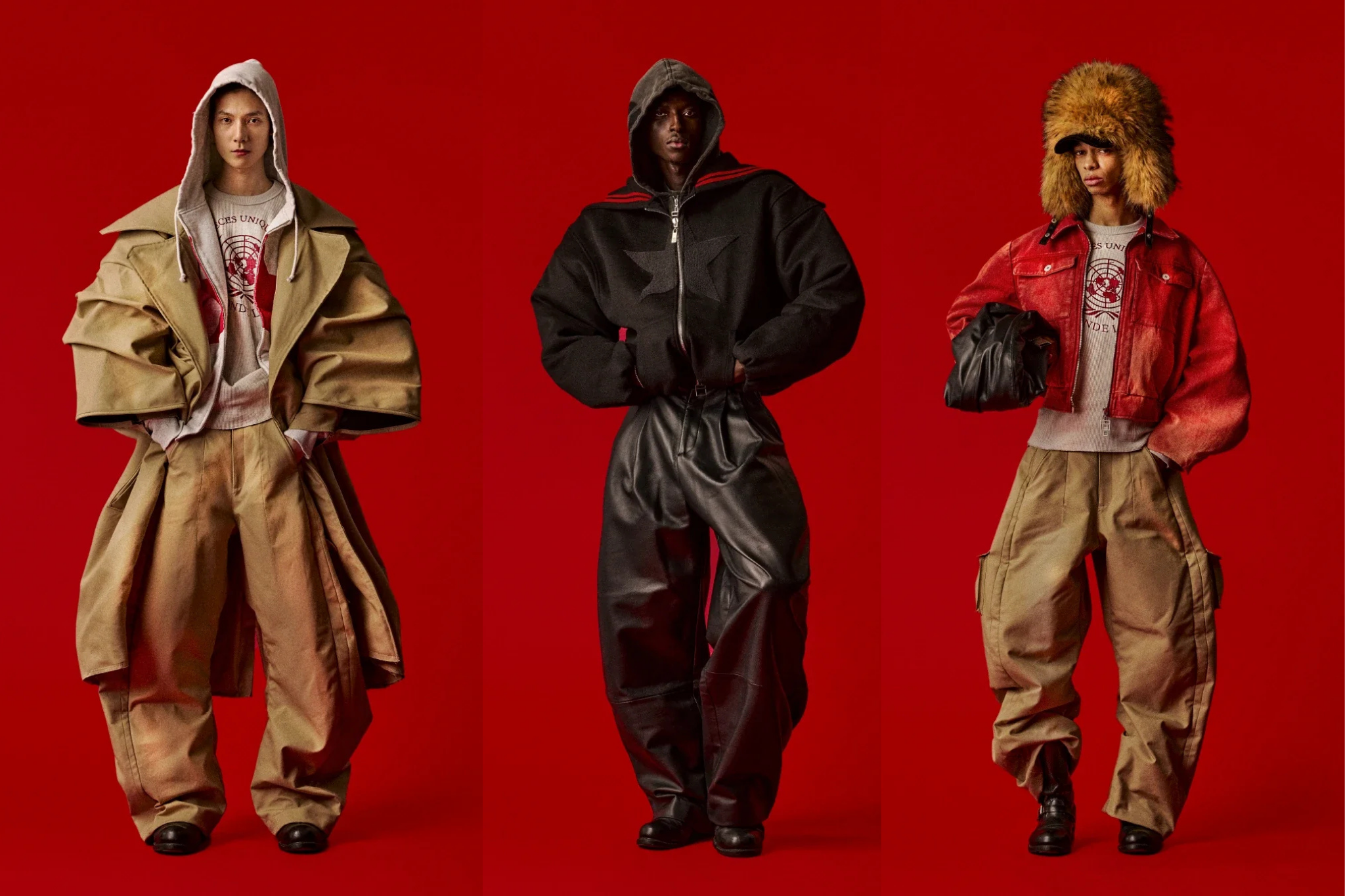
For Fall–Winter 2025, Edmond Luu turns family memory, political symbolism and the language of protection into one of Pièces Uniques’ most compelling worlds yet.

There is something immediately confrontational about Pièces Uniques’ Fall–Winter 2025 collection. Not necessarily because the clothes shout — although some quite literally carry slogans — but because everything appears to have been designed around a state of tension.
Protection and exposure. Uniform and individuality. Luxury and damage. Authority and rebellion.
Against a relentless red backdrop, models emerge in enormous fur coats, military-inflected outerwear, distressed leather, exaggerated trousers and pieces carrying the words MONDE LIBRE — “Free World.” Faces are sometimes visible, sometimes partially obscured, sometimes erased almost completely. The resulting imagery feels less like a conventional seasonal campaign than a series of portraits from an imagined political state.
The collection is called COUP D’ÉTAT.
And for Creative Director Edmond Luu, the starting point is deeply personal.
A Collection That Begins With Memory
The narrative originated in a conversation between Luu and his Vietnamese grandfather about the Vietnam War and the experiences of civilians attempting to protect their homeland during conflict.
Rather than recreating history literally, Luu translates that inherited memory into a contemporary visual language. Military references are present, but they are distorted. Familiar symbols of authority become fashion objects. Protective clothing becomes exaggerated. Uniforms lose their institutional certainty and begin to look almost ceremonial.
It is an approach consistent with the universe Luu has been building through Pièces Uniques since founding the Paris label in 2016.
His collections have rarely operated as isolated exercises in seasonal dressing. They function more like chapters within an expanding fictional world — informed by cinema, anime, architecture, popular culture and the visual codes Luu absorbed growing up.
Speaking previously about the brand, Luu described Pièces Uniques as a kind of cinematic universe, one where fantasy and reality are deliberately allowed to overlap. Highsnobiety has documented how anime, manga and the imagined worlds of his childhood became fundamental to this vocabulary, while previous collections have similarly been structured around territories, civilizations and narrative archetypes.
With COUP D’ÉTAT, however, fantasy encounters something heavier: history.

What Does the “Free World” Look Like?
Among the collection’s most visible elements are the words MONDE LIBRE.
At first glance, the phrase operates like a slogan. On black garments, rendered in red, it recalls political posters, military graphics and revolutionary typography. But its meaning is intentionally unstable.
“Free World” can describe an aspiration. It can also describe a political claim.
That ambiguity is precisely where the collection becomes more interesting.
Rather than presenting freedom as something comfortably achieved, Pièces Uniques seems to ask who gets to define it, who gets to represent it and what happens when institutions use the language of liberty while simultaneously exercising control.
Elsewhere, symbols resembling those associated with international institutions are reconfigured and displaced from their familiar contexts. Stars recur throughout the collection, referencing Luu’s Vietnamese heritage while also occupying the broader visual vocabulary of flags, nations and political identity.
The symbolism could easily become theatrical.
What saves it is the clothing.
Luu does not allow the concept to remain printed on the surface. He builds the same conflict into the garments themselves.

Protection as Silhouette
The strongest silhouettes in COUP D’ÉTAT appear almost defensive.
Shoulders expand beyond the natural body. Coats become enormous. Hoods swallow faces. Trousers balloon outward before contracting around boots. Fur surrounds the head and torso like insulation from an external threat.
The body is present, but frequently protected.
This idea has appeared before in Luu’s work. In an earlier interview, he spoke about wanting his garments to give their wearer a kind of fictional strength — comparing clothing to the transformative armour of characters such as Iron Man.
Here, that philosophy becomes less fantastical and more political.
Protection is no longer simply the fantasy of becoming a hero. It is the instinct to survive.
The massive faux-fur forms are particularly effective. In one look, brown fur envelopes almost the entire figure, leaving a darkened hood where a face might normally provide identity. In another, black fur extends across the shoulders and nearly to the floor, creating an imposing silhouette that seems simultaneously luxurious and threatening.
Then there are the smaller interventions: fur hats, oversized collars, padded constructions and garments wrapped around the body rather than conventionally worn.
They suggest that in uncertain environments, clothing becomes architecture.

Hard Materials, Softened Symbols
Perhaps the most intelligent aspect of the collection is its treatment of materials.
Leather appears in contrasting finishes — some grainy and visibly robust, others smoother and almost luxurious. Denim is treated and painted to evoke clothing marked by dirt and use. Fur moves between glamour and survivalism.
But one of the collection’s strongest conceptual gestures comes through merino wool manipulated into structures resembling barbed wire.
It is an effective reversal.
Barbed wire normally signifies restriction, borders and threat. Here, its silhouette is reconstructed through something tactile, warm and fundamentally protective.
The object remains recognizable, but its function changes.
That tension — danger made soft — captures much of what COUP D’ÉTAT is trying to achieve.
Instead of simply reproducing military garments, Luu disassembles their psychological associations. Hardness becomes softness. Uniform becomes costume. The institutional becomes personal.
Even the most aggressively utilitarian pieces maintain an almost couture-like concern with proportion.
The collection’s enormous cargo trousers are not simply oversized streetwear. Their folds and volumes actively reshape the lower body. Trench coats are amplified until their lapels appear architectural. Leather jackets sit close against the torso before suddenly expanding through the trousers beneath them.
These proportions create characters rather than outfits.

The Politics of the Covered Face
One of the most arresting recurring motifs in the campaign is concealment.
Some models disappear beneath hoods. Others wear knitted constructions exposing only the eyes. One face is punctuated by small metal openings; another is replaced visually by a red question mark.
It would be easy to read these images as purely dystopian.
But concealment also introduces a different idea: anonymity.
A uniform traditionally reduces the individual in favour of the institution. Pièces Uniques reverses that process. The more the face disappears, the more attention shifts toward the way the individual has constructed themselves.
Identity is communicated through silhouette rather than physiognomy.
In that sense, COUP D’ÉTAT feels surprisingly aligned with Luu’s broader exploration of masculinity.
His characters do not conform to one image of the contemporary man. They can be exaggerated, fragile, aggressive, elegant, hidden or exposed. A burgundy suit is disrupted by an enormous fur sash. A severe leather jacket meets inflated trousers. A military-coded black outfit becomes almost romantic through proportion.
Masculinity here is not presented as certainty.
It is something that can be rebuilt.

Red as Territory
The campaign imagery deserves attention independently of the garments.
Every model is photographed against essentially the same saturated red field. There is no architecture, landscape or contextual scenery to explain the world of the collection.
The colour becomes the world.
It evokes flags and propaganda, danger and ceremony, blood and revolution — associations that reinforce the collection without forcing a single interpretation.
More importantly, it allows every texture to become graphic.
Black leather becomes almost two-dimensional against it. Brown fur acquires an exaggerated warmth. Khaki appears closer to military canvas. Red details embedded within garments repeatedly disappear into and re-emerge from the background.
The consistency is particularly important because COUP D’ÉTAT contains a large number of ideas. Military clothing, institutional iconography, Vietnam, fur, slogans, masks, barbed wire, tailoring and streetwear could easily fragment into separate references.
The red backdrop forces them back into one visual universe.

Beyond Streetwear
Pièces Uniques is still frequently understandable through the language of streetwear, particularly because of its oversized proportions, graphics, hoodies, cargo shapes and the cultural references surrounding Luu’s work.
But COUP D’ÉTAT demonstrates why that classification now feels insufficient.
There is streetwear here, certainly.
There is also tailoring, costume, conceptual fashion and a growing preoccupation with construction.
That evolution has been visible for years. Highsnobiety described earlier Pièces Uniques collections as cinematic worlds rather than conventional clothing drops, while Luu himself has discussed his fascination with transforming the exaggerated wardrobes of fictional characters into wearable garments.
Fall–Winter 2025 pushes that methodology further.
Instead of designing clothes and then assigning them a narrative, the strongest pieces appear to exist because the narrative demanded them.
The volume has meaning.
The concealment has meaning.
Even the softness has meaning.
That distinction matters.

Edmond Luu and the Hero Inside the Clothes
For Luu, fashion has long been connected to the possibility of transformation.
“I believe in creating garments that accompany us through the quiet battles of our days—pieces that remind us we are the heroes of our own unfolding stories.”
Within the context of COUP D’ÉTAT, the statement becomes particularly resonant.
The hero imagined here is not necessarily triumphant.
Sometimes he is protected beneath layers. Sometimes he is anonymous. Sometimes he carries political symbols he may not completely trust. Sometimes freedom itself appears unresolved.
That uncertainty gives the collection its strength.
Fashion frequently borrows military imagery because uniforms provide instant visual authority. They offer recognisable hardware, disciplined silhouettes and centuries of symbolism.
Pièces Uniques attempts something more complicated.
Luu asks what happens after the authority of the uniform has been questioned.
What remains?
Perhaps the individual.
Perhaps memory.
Perhaps simply the clothes we choose to carry through whatever comes next.

QEditorial Perspective
Pièces Uniques occupies an interesting position within contemporary Paris fashion. Founded in 2016, the label can no longer be described as a newcomer, yet it retains the independence and experimentation commonly associated with an emerging house. Over several collections, Edmond Luu has developed a visual language grounded less in seasonal trend cycles than in world-building, character and narrative.
COUP D’ÉTAT suggests that this universe is becoming more sophisticated.
The collection works best when its political references are translated rather than illustrated: barbed wire becoming merino wool, protection becoming extreme volume, national symbolism becoming decoration, faces disappearing while silhouettes become more individual.
The question for Pièces Uniques is therefore no longer whether the brand has a recognisable identity.
It clearly does.
The more interesting question is how far Edmond Luu can expand that mythology without losing the intimacy that made it compelling in the first place.
With COUP D’ÉTAT, the answer appears to be: quite far.
And perhaps that is the most compelling form of rebellion available to an independent fashion house today — not simply creating another collection, but continuing to construct a world recognisably its own.
Editor’s Note
QEditorial presents Pièces Uniques’ Fall–Winter 2025 collection “COUP D’ÉTAT” as part of its ongoing exploration of independent fashion voices shaping contemporary visual culture. All imagery is used for editorial purposes and remains the property of Pièces Uniques and its respective copyright holders.
With “COUP D’ÉTAT,” Edmond Luu confirms that Pièces Uniques is not simply designing clothes, but building a visual language of its own — one shaped by memory, resistance and the freedom to define identity on personal terms.
QEditorial Magazine · Fashion · Menswear · Emerging Designers · Paris Fashion · Contemporary Culture
 All images featured in this article were sourced from publicly available web sources and are used for editorial purposes only. All rights remain with Pièces Uniques and the respective photographers and copyright holders.

Leave a Reply