
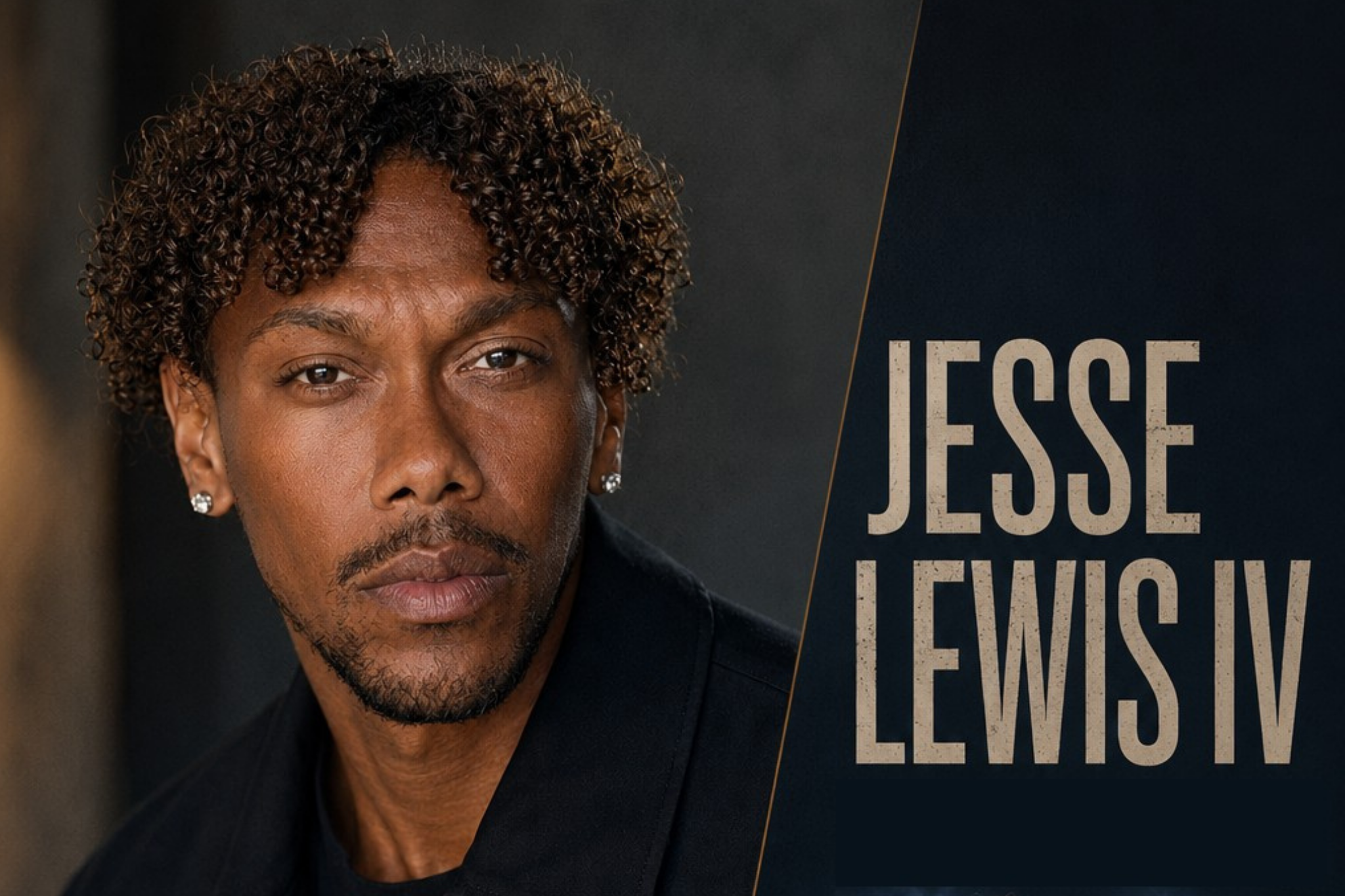
Jesse Lewis IV on Identity, Transformation and the Humanity Behind Route 187
An Exclusive QEditorial Interview.

There is a moment in an actor’s transformation when the mirror can become dangerous. Hair changes, makeup reconstructs familiar features, clothing alters the silhouette. For an audience, this is often where transformation begins: in what can be seen. For Jesse Lewis IV, becoming Miss Stu began somewhere else. It began with a voice.
Not simply its pitch or sound, but its pauses, breathing, rhythm, hesitation and emphasis—the almost invisible decisions through which a person reveals how they have learned to exist in the world. “Years ago, studying Jessica Lange’s work taught me something about my own process,” Lewis tells QEditorial in an exclusive interview ahead of the premiere of Route 187. “When I find a character’s voice, I often begin to understand everything else.”
The voice changed several times during his preparation. Some ideas worked. Others were abandoned. What ultimately mattered was not finding an effect, but finding something he could believe. “Once the voice began to feel truthful, the physical transformation made sense differently. The hair, makeup and wardrobe weren’t creating her anymore; they were revealing someone I had already started to hear.”
Eventually, Lewis looked into the mirror and stopped evaluating whether the transformation was convincing. Instead, he found himself wondering how Miss Stu would respond to the person looking back at her. “That’s when Miss Stu started breathing for me.”
It is a revealing distinction, because while Route 187 arrives on Paramount+ on September 16 as a new limited series, Lewis’s performance opens another conversation entirely: about the difference between appearance and identity, between transformation and imitation, and between being looked at and actually being seen.
For QEditorial, that distinction is where the story begins.
Before the Transformation, a Person
Jesse Lewis IV is an actor and live events producer whose career spans more than two decades across television, film and live entertainment. An alumnus of Alabama A&M University, Lewis is currently pursuing an MBA at Boston University’s Questrom School of Business.
His latest role, however, depends on something more intimate than professional chronology. In Route 187, Lewis appears as Miss Stu, a character embedded within the fictional community of South Winslow. Paramount+ describes the series as a crime drama set along an infamous city bus route known locally as Route 187, where residents navigate violence, poverty and lost hope until a routine bus ride erupts into tragedy. Journalist Mason James becomes determined to uncover what happened, drawing the series deeper into the lives of people surviving at the edges of the city.
Before Lewis could think about what Miss Stu looked like, however, he needed to determine who she was when nobody was watching.
“Before anything else, Miss Stu had to become a human being to me,” he says. “I didn’t want to begin with the wig, makeup, clothes, or even the fact that she is transgender. Those are things we can see. I needed to understand what we couldn’t see: Who does she love? What has she survived? Why do people trust her? What happens when no one else is in the room?”
That choice is important precisely because the transformation is so visible. Screen culture has long been fascinated by actors who disappear behind makeup, prosthetics, changes of body, costume or accent. Transformation itself can quickly become the event. Lewis wanted the opposite.
He knew he was entering an experience that was not his own. Research, therefore, could not simply become a collection of external gestures. “I watched interviews, read articles, listened to women and transgender women speak about their lives, and studied subtle things—humor, stillness, cadence, confidence, vulnerability—not to collect mannerisms, but to question my own assumptions.”
Lewis states the principle at the center of his approach: “You can’t play an identity. My responsibility was to play Miss Stu.”
It may be the clearest statement through which to understand the entire performance. Miss Stu is not an identity category onto which a personality has been attached. She is a person.
When Clothing Does Not Need to Announce Power
Fashion on screen often communicates hierarchy before dialogue has the opportunity to explain it. A perfectly constructed suit tells us who expects to enter a room with authority. Jewelry can signal wealth, inheritance or aspiration. A uniform can establish rank before a character speaks.
Miss Stu does not operate within those codes.
“She is a working-class woman living in a world that has largely forgotten people like her,” Lewis explains. “She works and takes pride in herself, but she doesn’t have the means—or frankly the reason—to recreate some iconic fashion moment every morning.”
There are no designers waiting in Miss Stu’s closet. Her makeup is minimal. Her clothing belongs to the reality of her life. For an editorial platform such as QEditorial, where fashion is often considered less as product than as a language of identity, that makes Miss Stu particularly interesting. Fashion does not disappear when luxury disappears. Clothing continues to communicate even when it is practical, repetitive, inexpensive or ordinary.
Lewis reduces the idea to a remarkably simple line: “Dignity isn’t dependent on access.”
Miss Stu has spent much of her life in environments where she can be marginalized, underestimated or ignored. Yet she continues to decide how she presents herself. There is femininity in that decision, but not femininity constructed for approval. There is pride, practicality and an understanding that visual authority does not have to arrive through consumption.
“She can walk into a room without designer clothes, elaborate makeup or traditional symbols of power and still command it.”
Contemporary culture often conflates visibility with acquisition: the right dress, the right bag, the polished skin, the carefully assembled image. Miss Stu belongs to another visual economy. She has no obligation to become aspirational in order to become important.
“The most revealing thing isn’t always what someone can afford,” Lewis says. “It’s what they do with what they have—and the confidence with which they wear it.”
Style has never belonged exclusively to wealth. It belongs equally to repetition, posture, choice, self-awareness and the meaning a body gives to what it wears.
Miss Stu’s wardrobe does not manufacture authority. She supplies it herself.
Listening Before Reinventing
Lewis is careful not to present the construction of Miss Stu as an individual creative victory. The character existed before he entered the process.
Route 187 was created and written by Mark E. Swinton, who also serves as the series’ director. Swinton had already imagined the world of South Winslow and the people who inhabit it before Lewis stepped into Miss Stu’s life. Tyler Perry serves as an executive producer, with Tyler Perry Studios behind the production.
Lewis understood that collaboration sometimes requires an actor to resist the instinct to immediately impose himself onto the role. “I think the most important thing was knowing when to listen.”
He describes Route 187 as a labor of love for Swinton and speaks about approaching the material with an awareness that its creator had already spent considerable time living with these characters. “My responsibility wasn’t to arrive and reinvent the woman he had written. It was to listen—to Mark, the text, and what hair, makeup and costume were building from his vision—and figure out how to take those elements off the page and into three dimensions.”
There is something refreshingly unromantic about this description of acting. No mythology of solitary genius. No attempt to claim complete ownership of a character. Instead, performance becomes interpretation.
“The creator knows who this person is, but eventually she has to breathe, move, speak and react when the camera rolls. That’s where my preparation and instincts entered the process.”
Lewis wanted Swinton to recognize the character he had imagined once Miss Stu finally appeared before the camera. “I wanted Mark to recognize the woman he had written living inside me.”
The Body Remembers
After the voice came the body. Lewis began by asking what Miss Stu’s voice did to her physical presence, a question that immediately moved him away from imitation. “I wasn’t interested in manufacturing femininity through gestures,” he says. Instead, he began considering how Miss Stu occupies space: the pace of her walk, where she carries tension, what happens to her posture when she feels watched, where her eyes move when she enters an unfamiliar room, and what changes when she is somewhere safe enough to let some of that tension go.
These questions transformed physicality from choreography into biography. Bodies accumulate information. A person who has spent years expecting danger may enter a room differently from someone who has always assumed safety. Someone accustomed to being underestimated may develop an economy of movement that communicates authority without spectacle.
Lewis explored Miss Stu’s stillness as carefully as her motion, considering how her body might respond differently to safety and danger. “Eventually I stopped asking how a woman moves and asked, ‘How does Miss Stu move—and what happened to her that made her move that way?’”
Then comes one of the most revealing statements in our conversation: “That’s when physicality stopped being movement and became history.”
This is where performance becomes particularly interesting. The body is no longer being asked to demonstrate gender. It is being asked to remember experience.
Femininity Without Permission

Playing Miss Stu also required Lewis to question some of the assumptions surrounding femininity and masculinity that people absorb long before they consciously examine them.
“Absolutely,” he says when QEditorial asks whether the character challenged his ideas about gender, beauty and self-expression. “But I think the bigger change was realizing how often we try to define those things for other people.”
Fashion has historically participated in defining these boundaries while simultaneously dismantling them. A garment can reinforce gender convention or destabilize it. Beauty can reproduce an accepted ideal or expose how artificial that ideal has always been.
For Lewis, the more specific Miss Stu became, the less useful those broad definitions were. “Her femininity didn’t need to be proven through a particular walk, voice, hairstyle or piece of clothing. It belonged to her.”
That realization reached beyond the character. “We spend so much of our lives receiving messages about what is masculine enough, feminine enough, beautiful enough, acceptable enough.”
Enough for whom?
Enough according to which observer?
Miss Stu, at least in Lewis’s interpretation, refuses to participate in that negotiation.
“Miss Stu reminded me that self-expression becomes much more interesting when it isn’t asking permission.”
It is difficult not to read the statement as a wider commentary on beauty. Contemporary beauty culture often presents itself as liberation while remaining governed by enormous systems of approval: trends, algorithms, age, gender expectations, consumer behavior and the permanent availability of comparison.
Lewis arrives somewhere quieter.
“Maybe real beauty is knowing exactly who you are—and having the courage to remain that person while the world catches up.”
Authenticity Begins Where Imitation Ends
There is an unavoidable complexity in Lewis portraying Miss Stu. He is portraying an experience that is not his own, and he does not attempt to erase that distance. Instead, it repeatedly appears in the way he discusses preparation and responsibility.
“For me, authenticity begins where imitation ends.”
Hair can transform. Makeup can transform. Wardrobe, voice and physicality can transform. But none of these answer the central question required of an actor: who is this person when nobody is watching?
With Miss Stu, Lewis’s private questions became increasingly intimate. What frightens her? What makes her laugh? Who has the ability to hurt her? What does she protect? What does she need but refuse to admit that she needs?
“These answers aren’t necessarily visible to an audience, but I believe audiences can feel when they’re missing.”
It is one of acting’s central paradoxes: enormous preparation may be required to create details the viewer never consciously identifies. We do not necessarily need to know why a character pauses before answering. We need to believe the pause. We do not need an explanation for every defensive gesture. We need to feel that the defense existed before the camera arrived.
For Lewis, this responsibility became especially important because Miss Stu’s lived experience differs from his own. “I never wanted the transformation to become the performance. It was simply the doorway.”
His responsibility was to walk through it.
“Transformation may make you look like someone else. Authenticity is what makes an audience forget they’re looking at you at all.”
A Woman at the Margins, Holding the Center
At the center of Route 187 is South Winslow, a fictional community marked by financial hardship, violence and people living under continuous pressure. When violence erupts during what should have been an ordinary journey, the event becomes the catalyst for a wider investigation into the community and the people living within it.
Within this environment, Miss Stu could easily have been defined primarily by marginalization. Lewis hopes audiences encounter something far more complicated.
“I think audiences may expect Miss Stu to be defined by what makes her different. What I hope surprises them is how familiar she feels.”
She is a protector. She has created space where people who might otherwise have nowhere to go can experience some form of safety. But Lewis is equally insistent that she not become morally decorative.
“That doesn’t make her a saint.”
She has contradictions, humor, boundaries, history and survival instincts. That complexity matters because representation becomes less interesting when marginalized characters are required to function as lessons rather than people.
Miss Stu does not need to give a speech about belonging.
“She practices it.”
Lewis describes a woman who understands the value of being seen precisely because she understands what it means to be disregarded. In one of the most revealing inversions in his description of the character, the person society may place at its edges becomes central to the survival of others.
“Sometimes the person the world places at the margins becomes the person holding everyone else together.”
Miss Stu is not waiting for the world to validate her importance.
“She already knows that she does.”
Twenty Years Before the Door Opened
There is another transformation inside this story, and it belongs to Jesse Lewis IV himself.
His career has developed across more than two decades, with credits extending from reality television into scripted television and film. His IMDb profile now lists dozens of acting credits, with Route 187 placing Miss Stu among his latest roles.
Careers can look deceptively linear when condensed into biographies. A list of credits creates an illusion of inevitability that rarely reflects what a working actor actually experiences.
“There were years when the dream felt incredibly close and others when I had very little evidence it was moving at all,” Lewis tells QEditorial. “But I kept studying people, working, dreaming and believing there were characters inside me I hadn’t been given the opportunity to show yet.”
Miss Stu was one of them.
Lewis says he is interested in disappearing into complicated people. He wants roles that frighten him slightly, demand research, challenge his instincts and leave him changed after the process.
“I want to make work people talk about—not simply because they watched it, but because something remained.”
That interest in longevity also connects to another part of Lewis’s professional life: understanding the business required to sustain a creative career.
It is a useful counterpoint to the romantic mythology surrounding acting. Art and business are frequently treated as opposing forces until an artist discovers that understanding the second may be essential to sustaining the first.
For Lewis, longevity increasingly appears to mean readiness and agency.
“Twenty years taught me that longevity isn’t just surviving until someone gives you an opportunity. It’s becoming the artist who’s ready when the opportunity finally arrives.”
Then he adds a line that changes the direction of the conversation completely:
“I’ve spent twenty years waiting for doors to open. Now I’m interested in what I can build once I’m inside.”
What Remains When the Image Disappears
It would be easy to end this story with transformation. Jesse becomes Miss Stu. Voice, hair, makeup, clothing and movement converge. The camera records the result.
But that would misunderstand almost everything Lewis has been saying.
The image is the least permanent part.
“I hope they remember a person,” he says when QEditorial asks what he wants audiences to carry with them after meeting Miss Stu.
Not the wig. Not the makeup. Not necessarily every detail of the story.
A person.
He hopes audiences remember how Miss Stu loved, protected and survived; how she occupied space; how she refused to make her humanity contingent upon somebody else’s approval. Maybe, he says, she will make someone reconsider a person they judged too quickly. Maybe she will remind someone of somebody they once knew. Perhaps years later the viewer will no longer remember exactly what Miss Stu said, but will still remember how she made them feel.
That ambition feels particularly relevant now. Contemporary culture produces extraordinary quantities of imagery while asking remarkably little of us in terms of remembering it. Faces, transformations, campaigns, characters and moments arrive one after another, each fighting briefly for attention before being replaced.
Lewis has no interest in contributing another disposable image to that cycle.
“We’re surrounded by images that disappear almost as quickly as we consume them. I don’t want to make disposable characters. I want to create characters whose humanity stays with you.”
Perhaps that is ultimately why the visual transformation into Miss Stu matters. Not because Jesse Lewis IV disappears beneath it, but because, if the performance succeeds, the transformation itself eventually disappears too.
The audience stops examining the hair. Stops examining the clothes. Stops deciding whether the voice is convincing. Stops searching for the actor underneath.
What remains is a woman in South Winslow who has survived enough to understand the value of shelter; who has learned how to occupy space without asking permission; who understands that dignity does not arrive with access, and whose femininity requires no external certification.
A woman positioned at the margins who, somehow, becomes part of the center.
Miss Stu.
Because for Lewis, the measure of a character has never been how dramatically an actor can change in order to become somebody else. It is how long that somebody else survives after the transformation is over.
“Ultimately, the measure of a character isn’t how long they’re on the screen,” he tells QEditorial. “It’s how long they live in you after the screen goes dark.”
Editorial Note
At QEditorial, identity is never defined by appearance alone. It is shaped through the way we dress, move, occupy space and choose to be seen.
In Becoming Miss Stu, our exclusive conversation with Jesse Lewis IV moves beyond the visible transformation behind his role in Route 187 to explore something more enduring: the construction of a human being. Through voice, clothing, physicality and performance, Lewis approaches Miss Stu not as an identity to imitate, but as a person whose history must first be understood.
His perspective opens a wider conversation about femininity, representation and beauty—particularly the idea that dignity does not depend on access, and that self-expression becomes most powerful when it no longer asks for permission.
This is where Route 187 enters the world of QEditorial: not simply as a screen premiere, but as a story about fashion, culture and identity—and the humanity that exists beyond the image.
Nicolò Di Stefano
QEditorial Magazine

QEditorial Exclusive
This feature is based on an exclusive QEditorial interview with Jesse Lewis IV, conducted ahead of the September 16, 2026 premiere of Route 187.
Route 187 premieres September 16, 2026 on Paramount+. Jesse Lewis IV portrays Miss Stu. The series was created and written by Mark E. Swinton.
Personal editorial imagery: Courtesy of Jesse Lewis IV. Official Route 187 imagery/video: Courtesy of the production / respective copyright holders, according to the supplied press materials.


Leave a Reply