
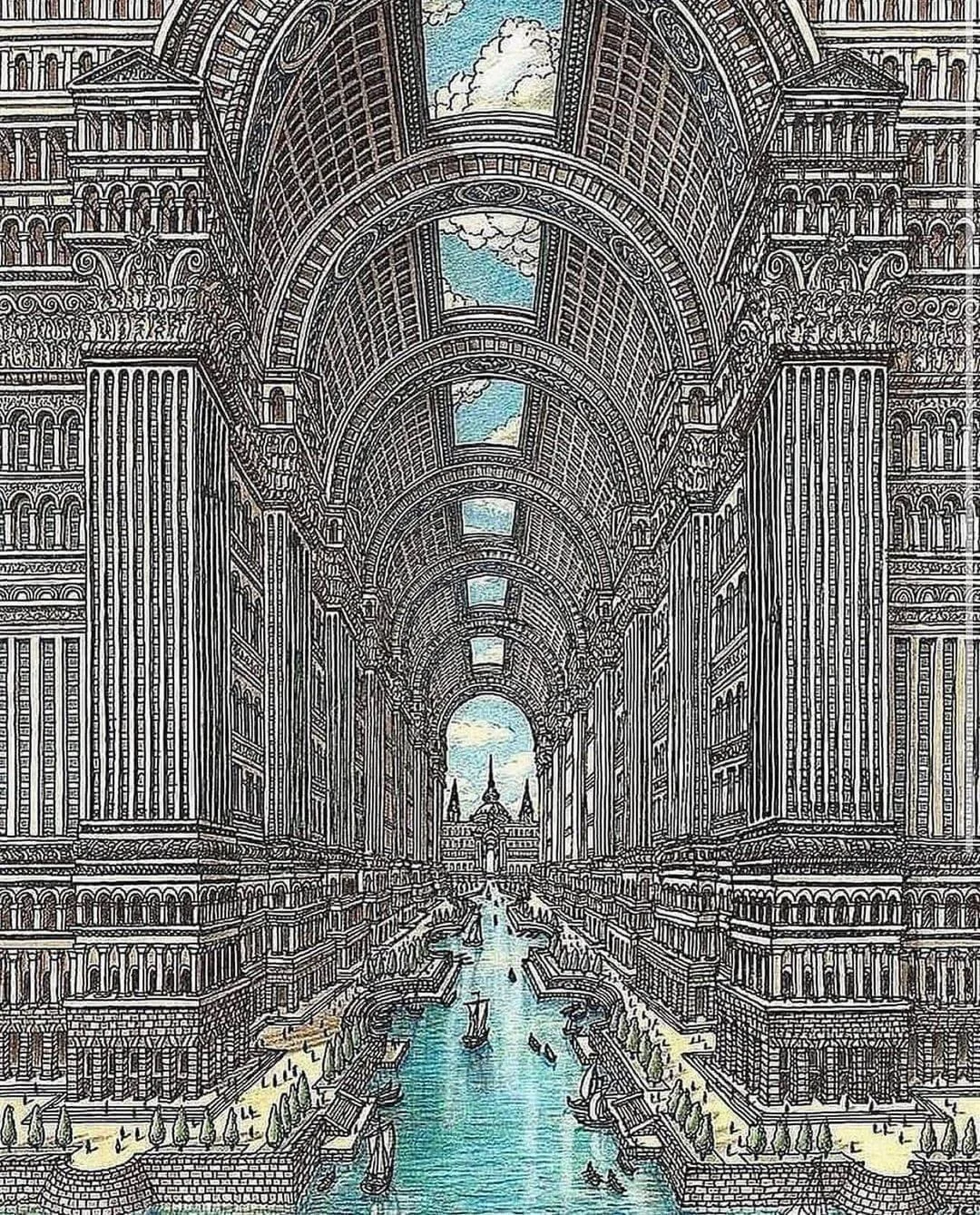
Long before generative technology began producing monumental cities and impossible structures, Artur Skizhali-Veys was already drawing architectural worlds that appeared to belong to another century.

There is something strangely familiar about the architectural worlds of Artur Skizhali-Veys.
Monumental towers rise above endless urban landscapes. Bridges appear to connect entire civilizations. Classical arches, industrial structures, elevated roads, domes, columns, and futuristic machines coexist within cities whose scale seems almost impossible to comprehend.
At first glance, these images might easily be mistaken for contemporary experiments created through artificial intelligence.
They have the visual intensity of an elaborate prompt. The density of a digitally generated metropolis. The impossible geometry of a world produced by an algorithm unconstrained by engineering, cost, gravity, or reality.
Yet these architectural fantasies did not begin with generative software.
They began with the imagination and architectural knowledge of a human being.
And that distinction makes them even more extraordinary.
Architecture Beyond Construction
Born in 1963, Artur Skizhali-Veys is a Russian architect, artist, and architectural fantasist whose work has explored fictional and futuristic architecture since the late 1990s. Trained at the Moscow Architectural Institute, he gradually moved away from conventional construction and toward the creation of speculative cities, monumental structures, and imagined urban civilizations.
His drawings do not necessarily propose buildings intended to be constructed.
Instead, they explore what architecture can become when it is liberated from the immediate obligations of clients, budgets, building codes, and physical limitations.
This is architecture as speculation.
Architecture as storytelling.
Architecture as a space in which history, technology, fantasy, and urban theory can exist simultaneously.
Skizhali-Veys belongs to a long tradition of architects who understood that drawing could be more than a preparatory stage before construction. It could become a complete intellectual and artistic practice in its own right—a method for examining the city not only as it exists, but as it might one day become.
His architectural fantasies have been presented in exhibitions in Moscow, recognized through international architectural graphics competitions, and included among works associated with Berlin’s Museum for Architectural Drawing, operated by the Tchoban Foundation.
But today, his work carries another unexpected significance.
It appears to anticipate the visual culture of artificial intelligence.
The AI Aesthetic Before Generative AI

The current generation has become accustomed to seeing impossible architecture.
Social platforms are filled with floating museums, organic skyscrapers, cities carved into mountains, futuristic palaces, underwater civilizations, and enormous structures suspended above unfamiliar landscapes.
Many of these images are created through generative systems capable of combining architectural periods, materials, locations, and visual languages within seconds. Research into AI-assisted architectural design has already examined how tools such as diffusion models can support early-stage ideation, spatial experimentation, and the visualization of forms that would be difficult to develop through conventional methods alone.
Because this imagery has become so widespread, we have started to associate architectural impossibility with artificial intelligence.
Yet Skizhali-Veys’s work disrupts that assumption.
His drawings possess many of the characteristics now associated with AI-generated architecture: extreme scale, intricate repetition, improbable structural combinations, cinematic perspective, historical hybridity, and an almost overwhelming accumulation of detail.
There are cities within cities.
Structures appear to expand infinitely beyond the boundaries of the image.
Architectural styles that should belong to different centuries are brought together within the same imagined environment. Classical monumentality meets industrial infrastructure. Decorative forms coexist with mechanical systems. Ancient visual memories are reconstructed as visions of an unfamiliar future.
The result feels algorithmic.
But it is not.
What appears to be the output of machine imagination is, instead, the product of architectural training, manual composition, patience, memory, and individual vision.
When the Human Mind Becomes the Generator

Artificial intelligence can rapidly combine enormous quantities of visual information. It can recognize patterns, imitate stylistic conventions, and produce unexpected relationships between forms.
But Skizhali-Veys’s drawings remind us that architectural generation existed long before software began participating in the creative process.
The human mind was the original generative system.
An architect could absorb the history of cities, the logic of infrastructure, the symbolism of monuments, the theatricality of perspective, and the anxieties or ambitions of a particular era—and transform them into a world that had never previously existed.
For Skizhali-Veys, imagination does not appear as an escape from architectural knowledge. It is made possible by that knowledge.
His fictional environments often feel convincing precisely because they are not random. Their visual complexity is supported by an understanding of scale, construction, movement, density, circulation, and urban hierarchy.
Even when the structures become impossible, they retain a sense of architectural order.
We can imagine entering them.
Crossing their bridges.
Ascending their towers.
Becoming lost within their enormous public spaces.
This is what separates architectural fantasy from visual spectacle alone. The image does not merely show us an unusual building; it invites us to imagine the civilization that might have built it.
A Dialogue Across Two Architectural Futures
In QEditorial’s previous feature, When Architecture Learns to Dream: Why Joshua Vermillion Is Reimagining Space in the Age of AI, we explored how computational creativity and artificial intelligence are expanding contemporary conversations around architecture, atmosphere, emotion, and immersive design.
Joshua Vermillion represents one side of architecture’s evolving relationship with technology: the designer working within a moment when AI can actively participate in experimentation, visualization, and the development of new spatial languages.
Artur Skizhali-Veys offers the other side of that conversation.
His work asks us to look backward and recognize that the visual language we now describe as “AI-like” did not originate with artificial intelligence.
Long before algorithms learned to generate speculative cities, architects were already using drawing to leave reality behind.
The connection between these two practices is not based on identical tools. It is based on a shared desire to extend the limits of architectural possibility.
Vermillion’s work belongs to an age in which computation can collaborate with the designer. Skizhali-Veys’s drawings emerged from an earlier form of generation: the slow construction of a world through the human hand.
Together, they reveal that technology may transform the architectural process, but the impulse behind it remains remarkably consistent.
The architect still asks:
What else could a city become?
How might space alter human perception?
Can architecture create a reality that does not yet exist?
The City as Myth, Machine, and Memory
Skizhali-Veys’s cities do not present the future as something entirely new.
They often appear to carry the remains of the past within them.
This is one of the most compelling aspects of his work. His imagined futures do not erase architectural history; they enlarge, distort, and reassemble it.
A tower may recall an ancient monument while simultaneously resembling a machine. A bridge may possess the ceremonial grandeur of an imperial structure but operate at the scale of futuristic infrastructure. Entire urban compositions seem to contain echoes of classical cities, industrial landscapes, speculative science fiction, and utopian planning.
The future, in these drawings, is not a clean break from history.
It is history accumulated to the point of transformation.
This gives the work a psychological depth that goes beyond futurism. These are not merely optimistic images of technological progress. Some appear triumphant; others oppressive. Their immense scale can inspire wonder, but it can also make the human figure appear small and vulnerable.
The cities seem capable of protecting civilization—or consuming it.
That ambiguity gives them power.
The most memorable speculative architecture rarely tells us whether the future will be better or worse. It shows us a world and allows us to confront our own hopes and anxieties within it.
Why These Drawings Matter Now
The renewed relevance of Skizhali-Veys’s work arrives at a moment when the production of images has become almost instantaneous.
A description typed into a generative platform can now produce an architectural fantasy within seconds. This accessibility has opened important creative possibilities, allowing architects, students, artists, and designers to explore forms that might otherwise remain difficult to visualize.
At the same time, it raises questions about authorship, intention, originality, and the difference between generating an image and developing an architectural idea.
Skizhali-Veys’s drawings cannot provide a simple answer to those questions.
They do, however, provide perspective.
They remind us that speed is not the same as vision.
Complexity is not automatically meaning.
And visual astonishment does not necessarily constitute architectural thought.
His work appears futuristic not simply because it depicts extraordinary structures, but because those structures belong to coherent imagined worlds. They suggest systems, societies, histories, and ways of living beyond the visible frame.
The viewer is not only impressed by what has been drawn.
The viewer begins to wonder why it exists.
Beyond the Prompt
Artificial intelligence is already reshaping the way architecture is represented and discussed. It can help designers test visual directions, reinterpret references, explore materials, and imagine environments beyond conventional drafting.
But perhaps the most valuable comparison between Skizhali-Veys and contemporary AI culture is not about whether a machine can reproduce his style.
The more important question is whether technology can reproduce the depth of intention behind a world.
A prompt can describe a monumental city.
An image generator can visualize it.
But architecture begins to matter when the city carries an idea about humanity.
Who lives there?
Who holds power?
How does the body move through such enormous spaces?
Does technology liberate the people within the city—or reduce them to almost invisible figures beneath its monuments?
Skizhali-Veys’s work remains compelling because it gives these questions a visual form without completely resolving them.
His drawings leave us suspended between admiration and uncertainty.
Between utopia and dystopia.
Between the city as a human achievement and the city as a force larger than humanity itself.
The Future Was Already Being Drawn
It would be easy to describe Artur Skizhali-Veys as an architect who created AI imagery before AI.
But that description, while visually understandable, would also be incomplete.
His work is significant not because it resembles what machines can produce today.
It is significant because it proves that the architectural imagination was already capable of reaching those worlds independently.
Before artificial intelligence learned to combine styles, architects combined centuries.
Before software generated impossible structures, artists drew them.
Before algorithms began constructing visual futures, the human mind had already started building cities that reality was not yet prepared to contain.
Artur Skizhali-Veys did not predict artificial intelligence itself.
He anticipated the scale of imagination that we would eventually associate with it.
And in doing so, his architectural fantasies offer an essential reminder for the future of design: technology may accelerate the creation of images, but imagination remains the force that gives those images purpose.
Editor’s Note
Artur Skizhali-Veys’s architectural fantasies reveal that the desire to imagine impossible spaces existed long before generative technology entered the design studio. As artificial intelligence expands the methods available to contemporary architects, his work invites us to remember that every meaningful future—whether drawn by hand or developed with computational tools—must begin with a human question.
Explore QEditorial’s related feature, When Architecture Learns to Dream: Why Joshua Vermillion Is Reimagining Space in the Age of AI.
QEditorial Magazine — Fashion · Culture · Identity QEditorial.com




Leave a Reply