

In a time when architecture is often expected to impress, communicate, compete, and become instantly recognizable, the work of Tadao Ando continues to speak with a different kind of force: the force of silence.
His architecture does not seek noise. It does not depend on formal excess, immediate spectacle, or decorative complexity. On the contrary, it seems to emerge from a radical act of reduction: concrete, light, water, geometry, emptiness. Essential, almost primitive elements that, in his hands, become instruments of contemplation.
Tadao Ando does not simply design buildings. He creates emotional conditions. Spaces in which the body slows down, the gaze changes rhythm, and light becomes an almost physical presence.
Born in Osaka in 1941, Ando is a distinctive figure in the history of contemporary architecture. Self-taught and outside the traditional academic path, he developed his own language through observation, travel, discipline, and a deep relationship with Japanese tradition. In 1995, he received the Pritzker Architecture Prize, the most prestigious international recognition in architecture, confirming the universal value of a practice built on apparent simplicity.
What makes Ando so recognizable is not only his use of reinforced concrete, but the way he transforms it. In his work, concrete does not appear cold or purely industrial. It becomes a silent skin, a surface capable of receiving shadows, reflections, and changes in light. The material does not dominate the space; it prepares it.
For Ando, light is not a technical detail. It is the heart of architecture. It is what gives life to concrete, what measures time, what introduces movement into apparently immobile forms. His architecture shows how a space can change without changing its structure: all it takes is the movement of the sun, a cloud, a season, a reflection on water.
This tension between matter and the immaterial runs through many of his most celebrated works. The Church of the Light, in Ibaraki, is perhaps one of the most powerful syntheses of his language: an essential concrete volume crossed by a cross of light. Here, architecture does not represent the sacred through ornament, but allows it to emerge through absence. It is precisely the void, cut into the wall, that generates presence.

The same sensitivity can be found on Naoshima, the Japanese island that has become one of the symbolic places of the dialogue between contemporary art, landscape, and architecture. The Chichu Art Museum, designed by Ando, is built largely underground, a choice that reduces its visual impact on the environment and transforms the visit into an almost introspective experience. The museum houses works by Claude Monet, James Turrell, and Walter De Maria, but what is most striking is the way the building itself becomes part of the artwork: a journey through natural light, inclined walls, geometric courtyards, and controlled silences.
On Naoshima, Ando does not impose architecture on the landscape. He conceals it, cuts into it, and allows it to emerge as a measured presence. The result is not mimicry, but respect. The building does not disappear: it breathes with the place.
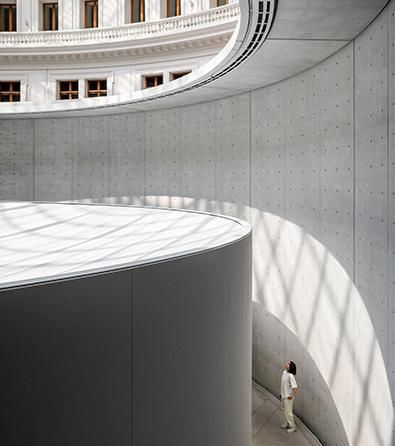
This ability to intervene without erasing is also evident in the transformation of the Bourse de Commerce in Paris, today home to the Pinault Collection. Inside a historic building charged with memory, Ando inserted a large concrete cylinder, creating a dialogue between past and present, between the historic decoration of the dome and the contemporary purity of the new structure. The project, developed together with other studios and specialists, required years of transformation and demonstrates how his language can also engage with the complexity of European history.

The gesture is powerful precisely because it does not seek to cancel what existed before. Ando’s concrete does not erase the memory of the place; it places it in tension. It creates a pause, an internal chamber, a space of concentration within a building originally created for commerce and now dedicated to contemporary art.
In this sense, Ando is a profoundly contemporary architect, but not because he follows the speed of the present. On the contrary, his strength lies in resisting that speed. His works ask for time. They are not consumed in a single image. They require presence, movement, silence.
His work reminds us that architecture is not only form, function, or public image. It is also a discipline of looking. It is the way a wall meets light, the way a corridor prepares a discovery, the way a void can become more eloquent than a decorated surface.
In an increasingly saturated visual world, Tadao Ando continues to defend a rare idea: that beauty can be severe, that luxury can coincide with emptiness, that spirituality can arise from a concrete wall and a ray of light.
His architecture does not only ask to be seen. It asks to be inhabited inwardly.
And perhaps this is where his true greatness lies. Tadao Ando does not build monuments to the architect’s ego. He builds spaces in which the human being can rediscover measure, solitude, attention, and wonder.
In an age that continues to multiply images, surfaces, and noise, his work remains an essential lesson: sometimes, in order to say something profound, architecture must learn to be silent.
Nota editoriale
Tadao Ando’s architecture reminds us that space can still be a form of silence.
In a visual culture increasingly shaped by speed, spectacle, and instant recognition, Ando’s work offers a different rhythm. His buildings do not ask to be consumed quickly. They ask to be entered, felt, and understood through time.
Through concrete, light, water, geometry, and emptiness, Ando has created one of the most recognizable architectural languages of the contemporary era. Yet the power of his work does not lie only in its formal clarity. It lies in its emotional restraint — in the way a wall, a shadow, or a beam of light can become a spiritual experience.
For QEditorial, Tadao Ando represents a rare kind of modernity: one that does not erase silence, memory, or interior life, but gives them architectural form.
QEditorial Magazine — Fashion · Culture · Identity QEditorial.com




Leave a Reply