
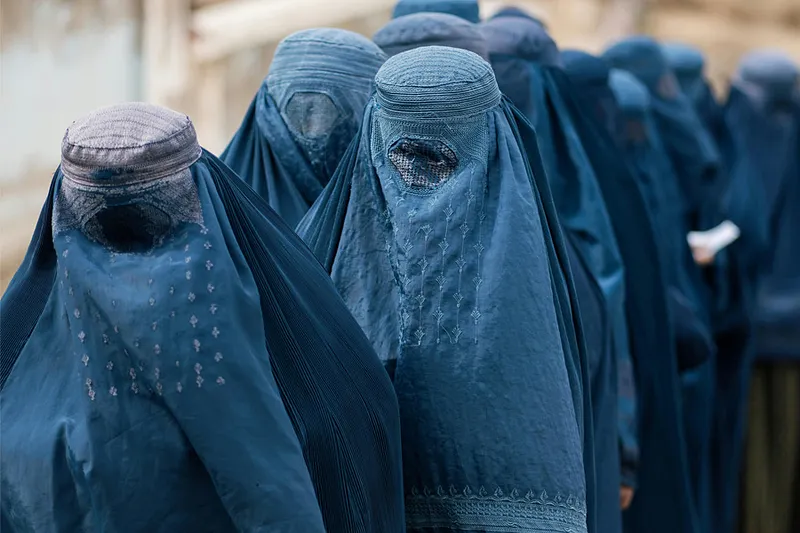
How the regulation of women’s clothing becomes a tool of political control, identity erasure, and resistance in Iran, Afghanistan, and beyond.

When a woman does not hold control over her own body, what she loses is not limited to her clothing choices. On a broader scale, it affects her identity and the power she holds over it.
It was February 2026 when Iran once again became the main topic of international news. After the United States and Israel launched military strikes against Iran on February 28, global attention turned to Tehran and to its people, who have continued to live, resist, and fight under extraordinary pressure.
It was in 2022 that the world mobilised internationally to share the story of Mahsa Amini, a woman who died that September while in the custody of the morality police, after being arrested over alleged improper veiling.
In this political climate, discussing war inevitably leads to a broader discussion concerning women. Despite their political differences and legal systems, countries such as Iran and Afghanistan both prove how the regulation of women’s bodies can become a tool of control.
The social oppression women are subjected to in these environments did not begin when our media started to cover it. It is the direct consequence of decades of political injustices in which women are denied the chance to live normal lives: they are victims of child marriages, excluded from the educational system, and prevented from engaging in society.
Under these circumstances, clothes become a means through which this condition continues to be imposed on them.
The exclusion from society that aims to erase women
Participation in society grants the individual a place inside the public sphere. It is where people are free to express their minds, exchange ideas and, eventually, turn these objectives into real change. Being able to participate in everyday life does not necessarily make you a great citizen, but for starters, it makes you one.
When that right is taken away, the sphere itself no longer feels safe. The individual finds herself not only unwelcome inside it, but banned from it. This condition distances a person from the role she had previously occupied. The connections with the government, institutions and even peers are broken: under this state, there is no respect for those who rule. Fear is the only thing that, if present, keeps voices quiet.
When women’s exclusion from these places began, the goal was to foster an ideology where the woman’s sense of self was dismissed, making her someone unable to contribute to the social system. Many define this relegation as a type of constriction that sees women as second-class citizens, but when a woman’s worth is definable only through the men she is surrounded by and the objectives she fulfils for them, it is hard to even imagine how such ideologies could see the woman as human, let alone as a citizen.
And one of the very first means through which these systems operate is by gaining control over what clothes women can or cannot wear, as before attacking her role in society, these institutions target her relationship with the self.
When what you wear defines your identity
In 2012, researchers Hajo Adam and Adam D. Galinsky coined the term Enclothed Cognition, a psychological phenomenon which suggests that we tend to embody the symbolic meaning of our attire, affecting our internal psychology and performance.
“Clothing allows individuals to convey their personalities, beliefs, and emotions without uttering a single word. How we dress speaks volumes about who we are and how exactly we want to be perceived by the world.”
Clothes are said to be a reflection of one’s identity. They are used to convey current or desired emotions and, furthermore, they become an established means of expression. The body itself is a part of us with which we have one of the most intimate relationships. When one loses power over her own person, this creates a disconnection between mind, will and action.
It is as if the goal was not only to cancel women from public roles, but to make them strangers to themselves as well. Not given the chance to create and express an identity, what remains is a mental absence, alienating them from their own human nature.
Women, Life, Freedom
But while the media have often painted women uniquely as victims in need of saving, those living in Iran, or those able to campaign for its cause internationally, are nowhere near passive individuals.
Women, Life, Freedom is a protest movement that emerged after the death of Mahsa Amini in 2022, bringing within it all the previous fights women had already concretised to protest against their condition.
The movement relentlessly challenges the forms of discrimination and oppression Iranian women have to face. Its very name originates from the Kurdish women’s movement, which has been fighting for women’s rights in the Middle East for decades.
Women and men have taken to the streets to fight for this cause, putting their lives in danger for a future that will hopefully be built on their victories.
In this equation, our role is to keep advocating for these causes, to keep talking about them and to remain open enough to learn what they stand for and why they had to be created in the first place.
To defend women’s clothing choices is not to defend fabric alone. It is to defend the right to inhabit one’s body, to appear in public, and to exist as a full self.
“The control of women’s bodies through clothing is not only a cultural or religious issue, but a political mechanism through which identity, autonomy, and public participation are restricted”
By Rebecca Krizman
Q Voice by QEditorial Magazine — Fashion · Culture · Identity
QEditorial.com


Leave a Reply