
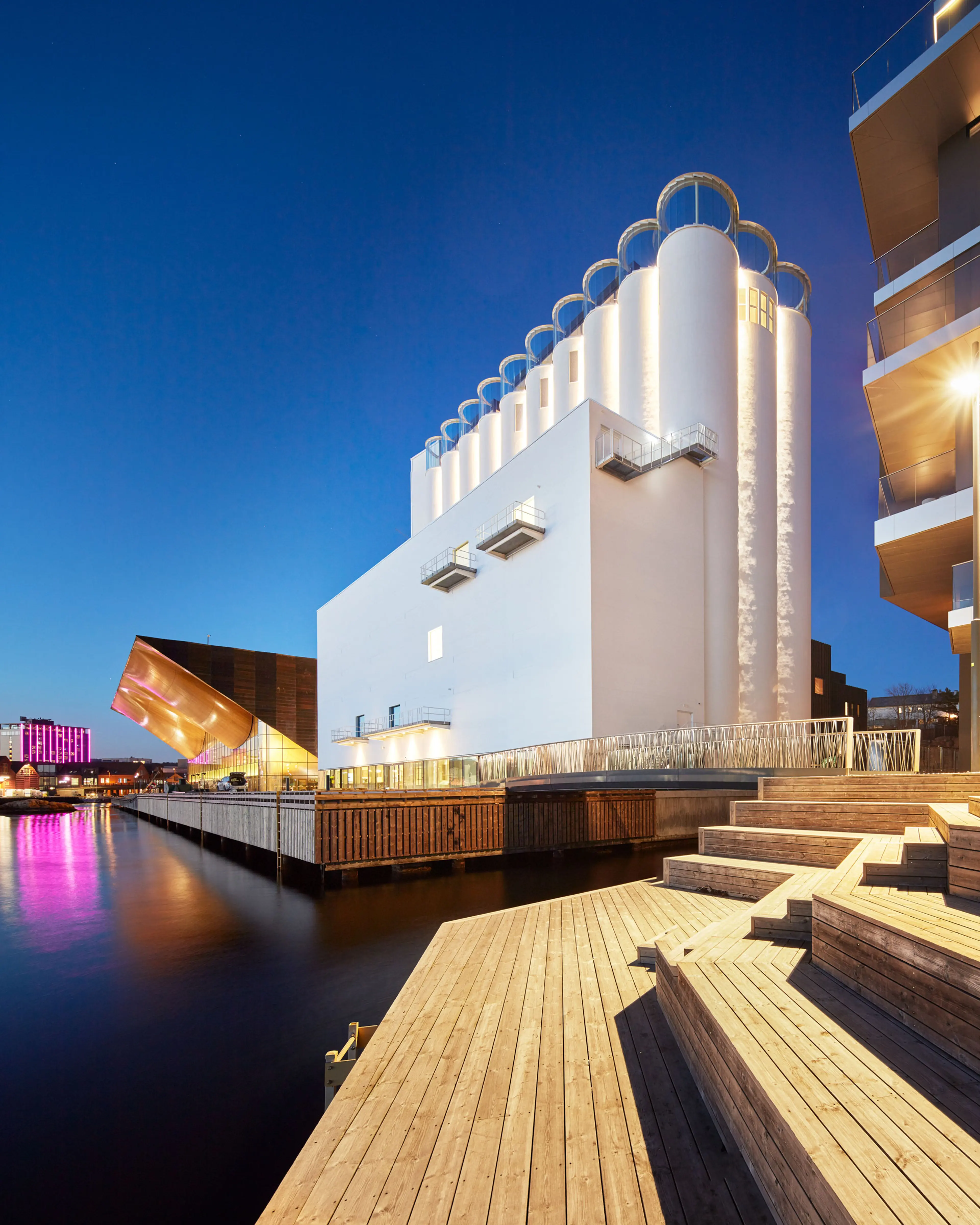
The Norwegian museum that turns a former industrial silo into a home for Nordic modernist art.
At Kristiansand, on the southern coast of Norway, a former grain silo from 1935 has become one of the most fascinating museum projects in Europe. Its name is Kunstsilo, and the word itself already contains its dual nature: art and industry, memory and transformation, functional architecture and cultural vision.
The building is located on the island of Odderøya, in Kristiansand, a place facing the sea and now representing a new cultural destination for those who want to discover a less predictable Norway, far from the exclusive imagery of the fjords and closer to a contemporary sensibility shaped by design, urban regeneration, and Nordic identity.

Kunstsilo was born from the transformation of an old industrial silo built in 1935. Originally, the building was used for grain storage and stood as one of the city’s functional landmarks. Its architecture, severe and vertical, belonged to the language of industry: concrete, cylinders, height, repetition, utility. Today, that same structure has been converted into a museum of modern and contemporary art without erasing the memory of the site. On the contrary, the strength of the project lies precisely here: not hiding its industrial past, but transforming it into an aesthetic experience.
The museum has become one of Scandinavia’s most ambitious cultural institutions. Kunstsilo presents itself as a center dedicated to art, culture, and public experiences, with particular attention to Nordic modernism. According to Visit Norway, the museum hosts three permanent collections and also includes the world’s largest collection of Nordic modernist art.
At the center of this story is Nicolai Tangen, collector, philanthropist, and today Chief Executive Officer of Norges Bank Investment Management, the organization responsible for managing Norway’s sovereign wealth fund. Born in Kristiansand, Tangen has built over more than thirty years one of the most important collections dedicated to Nordic modernist art. His collection, known as The Tangen Collection, includes more than 5,500 works and now represents the heart of the Kunstsilo project.
Tangen’s biography makes the project even more compelling. We are not simply looking at a major private collector, but at a figure who decided to transform ownership into public restitution. Through his philanthropic work and the AKO Foundation, Tangen has tied an essential part of his cultural identity to his hometown. The decision to share a private collection with the public completely changes the meaning of collecting: the artwork does not remain enclosed within an exclusive dimension, but becomes accessible heritage, an educational instrument, and an opportunity for encounter.
The type of art preserved and presented by Kunstsilo is particularly relevant. The museum focuses primarily on Nordic modernist art, with works from Norway, Sweden, Denmark, Finland, and Iceland. It is an artistic landscape often less discussed than French, Italian, German, or American modernism, yet one of extraordinary visual and cultural strength.

Nordic modernism is not only an aesthetic movement. It is a way of looking at the world. Within its languages coexist abstraction, nature, light, landscape, interiority, geometric form, and social sensitivity. Many Nordic artists of the twentieth century worked within a subtle balance between rigor and poetry, between color and silence, between international modernity and local identity. Kunstsilo therefore offers not only a collection, but a perspective: showing how Northern Europe participated in the construction of modernism with its own voice, often more intimate, atmospheric, and psychological.
The museum’s architecture amplifies this narrative. The transformation of the silo is not a simple restoration, nor a cancellation of the original building. It is a form of dialogue. The large cylindrical concrete structures, once connected to agricultural and industrial function, now become part of the museum experience. The visitor does not enter a neutral container, but an architectural body charged with memory. The museum itself becomes an inhabitable sculpture.
This is perhaps Kunstsilo’s most contemporary strength: demonstrating that cultural architecture does not necessarily need to be born from a new and spectacular gesture. It can also emerge from what already exists, from what seemed obsolete, from a forgotten building or one difficult to imagine in a second life. At a historical moment when many cities are searching for new models of regeneration, Kunstsilo offers a powerful answer: transforming industrial heritage into cultural infrastructure.
Kristiansand, in this sense, is not a geographical detail. It is part of the story. A coastal city in southern Norway, traditionally known for its maritime position and relationship with the landscape, Kristiansand now finds in Kunstsilo a new point of international attraction. The museum does not simply bring art into the city; it redefines the image of the city itself. It turns it into a destination, not only a passage. It places it within a broader cultural map where architecture, tourism, and art meet.

Kunstsilo is also an example of how the contemporary museum is changing its function. It is no longer only a space where artworks are observed in silence. It is a place of experience, education, encounter, and public identity. In addition to its permanent collections, the museum hosts temporary exhibitions, events, cultural activities, workshops, and programs dedicated to different audiences. Art is presented not as a distant object, but as a living language.
In this sense, Nicolai Tangen’s gesture takes on an even stronger symbolic value. Donating or making such a vast collection accessible to his hometown means imagining private heritage as a collective responsibility. It is an act of contemporary patronage, but also a cultural declaration: what has value does not necessarily have to remain separate from the public.
Kunstsilo tells many stories at once. It tells the possibility of saving an industrial building without turning it into nostalgia. It tells the strength of Nordic art, often quieter but profoundly intense. It tells the role of a collector who chooses to give back to the community what he has built over time. And it tells of a city that, through a museum, chooses to redefine its cultural presence in Europe.
From a grain silo to a home for Nordic modernist art, Kunstsilo is more than a museum. It is a lesson in transformation. It proves that architecture can preserve memory without standing still, that a private collection can become a public good, and that even a building originally created to contain matter can, a century later, contain imagination.




Leave a Reply