
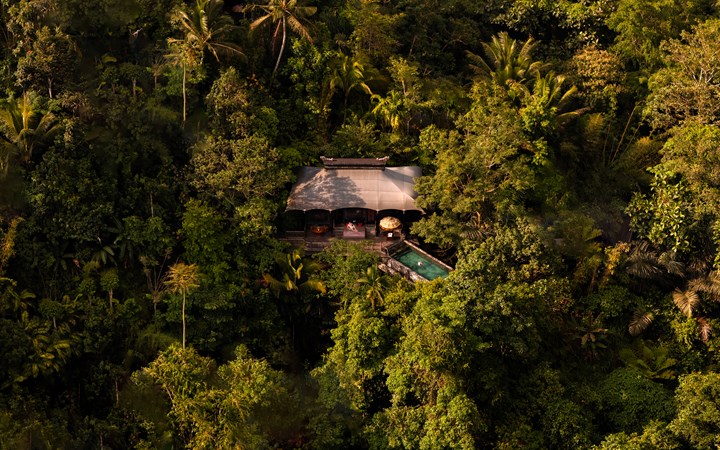
In the rainforest of Bali, Capella Ubud reimagines five-star hospitality as a theatrical dialogue between nature, design, privacy, and cultural memory.

Luxury hospitality is often measured through visibility. The grand entrance. The marble lobby. The panoramic suite. The gesture of arrival.
Capella Ubud, Bali, proposes something different.
Here, luxury does not announce itself from a distance. It hides. It folds into the rainforest. It waits behind foliage, suspended paths, canvas walls, private pools, carved details, copper bathtubs, and the deep green silence of Ubud’s jungle.
This is not a hotel that tries to dominate its landscape. It is a hotel that seems to have made an agreement with it.
Located in the village of Keliki, outside Ubud, Capella Ubud is one of the most distinctive hospitality projects in Bali: a refined tented camp designed by Bill Bensley, the visionary architect and designer known for creating hotels that behave less like buildings and more like stories. Instead of producing another conventional resort, Capella Ubud takes the idea of the jungle camp and elevates it into something theatrical, intimate, and deeply sensory.
The result is a place where hospitality becomes narrative.
Each tent feels like a private world. Not a room, not exactly a villa, but a curated environment suspended between fantasy and memory. The interiors evoke the spirit of nineteenth-century explorers, yet the experience is entirely contemporary: private pools, generous terraces, refined service, and the kind of visual detail that turns every corner into a scene.

But what makes Capella Ubud compelling is not only its design. It is the way the design refuses to erase nature.
The property is hidden among trees and shaped around the existing rainforest. Rather than clearing the land and imposing architecture upon it, the project works with the landscape. This is where the hotel becomes more than a luxury escape. It becomes a statement about what modern hospitality can be when it stops treating nature as decoration and begins treating it as the main host.
There is something important in this idea.
In recent years, luxury travel has increasingly moved away from excess as display. The most interesting hotels today are not necessarily the largest, the most expensive, or the most obviously spectacular. They are the places that create a relationship between guest and environment. They offer not only comfort, but atmosphere. Not only service, but memory.
Capella Ubud understands this perfectly.
The jungle is not a backdrop. It is part of the architecture. The sound of leaves, the humidity of the air, the filtered light, the feeling of privacy, the slight theatricality of canvas and wood — all of it contributes to an experience that feels far removed from the predictable grammar of resort luxury.
This is why the property feels so relevant now.
Hospitality is no longer only about staying somewhere beautiful. It is about entering a point of view. A hotel must have a soul, a rhythm, a reason to exist in that specific place. Capella Ubud could not be moved elsewhere without losing its meaning. Its identity depends on Bali, on Ubud, on the forest, on the tension between wildness and refinement.
That tension is the true luxury.
The guest is not asked to abandon comfort. Quite the opposite. Capella Ubud offers the softness, service, privacy, and detail expected from a five-star destination. But it also asks the guest to listen more closely. To notice the landscape. To accept that luxury can be quieter, stranger, more immersive, and more emotional than a polished room with a perfect view.

In this sense, Capella Ubud belongs to a new language of hospitality: one where the hotel is not separated from culture, landscape, or imagination.
It is not simply a place to sleep in Bali.
It is a place that stages a question: what happens when luxury stops trying to conquer nature and begins to disappear into it?
For QEditorial Hospitality, the answer is clear.
Capella Ubud represents one of the most compelling forms of contemporary escape: not escape from the world, but escape into a more attentive way of seeing it.
Editor’s Note
Capella Ubud reminds us that the future of luxury hospitality may not be louder, taller, or more excessive. It may be more hidden. More rooted. More respectful of place. In the jungle of Bali, hospitality becomes not a performance of wealth, but a choreography of silence, design, nature, and memory.
QEditorial Magazine — Fashion · Culture · Identity – QEditorial.com




Leave a Reply