
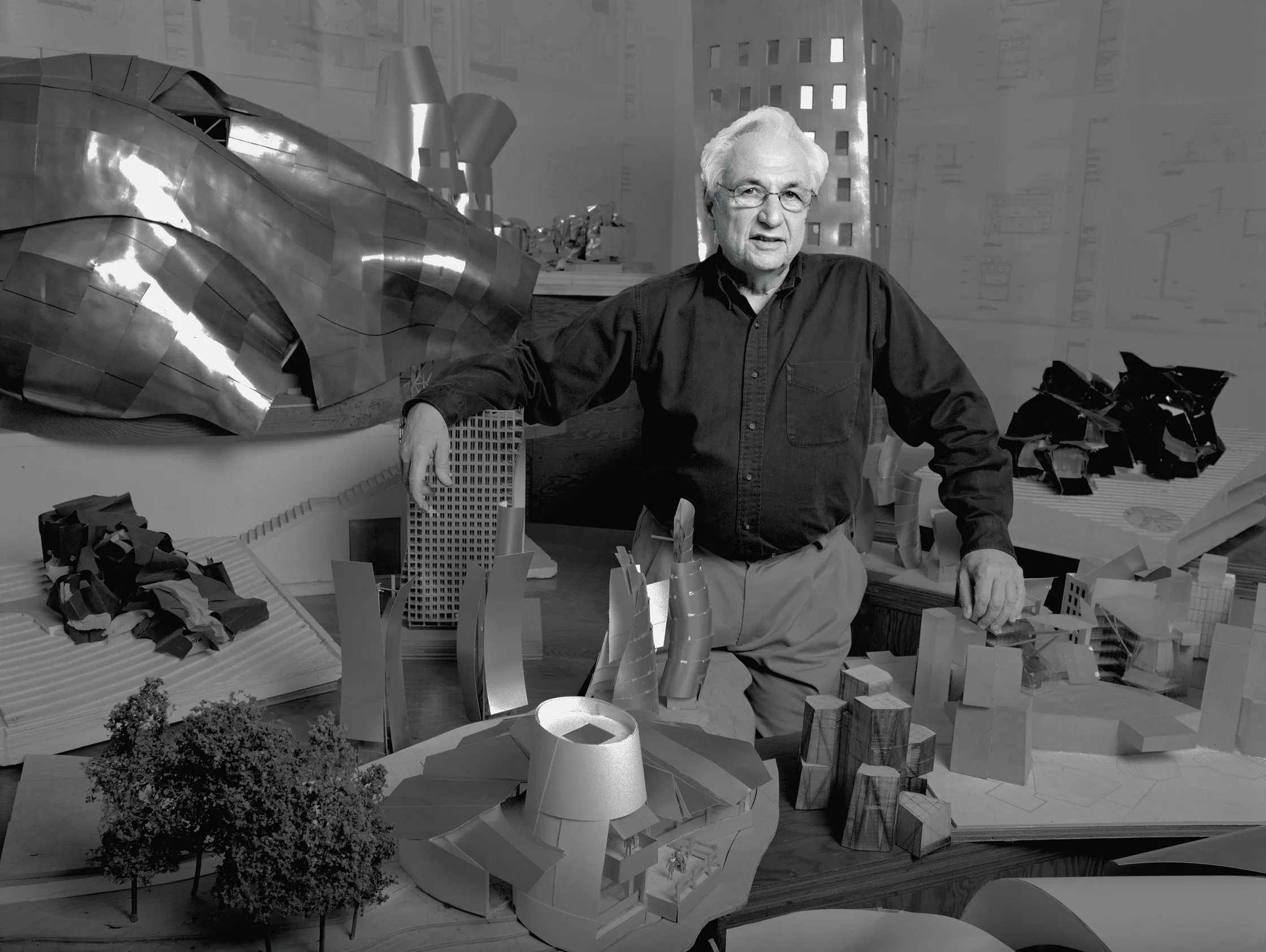
How Frank Gehry transformed architecture from static construction into cultural emotion — reshaping cities, luxury, and the way we experience space.

There are architects who build structures.
And then there are architects who change the emotional vocabulary of entire cities.
Frank Gehry belongs to the second category.
For more than five decades, Gehry has challenged the idea that architecture should simply function. Instead, he introduced something far more radical: movement, unpredictability, and emotion.
In a world often obsessed with symmetry, straight lines, and rational perfection, Gehry dared to ask a different question:
What if buildings could feel alive?
Born in Toronto in 1929 and later becoming one of America’s most influential architects, Frank Gehry never truly followed the rules of conventional architecture. While modernism often celebrated discipline and order, Gehry embraced fragmentation, asymmetry, metallic surfaces, and sculptural experimentation.
His buildings do not merely stand.
They move.
Or at least, they feel as though they do.
Curves collapse into unexpected angles. Titanium reflects changing skies. Glass bends light like fabric. Walls become rhythm rather than boundaries.
Looking at a Gehry building rarely feels like observing architecture.
It feels closer to witnessing sculpture on an urban scale.
Perhaps no project changed global architecture more dramatically than the Guggenheim Museum Bilbao.
When it opened in 1997 in northern Spain, the building did something almost unprecedented: it transformed an entire city.
Bilbao, once known primarily as an industrial center, suddenly became an international cultural destination.
Economists, urban planners, and architects would later call this transformation “The Bilbao Effect” — the idea that architecture itself could reposition a city economically, culturally, and globally.

The museum’s flowing titanium surfaces seemed almost impossible at the time, resembling a ship, a flower, or even moving water depending on the angle and the light.
Yet what Gehry created was more than visual spectacle.
He created emotional memory.
People did not simply visit Bilbao.
They remembered how it felt.
That distinction matters.
Because Gehry’s architecture has always operated in the territory between functionality and feeling.
The same philosophy appears in the Walt Disney Concert Hall in Los Angeles.
Unlike the intimidating heaviness often associated with monumental architecture, the building feels soft, almost musical in itself.
Its metallic forms appear to dance around light, reflecting the energy of performance long before anyone enters the theater.
Years later, Gehry would continue this language in Paris with the Fondation Louis Vuitton — a building appearing almost like floating sails suspended in glass.
The structure feels simultaneously futuristic and poetic, proving again that architecture could exist as both engineering and dream.
But Gehry’s importance extends far beyond iconic buildings.
He fundamentally changed how contemporary culture sees architecture.

Before Gehry, architecture was often discussed through practicality, structure, and permanence.
After Gehry, buildings increasingly became experiences.
Destinations.
Photographic moments.
Emotional symbols.
In many ways, Gehry anticipated today’s visual culture decades before social media existed.
His buildings were never passive backgrounds.
They demanded attention.
They invited interaction.
They became identity.
This influence can even be felt in luxury and fashion.
Much like couture designers manipulate fabric into unexpected silhouettes, Gehry manipulates steel, glass, and concrete into forms that appear fluid and deeply emotional.
It is no coincidence that luxury brands increasingly collaborate with architects and designers capable of storytelling through form.
Architecture, like fashion, no longer simply serves a purpose.
It communicates aspiration.
Emotion.
Belonging.
Of course, Gehry has not escaped criticism.
Some critics argue his buildings prioritize spectacle over practicality. Others see excess where admirers see genius.
Yet perhaps great cultural figures are rarely meant to create consensus.
Their role is disruption.
And Gehry disrupted architecture in ways few architects ever have.
At a moment when cities around the world increasingly risk looking identical — towers repeating the same language of glass and efficiency — Frank Gehry remains proof that architecture can still possess individuality.
That buildings can surprise us.
Challenge us.
Even emotionally move us.
Because perhaps the greatest achievement of Frank Gehry is not that he designed extraordinary spaces.
It is that he reminded us architecture still has the power to make us feel something.

Editor’s Note
Frank Gehry transformed architecture into something rarely associated with buildings: emotion. His work reminds us that cities are not remembered through practicality alone, but through the spaces capable of leaving a lasting emotional imprint. In an era increasingly dominated by repetition and efficiency, Gehry continues to stand as a symbol of creative courage — proving that architecture can still surprise, inspire, and shape cultural identity.
Editorial Image Disclaimer
Images are used solely for editorial, cultural commentary, review, reporting, and informational purposes. QEditorial Magazine does not claim ownership of third-party images, trademarks, or copyrighted materials unless otherwise stated. All rights remain with their respective owners.
If you are a rights holder and believe an image requires updated credit, correction, or removal, please contact QEditorial Magazine and we will review the request promptly.


Leave a Reply