
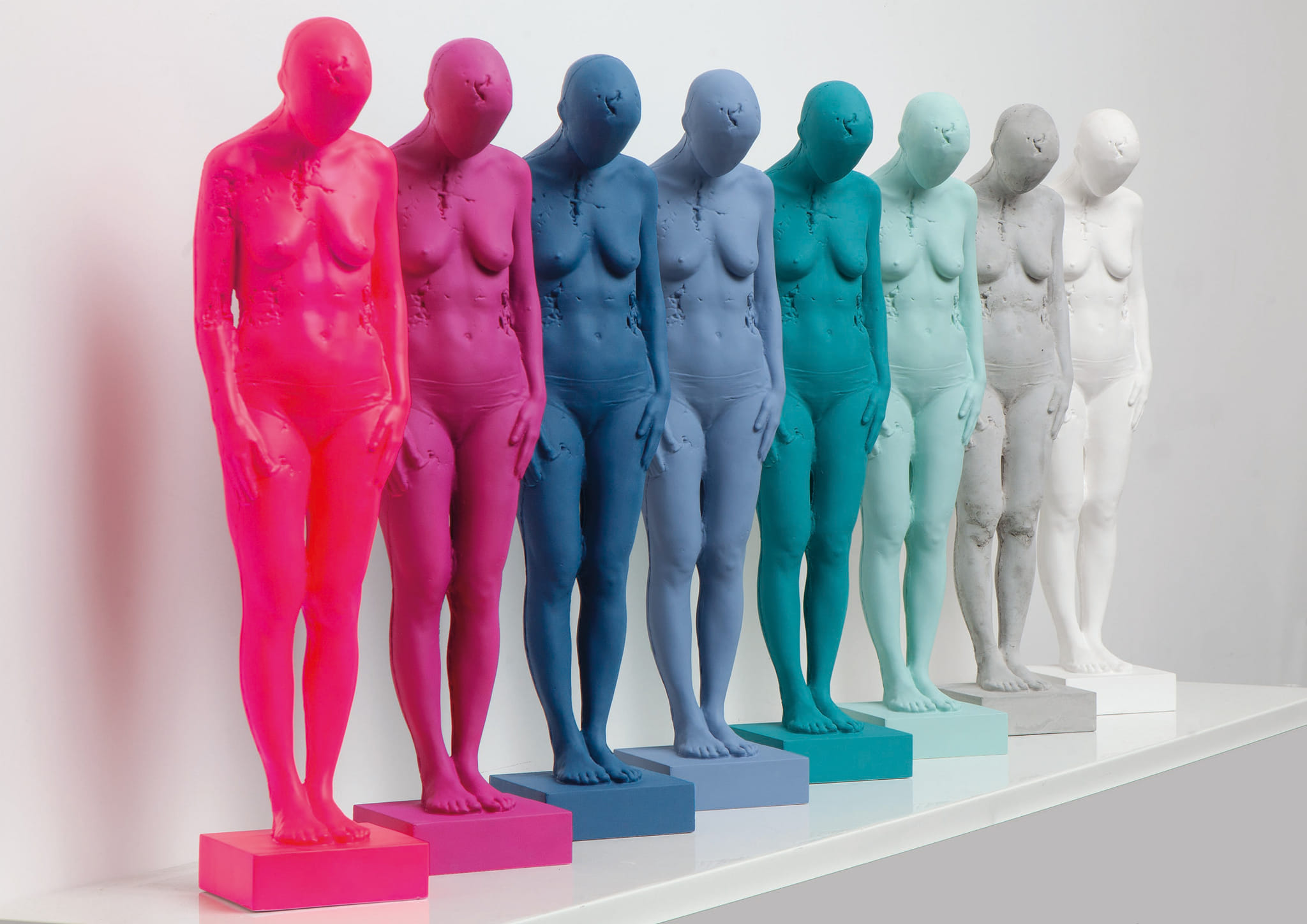

There are artists who create objects.
And there are artists who create presences.
The sculptures of Elia Alunni Tullini do not simply occupy space; they seem to remain inside it like unresolved memories. Silent bodies. Fragmented figures. Human forms suspended between collapse and permanence.
Born in Foligno in 1986 and shaped through years of technical work inside one of Italy’s historic artistic foundries, Tullini belongs to that rare category of contemporary sculptors capable of combining material discipline with philosophical tension. His works are not driven by decoration or aesthetic comfort. They emerge instead from fracture, erosion, absence, and the psychological condition of modern existence.

At first glance, the viewer encounters the body.
But not the classical body.
These are not heroic figures in the Renaissance sense, nor idealized contemporary forms polished into perfection. Tullini’s sculptures appear consumed by time itself. The surfaces crack. Cement fractures. Ceramic skin opens like damaged architecture. Faces dissolve. Identity disappears.
And yet the figures remain standing.
That tension may be the true center of his work.
The human being, in Tullini’s visual language, becomes an unstable structure attempting to survive the emotional and cultural pressure of the contemporary world.
There is something deeply European in this artistic approach. One can sense echoes of Alberto Giacometti in the existential solitude of the figure, traces of Igor Mitoraj in the fractured anatomy, and moments that recall the spatial silence of Antony Gormley. Yet Tullini’s work avoids imitation because its material language feels rooted in a distinctly contemporary anxiety.
His sculptures do not look ancient.
They look post-human.
Matter as psychological language
One of the most compelling aspects of Tullini’s practice is his relationship with materials. Cement, ceramic, bronze, and industrial compounds are not used for purely formal reasons. They function symbolically.
Cement — the material of cities, brutalist structures, and modern expansion — becomes fragile under his treatment. Ceramic behaves almost like wounded flesh. Bronze loses triumphal rhetoric and instead acquires a funerary silence.
The result is sculpture that feels simultaneously archaeological and futuristic.
In many works, the body appears partially dissolved, as if identity itself had become unstable. The figures often lack clear facial definition, suggesting not anonymity as stylistic choice, but anonymity as contemporary condition.
This is perhaps where Tullini’s work becomes particularly relevant today.
We live in an era obsessed with visibility, performance, and constant self-exposure, yet genuine identity increasingly appears fragmented beneath the surface. Social systems demand perpetual presentation, but rarely allow psychological permanence. Tullini transforms this contradiction into physical form.
His sculptures seem exhausted by modern existence.
 And that exhaustion becomes beautiful.
One of his most recognized works, Involucro, presented during the London Art Biennale 2021, captures this philosophy with particular clarity. The figure stands upright yet visibly damaged, almost as if the external shell can no longer fully contain the psychological interior.
The title itself — “Involucro,” meaning shell or casing — suggests protection, but also imprisonment.
The body survives, but only barely.
There is also an important silence in his work. Unlike much contemporary art that depends heavily on conceptual explanation, Tullini’s sculptures communicate emotionally before intellectually. Their presence is immediate. One feels the weight, the fragility, and the isolation before analyzing the theory behind them.
That instinctive reaction is what gives the work its strength.
Between collapse and permanence
What makes Tullini particularly interesting within the current contemporary art landscape is that his work resists visual trend culture. These sculptures do not appear designed for digital consumption or rapid aesthetic gratification. They ask for slowness. Physicality. Observation.
In a cultural moment increasingly dominated by speed and surface, that restraint becomes powerful.
His figures appear almost abandoned by time, yet they continue existing with dignity. Cracked, wounded, unfinished — but still present.
Perhaps that is why they resonate.

Because beneath the material experimentation and sculptural technique lies something profoundly human: the attempt to remain whole inside a world constantly producing fragmentation.
And maybe contemporary sculpture today no longer needs to celebrate perfection.
Maybe it only needs to tell the truth about survival.
Editorial Reflection
There is something unusually honest in the work of Elia Alunni Tullini.
Not optimistic.
Not theatrical.
Not artificially intellectual.
Honest.
Many contemporary artists today attempt to create relevance through provocation, political noise, or visual excess. Tullini moves in the opposite direction. His sculptures feel quieter, heavier, more psychological. They do not scream for attention. They remain still and allow the viewer to confront them slowly.
What impressed me most is the sensation that these figures already carry memory inside them. They feel aged before birth, damaged before completion, almost as if the artist understands that modern identity itself has become structurally fragile.
And perhaps that is precisely why the work feels so current.
Because we are living through an era where people increasingly appear emotionally fractured while trying to maintain perfect external surfaces. Tullini reverses this mechanism. He exposes the fracture openly. The crack becomes part of the form itself.
There is also something deeply Italian in this tension between beauty and ruin. Italy has always existed between permanence and decay — ancient stone, broken architecture, unfinished history, preserved memory. In many ways, his sculptures seem to inherit that cultural atmosphere and translate it into contemporary psychological language.
The result is work that does not simply represent the human body.
It represents the weight of being human today.


Leave a Reply