

From legacy fortunes to cultural capital, New York’s private clubs reveal how architecture, discretion, and curated access continue to shape one of the world’s most powerful cities.
In New York, power rarely announces itself.
Contrary to popular imagination, the city’s most influential circles are not always found beneath flashing chandeliers, velvet ropes, or public spectacle. More often, influence moves quietly — behind unmarked doors, inside softly lit dining rooms, across marble corridors and wood-paneled libraries where privacy itself has become the ultimate currency.
For generations, Manhattan’s old money families understood something essential: true influence thrives best in controlled environments.
Not necessarily in public institutions, but in spaces designed to protect continuity.
Today, the city’s private clubs continue that tradition, though in a transformed way. What was once dominated almost exclusively by legacy wealth — finance dynasties, real-estate empires, philanthropic families, and East Coast social institutions — has gradually expanded to include hedge fund founders, fashion benefactors, cultural gatekeepers, media executives, global entrepreneurs, and discreet international capital.
Yet one thing remains unchanged:
Luxury, in its highest form, still seeks privacy.
Perhaps nowhere expresses this better than Aman New York.
The New Palace of Discretion

Aman New York occupies one of Manhattan’s most strategic addresses: Fifth Avenue, directly within the historic Crown Building. But unlike traditional luxury hotels, Aman operates with an almost paradoxical philosophy — extraordinary opulence hidden behind deliberate silence.
Walking inside feels less like entering a hotel and more like stepping into an ecosystem of controlled calm. Japanese minimalism softens Manhattan excess. Dark woods, stone textures, restrained lighting, private lounges, wellness sanctuaries, and ultra-personalized service redefine what contemporary luxury looks like.
This is not the performative luxury of logos.
It is the luxury of invisibility.
In a city increasingly dominated by overstimulation, Aman reflects the tastes of a world where privacy itself signals status. The circles surrounding spaces like Aman often overlap with international finance, private equity, luxury real estate, global philanthropy, and discreet family wealth — individuals who value access precisely because it remains difficult to obtain.
But New York has never spoken only one language of power.
Downtown, another expression of influence emerged — softer, more European, but equally strategic.
The Return of European Elegance

At Casa Cipriani New York, located inside Manhattan’s restored Battery Maritime Building, luxury feels cinematic.
Casa Cipriani does not merely function as a members club. It stages a particular idea of refinement.
The interiors — designed with quiet grandeur, maritime references, velvet textures, dark woods, warm lighting, and Italian restraint — create a psychological distance from the chaos of the city outside.
Here, hospitality becomes social architecture.
The crowd surrounding Casa Cipriani frequently reflects the intersection between finance families, global investors, hospitality figures, fashion executives, art patrons, and a growing international elite that increasingly moves between Milan, London, Dubai, Paris, and Manhattan.
If Aman feels monastic, Casa Cipriani feels aristocratic.
Its power lies in atmosphere.
Because old money has always understood something fundamental: environments shape relationships.
Deals rarely begin in conference rooms.
They begin over dinner.
Where Influence Becomes Intellectual

Further uptown, Core Club represents another variation of private power.
Core Club feels less theatrical and more curated around intellectual capital.
Designed to attract CEOs, philanthropists, collectors, investors, cultural leaders, and entrepreneurs, Core Club belongs to a different tradition of exclusivity: one based not simply on wealth, but on proximity to ideas and influence.
In spaces like these, modern power increasingly blends legacy capital with cultural intelligence.
The old Manhattan distinction between inherited wealth and earned wealth has become less rigid.
Today’s private ecosystem often rewards those capable of moving seamlessly between both worlds.
The Rise of Cultural Power

Yet New York’s social map has shifted.
Power no longer belongs exclusively to Fifth Avenue institutions.
Increasingly, cultural influence itself has become capital.
At Zero Bond, discretion merges with visibility.
Zero Bond has become emblematic of a new Manhattan elite — one where fashion, entertainment, media, technology founders, investors, and cultural tastemakers increasingly overlap.
Its interiors reject old aristocratic stiffness. Instead, they cultivate intimacy: private dining, controlled access, conversational architecture.
The space feels intentionally designed for relationships.
Nearby, San Vicente West Village, inspired by its California origins, reflects a similarly curated ecosystem.
Inside, quiet luxury replaces spectacle. Privacy policies, soft interiors, controlled visibility, and social selectiveness have become increasingly attractive to high-profile individuals navigating a world of permanent exposure.
Luxury today is no longer about being seen.
Sometimes, it is about disappearing.
From Membership to Cultural Ecosystem
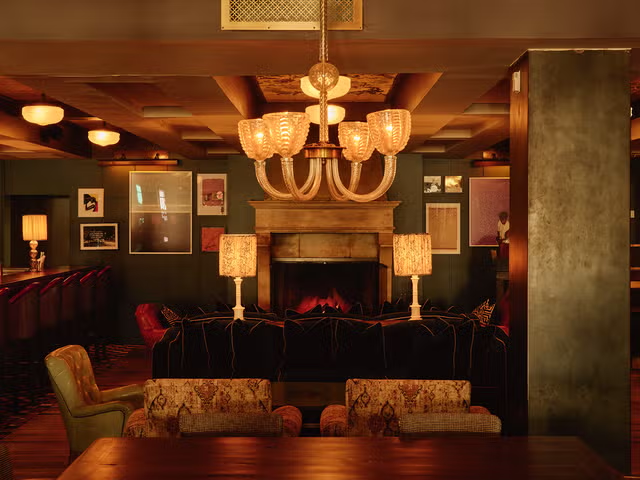
Even historically more accessible clubs such as Soho House Meatpacking and The Ned NoMad reveal an important transformation.
What began as members clubs for creatives evolved into infrastructures for social capital.
At, fashion insiders, editors, filmmakers, photographers, hospitality entrepreneurs, founders, and luxury professionals have increasingly blurred traditional professional boundaries.
Meanwhile, The Ned NoMad merges hotel culture with selective membership, producing an atmosphere somewhere between grand European hospitality and modern entrepreneurial networking.
Even newer concepts such as Branch New York reflect a growing appetite for quieter, more understated forms of luxury networking — less celebrity-driven, more psychologically intimate.
Why Private Clubs Still Matter
The modern obsession with private clubs is not simply about exclusivity.
It is about structure.
Historically, old money families relied on institutions — universities, foundations, museums, philanthropic boards, clubs, and social circles — to maintain continuity across generations.
Private clubs were never merely places to drink cocktails.
They functioned as invisible infrastructures of trust.
And perhaps this is why they continue to fascinate today.
Because despite technology, despite social media, despite changing economies, Manhattan still rewards one ancient principle:
Relationships matter.
And the rooms where relationships are built often shape cities far more than the towers surrounding them.
Editor’s Reflection
Luxury often appears loud from the outside. But historically, the most enduring forms of wealth have spoken softly.
Perhaps this is what New York’s private clubs continue to teach us: true power rarely performs itself. It simply learns how to remain in the room.


Leave a Reply