
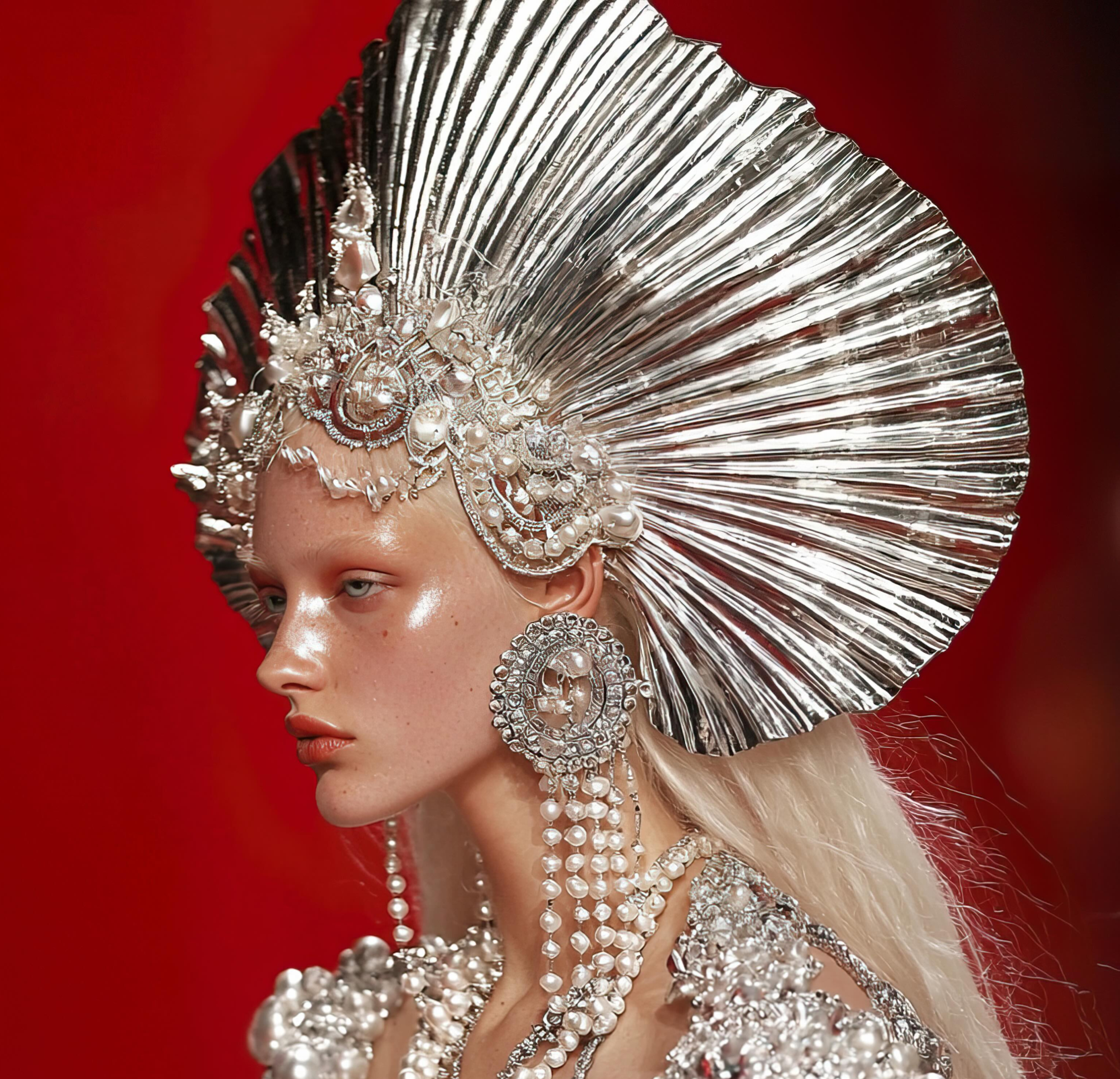
How Chen Foye turns feathers, structure, and fantasy into a sculptural language of contemporary wearable art.

Some garments are designed to dress the body. Others are created to transform it.
The work of Chen Foye, an emerging self-taught designer whose visual world moves between couture, sculpture, fantasy, and performance, belongs clearly to the second category. His pieces do not seem interested in fashion as simple clothing. They operate instead as wearable objects: dramatic, fragile, theatrical, and deeply constructed.
At a moment when fashion increasingly risks becoming repetitive, algorithmic, and aesthetically predictable, emerging creatives working outside traditional systems often become the most compelling voices. Among them, Chen Foye appears as a designer building a language of his own — one where the garment is not only worn, but staged, observed, and almost ritualized.
Rather than following the familiar vocabulary of luxury fashion — logos, commercial silhouettes, seasonal repetition — Chen Foye’s work approaches clothing as an artistic object. His practice feels closer to visual storytelling than to product design. Through intricate handmade construction, dramatic volumes, feathered surfaces, and sculptural forms, the pieces seem suspended between movement and stillness, delicacy and power.

What makes Chen Foye compelling is not only the final image, but the visible presence of process. Mannequins, studio fittings, hand-finished structures, experimental surfaces, and garments in construction suggest a practice built through physical making rather than digital illusion alone. In an age saturated with visual fantasy, this material evidence gives the work a different kind of weight.
Through his Feather Couture Collection, shared on his official Instagram profile, Chen Foye describes a body of work crafted entirely by himself in 2026, after extensive research into garment structures, construction, and hand-finishing. The result is a language where feathers become architecture, fabric becomes atmosphere, and the body becomes almost ceremonial.
There is something mythological in these garments. A red look unfolds like a theatrical apparition, occupying the body with the presence of a ritual costume. A white skeletal dress suggests biomorphic architecture, almost as if the garment were growing from an imaginary anatomy. A black sculptural silhouette feels closer to a dark botanical creature than to a conventional evening gown. Other pieces move between angelic softness, fantasy portraiture, and couture spectacle.

This is where Chen Foye becomes interesting within today’s cultural conversation around fashion. His work exists at the border between fashion and art, between garment and sculpture, between body and image. It does not follow the commercial rhythm of luxury branding. It feels personal, obsessive, and still in evolution.
Fashion history has often shown that some of the most memorable creative voices are those willing to move beyond usefulness. Designers such as Alexander McQueen transformed fashion through theatrical construction and emotional intensity, while Iris van Herpen pushed garments toward sculptural futurism, blurring the line between couture, technology, and art. Chen Foye’s work may be operating on an entirely different scale, but the instinct to push clothing beyond utility into artistic expression belongs to a similar creative impulse.
What makes emerging designers especially compelling is not perfection, but vision. In Chen Foye’s case, the appeal lies in the refusal to play safely. The garments do not feel commercially compromised; they feel deeply personal. They suggest experimentation still unfolding — an aesthetic language still being discovered in real time.
At QEditorial Magazine, we often speak about fashion not merely as industry, but as identity, culture, and visual storytelling. Designers like Chen Foye remind us that fashion can still surprise us when it stops trying to sell first and starts trying to say something.
Not every important creative language begins inside a major fashion house or an established school. Sometimes it begins in a studio, around a mannequin, through trial, patience, and the desire to create something that does not yet have a fixed category.

For QEditorial Magazine, Chen Foye represents exactly the kind of emerging visual voice worth observing: not because the work is already fully defined, but because it is alive, ambitious, and unmistakably searching for its own mythology.
Editorial Note
With this article, QEditorial Magazine approaches Chen Foye’s work not simply as experimental fashion, but as a visual exploration of the body, materiality, and imagination. His creations suggest a direction in which garments cease to function merely as clothing and instead become wearable art, sculptural couture, theatrical presence, and personal language. In a fashion landscape often dominated by repeated aesthetics, Chen Foye represents an emerging fashion designer worth observing: not yet defined by the system, yet precisely because of this, capable of restoring to avant-garde fashion a sense of risk, fantasy, and transformation.
QEditorial Magazine — Fashion · Culture · Identity



Leave a Reply