

When a sailing yacht is no longer only a vessel, but a floating palace, a private nation, and the most silent expression of contemporary wealth.

There is a particular kind of luxury that does not need to arrive loudly. It appears on the horizon as a silhouette, almost unreal, cutting through the sea with the calm authority of something that was never designed to ask for permission. In the world of superyachts, few objects express this idea more radically than Sailing Yacht A, the 142.81-metre sail-assisted superyacht built by Nobiskrug and designed by Philippe Starck. According to BOAT International, the yacht was delivered in 2017, has a top speed of 21 knots, accommodates up to 20 guests, and carries 54 crew members — numbers that place it less in the category of boat than in the territory of private architecture.
To call it “the most luxurious sailing yacht” is both accurate and incomplete. Luxury, at this level, is not simply marble, leather, rare woods, or private suites hidden below deck. It is scale. It is engineering. It is the ability to turn the sea itself into private space. Sailing Yacht A is frequently discussed as one of the largest and most expensive sailing yachts ever built, with Reuters reporting its value at approximately €530 million when Italian authorities seized it in 2022 after sanctions against Andrey Melnichenko. That event gave the vessel a second identity: not only as an object of design, but as a political symbol of wealth, ownership, visibility, and vulnerability.

Its form is deliberately strange. Unlike the romantic schooners of the old world, Sailing Yacht A does not try to look nostalgic. It does not perform maritime heritage in the language of polished brass and varnished tradition. Starck’s design is almost alien: smooth, monumental, minimal, and coldly futuristic. It looks less like a yacht and more like a private embassy from a future where billionaires build their own myths. In this sense, the yacht becomes a perfect expression of modern power: not inherited quietly, but engineered, staged, protected, and made visible from miles away.
The luxury of a sailing yacht has always been different from the luxury of a motor yacht. A motor yacht suggests speed, dominance, fuel, arrival. A sailing yacht carries another symbolism: discipline, knowledge, elegance, control over nature without appearing to fight it. The sail is one of the oldest technologies of human movement, but on a vessel like Sailing Yacht A, it becomes almost ceremonial. The yacht is not merely moved by the wind; it transforms wind into theatre.
This is why the modern super-sailing yacht matters culturally. It connects aristocratic leisure to contemporary capital. The great villas of the past were built on land, surrounded by gardens, servants, gates, and social codes. Today, for the ultra-wealthy, the sea has become another estate. A yacht is mobile land. It can appear in the Mediterranean during film festivals, disappear into private anchorages, host dinners, protect privacy, and project status without ever needing a permanent address.

The closest contemporary counterpoint is Koru, the 125.8–127 metre three-masted sailing yacht built by Oceanco and associated with Jeff Bezos. BOAT International describes Koru as the flagship of the Oceanco fleet and the largest Dutch-built superyacht in the world at the time of delivery, while Y.CO frames it as a symbol of renewal inspired by the Māori koru motif.
Where Sailing Yacht A feels futuristic and almost severe, Koru returns to a more classical idea of maritime prestige: a dark hull, long lines, three masts, and the romance of the grand schooner. But even this romance is strategic. A yacht of that scale cannot be innocent. It becomes a moving announcement of economic power, one that appears wherever power already gathers: the Caribbean, the Mediterranean, Cannes, Venice, St Barths. YachtCharterFleet notes that Koru represents one of the largest sailing yachts in the world, with an internal volume of about 3,300 GT and a three-masted schooner profile.
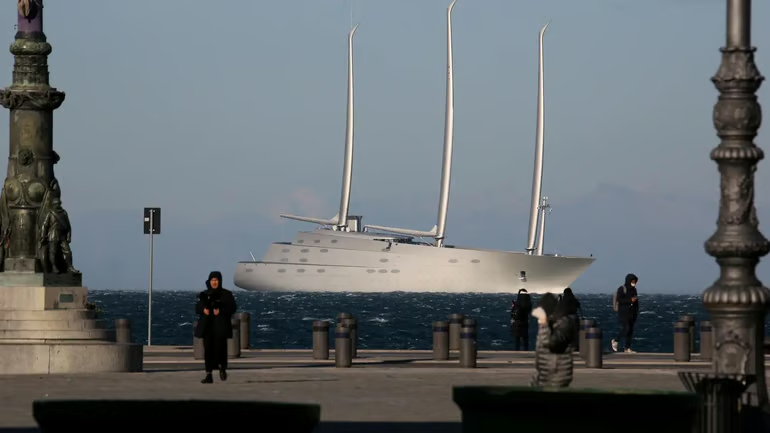
The difference between Sailing Yacht A and Koru is the difference between two languages of wealth. Sailing Yacht A speaks in abstraction, technology, and intimidation. Koru speaks in heritage, symbolism, and public mythology. One looks like an object designed to erase tradition; the other looks like a billionaire’s attempt to inherit it.
But both confirm the same truth: at the very top of luxury, possession is no longer enough. The object must become narrative. It must say something about the owner before anyone steps on board. It must be photographed from helicopters, tracked by yacht media, discussed in financial newspapers, and interpreted as design, scandal, architecture, engineering, and social theatre all at once.
The most luxurious sailing yacht, then, is not only the one with the largest hull, the highest price, or the most secret interiors. It is the one that changes the atmosphere around it. Sailing Yacht A does this with almost brutal clarity. It is not beautiful in the traditional sense. It is imposing. It is not discreet. It is silent, but impossible to ignore. That contradiction is exactly what makes it contemporary luxury.
Because true power today rarely shouts. It floats.

Editor’s Reflection
A sailing yacht is one of the rare objects where luxury becomes almost philosophical. Unlike a car, a watch, or even a private jet, it does not simply move through the world; it withdraws from it. It creates distance. It transforms water into territory, silence into status, and privacy into one of the highest forms of power.
What makes Sailing Yacht A so compelling is not only its size or price, but its refusal to appear ordinary. It does not try to be charming. It does not romanticize the past. It stands as a floating monument to a new kind of wealth: architectural, protected, almost untouchable, yet constantly visible. In this contradiction lies the essence of contemporary luxury. The richest objects today do not merely serve their owners; they become symbols through which the world reads power.
Perhaps this is why the sailing yacht remains such a powerful image. It suggests freedom, but also hierarchy. Escape, but also control. Beauty, but also domination. And at sea, far from the noise of land, luxury reveals one of its oldest truths: the ultimate privilege is not only to possess something rare, but to occupy a world that others can only observe from a distance.
QEditorial Magazine → qeditorial.com


Leave a Reply