

There was a time when luxury fashion dictated aesthetics from above.
Visual culture moved through a relatively controlled system: runways, magazines, galleries, elite tastemakers, advertising campaigns. Major fashion houses created the image, and the rest of culture eventually followed.
Today, that hierarchy feels far less stable.
Increasingly, luxury observes the internet itself. It watches independent artists, visual creators, digital communities, and the aesthetics that emerge organically from social platforms. The source of influence is no longer always institutional. Sometimes, it begins with one artist, one visual language, one image repeated until it becomes part of the collective imagination.
The recent online discussion surrounding Werner Bronkhorst and several Louis Vuitton leather accessories reflects this shift with remarkable clarity.
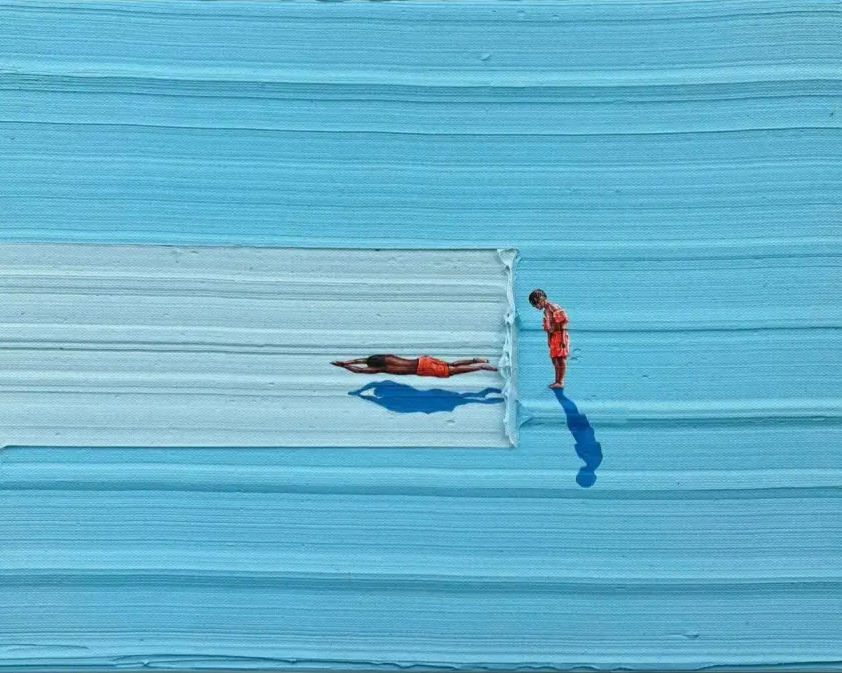
Bronkhorst, a South African-born Australian contemporary artist, is known for a highly recognizable visual language: miniature hyper-realistic figures placed inside vast textured surfaces. His worlds are quiet, spacious, almost suspended. Small human bodies appear within large abstract landscapes, creating a tension between presence and emptiness, intimacy and distance, playfulness and solitude.
It is a language that feels immediately contemporary.
His figures are tiny, but the emotional space around them is enormous. They seem to move through surfaces the way people move through modern life: visible, active, yet often overwhelmed by scale.
This is why his work travels so well through the digital world. It is visually immediate without being simple. It can be understood in a second, but it lingers much longer. In the visual economy of Instagram, that is a rare form of power.
The conversation around Louis Vuitton began because many viewers noticed a strong visual resemblance between Bronkhorst’s artistic language and certain Louis Vuitton small leather goods featuring miniature figures placed across large patterned or seasonal surfaces. Pink leather became a playful landscape. Snowy scenes became miniature worlds. The accessory appeared less like a simple object and more like a tiny narrative environment.
At the time of writing, there does not appear to be an officially announced collaboration between Werner Bronkhorst and Louis Vuitton.
And that is precisely what makes the discussion interesting.

The question is not only whether an image was copied, referenced, inspired, or coincidental. The larger question is how luxury now absorbs visual codes that are born outside its own traditional system.
Because today, fashion and art no longer move in separate rooms.
They frequent the same environments. They appear in the same feeds. They speak to the same audience. They are consumed through the same visual rhythm.
A painting, a campaign image, a collectible handbag, a digital artwork, a gallery installation, and a runway look now coexist within one continuous stream of images. The public does not always separate them by discipline. Instead, it reads them through mood, atmosphere, composition, and identity.
This is where Bronkhorst becomes an important case study.
He represents a new type of contemporary artist: independent, digitally visible, aesthetically consistent, and culturally fluid. He is not only producing artworks. He is producing a world.
His background also matters. Before becoming widely recognized, Bronkhorst worked as a bespoke furniture designer and craftsman in Sydney. That past is visible in the physical quality of his surfaces. His paintings are not simply flat images. They feel built. They carry weight, texture, material presence. The canvas becomes almost architectural, a constructed environment where tiny figures can live, play, wander, or disappear.
This is one of the reasons his work feels so compatible with fashion and design. It already thinks like an object. It understands surface. It understands scale. It understands the emotional power of material.

And luxury understands those same things.
A leather wallet, a handbag, or a silk scarf is never only functional in the world of luxury. It is a surface of identity. It is an object that carries narrative, status, memory, and atmosphere. When an artist’s visual language enters that space, the object becomes more than accessory. It becomes a portable artwork, or at least a fragment of a visual universe.
This is why the connection between art and fashion is no longer decorative. It is structural.
Luxury brands do not simply look to art for beauty. They look to art for cultural depth. For tension. For aura. For the feeling that an object belongs to a world larger than commerce.
At the same time, contemporary artists increasingly behave like maisons. They build recognizable codes. They curate their public image. They release works almost like collections. They cultivate audience, scarcity, storytelling, and emotional continuity.
In this sense, art and fashion are no longer opposites.
They are two languages moving through the same cultural architecture.
The Werner Bronkhorst and Louis Vuitton discussion reveals this new reality very clearly. Whether one interprets the resemblance as inspiration, coincidence, or appropriation, the reaction itself proves something important: audiences are now visually literate enough to recognize an artist’s code. They can see when a luxury product appears to echo a language already established elsewhere.
That recognition changes the balance of power.
In the past, independent artists often needed institutions to validate them. Today, a strong visual language can gain public recognition before the institution arrives. Social media has made audiences into witnesses. It has made influence traceable, debatable, and immediate.
This does not mean every resemblance is theft. Fashion has always borrowed, translated, referenced, and reinterpreted. Art has done the same. Culture itself is built through echoes.
But in the digital age, those echoes are no longer invisible.
They are screenshotted, compared, discussed, and circulated.
That is why this conversation matters beyond one artist and one maison. It points to a broader cultural tension: luxury wants the freshness of independent creativity, but independent creativity increasingly demands recognition.
And rightly so.

Because visual language is authorship.
Bronkhorst’s miniature figures are not merely a style. They are a worldview. They express a particular way of seeing the human figure in relation to space, surface, scale, and silence. To borrow that language without acknowledging its source would raise a much larger question about how fashion engages with artists in the age of digital visibility.
The strongest luxury collaborations have always understood this. They do not erase the artist. They amplify the artist. They allow two worlds to meet without one consuming the other.
That is the difference between collaboration and absorption.
And perhaps this is the real lesson.
Fashion and art can share the same room. They can speak to each other, influence each other, and create extraordinary cultural objects together. But when they do, authorship matters. Context matters. Recognition matters.

Because in a world where everything becomes image, the origin of an image becomes even more important.
Werner Bronkhorst’s work reminds us that scale is never only visual. It is cultural.
A small figure on a large surface can say something profound about the contemporary condition. A tiny person in a vast landscape can become a symbol of how we all move through modern life: visible, connected, exposed, yet still searching for place.
And when luxury begins to borrow that language, intentionally or not, it reveals just how powerful independent artists have become.
They are no longer outside the system.
They are shaping the atmosphere the system wants to inhabit.
Editor’s Reflection
Perhaps the most interesting part of this story is not whether fashion was inspired by art.
Fashion has always borrowed from art. Art has always influenced fashion. That relationship is centuries old.
What feels different today is where influence begins.
For a long time, visual culture moved through institutions: galleries, magazines, ateliers, museums, established creative circles. Now, influence can emerge from a single artist working independently, building an audience image by image inside the digital landscape itself.
That shift changes everything.
Artists like Werner Bronkhorst do not simply create artworks. They create atmospheres powerful enough to enter the broader visual culture surrounding fashion, luxury, design, and media. Their work travels quickly because it already understands the emotional language of the contemporary image: silence, scale, isolation, texture, and visual immediacy.
And perhaps this is why so many people immediately recognized echoes of his work when looking at certain luxury accessories. Not because audiences have become more critical, but because they have become more visually aware.
We now live inside a culture where aesthetics circulate faster than ever before. Inspiration, influence, homage, and appropriation often exist dangerously close to one another. The internet has not only accelerated creativity — it has made authorship more visible.
At the same time, this conversation also reveals something important about contemporary luxury itself. Modern luxury no longer searches only for beauty. It searches for atmosphere, emotional identity, and cultural relevance. And increasingly, independent artists are becoming the source of those worlds.
Perhaps that is the real transformation taking place.
The artist is no longer outside the luxury conversation.
The artist is becoming part of the language luxury uses to describe itself.


Leave a Reply