
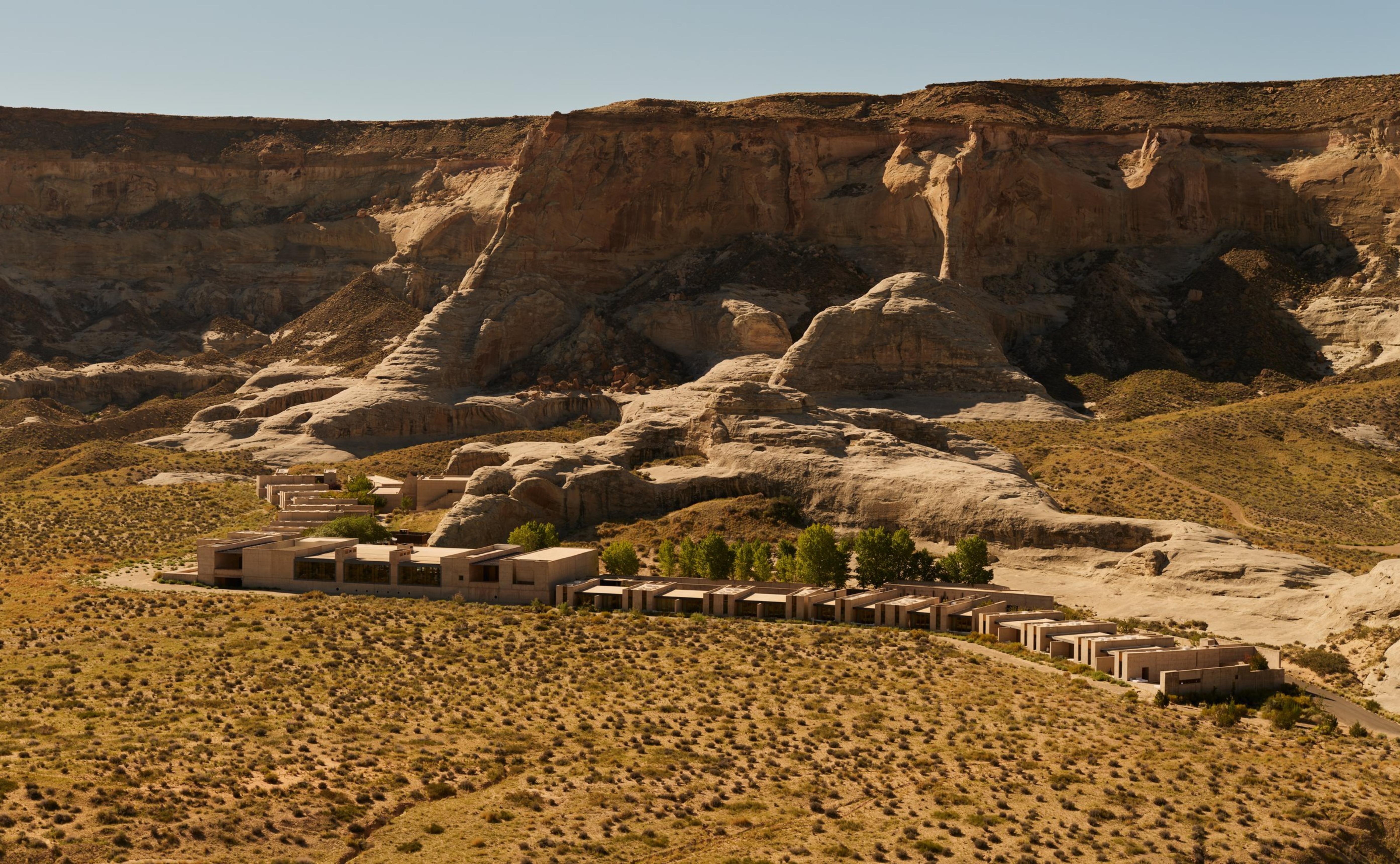
Amangiri does not seduce through excess. There are no chandeliers competing for attention, no theatrical opulence, no obsession with spectacle. Instead, it offers something increasingly rare in modern luxury: silence.
Hidden among the desert landscapes of southern Utah, near the borders of Arizona, Amangiri exists almost as an architectural mirage — emerging from rock, light, and emptiness rather than imposing itself upon them.
For many travelers, it has become one of the most exclusive luxury hotels in America. Yet to understand Amangiri only through exclusivity would be to misunderstand it entirely.
This is not luxury as performance.
This is luxury as disappearance.

The Architecture of Silence
Designed to disappear into the desert rather than dominate it, Amangiri feels closer to contemporary land art than traditional hospitality.
Its minimalist geometry, warm concrete, and monumental stillness reflect an almost spiritual relationship between architecture and landscape. Massive sandstone formations remain untouched, integrated into the hotel’s design as if nature itself became interior decoration.
Perhaps its most iconic feature is the central swimming pool, wrapped around an ancient rock formation — not as an act of visual drama, but of reverence.
At Amangiri, space itself becomes the luxury.
Large suites open toward uninterrupted desert horizons. Windows frame emptiness like paintings. Silence becomes texture.
The absence of distraction begins to feel intentional.
Almost therapeutic.
Luxury Beyond Visibility
Modern luxury culture often confuses wealth with visibility.
Louder fashion. Bigger logos. Faster cars. More performative consumption.
Amangiri proposes the opposite.
Its appeal belongs to a different cultural language — one aligned with what fashion increasingly calls quiet luxury, though perhaps the phrase no longer feels sufficient.
Because this is not merely understated wealth.
It is emotional restraint.
The hotel attracts celebrities, founders, designers, and cultural figures not necessarily because they seek visibility, but because they seek invisibility.
Privacy here becomes its own form of status.
In an era of overstimulation, disappearing into the desert may be the greatest privilege luxury can offer.

The New Luxury Is Wellness
Amangiri also reflects another major transformation happening inside global luxury culture: the shift from possession to wellbeing.
Travel is no longer simply movement.
It has become emotional restoration.
The resort’s wellness philosophy combines spa rituals, desert meditation, hydrotherapy, and movement experiences shaped by landscape and silence.
The desert itself becomes part of the therapy.
A kind of emotional architecture.
This may explain why destinations like Amangiri increasingly dominate searches such as best luxury hotels USA, exclusive desert resort, wellness luxury travel, and most unique hotels in America.
Travel today is increasingly psychological.
People are no longer escaping cities.
They are escaping noise.

Why the Desert Became the New Luxury Fantasy
There is something culturally fascinating about the rise of desert luxury.
For decades, luxury hospitality was defined by abundance: oceans, palaces, capitals, and spectacle.
Today, many of the world’s most desired destinations feel radically different.
Isolation.
Stillness.
Minimalism.
The desert, once perceived as absence, has become aspiration.
At Amangiri, emptiness itself becomes design language.
Nothing feels accidental.
Not the silence.
Not the distance.
Not even the sense of disconnection.
Because perhaps true luxury in 2026 is not access to more.
Perhaps it is permission to disappear.

Editor’s Reflection
Luxury once promised excess.
Today, the most intelligent forms of luxury promise clarity.
Amangiri reminds us that beauty does not always need ornament, and that silence — in a world built on endless attention — may have quietly become the most exclusive luxury of all.
QEditorial Magazine — Fashion · Culture · Identity → qeditorial.com



Leave a Reply