
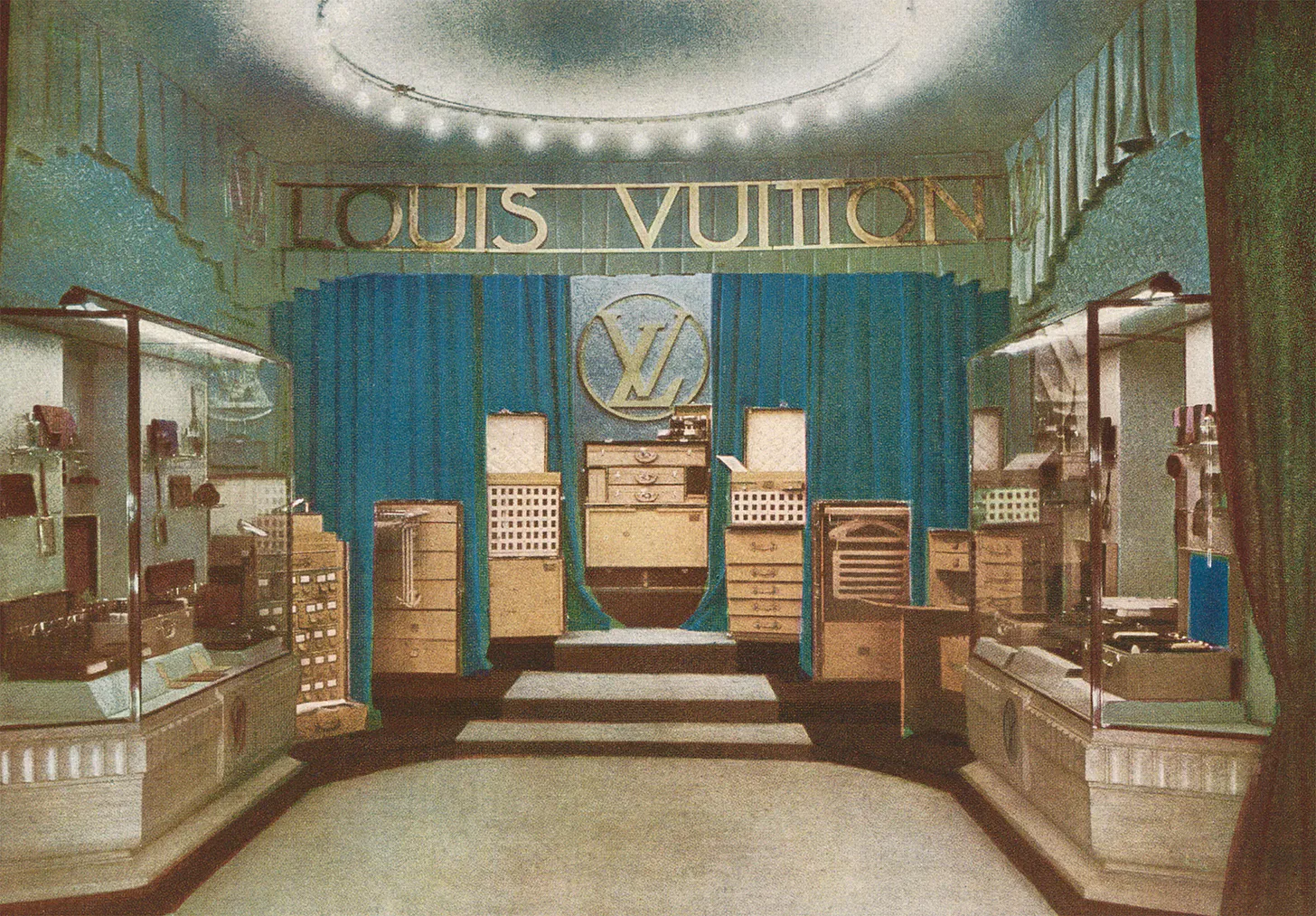

Luxury rarely begins as spectacle.
More often, it begins as usefulness refined to such a degree that function itself becomes elegance. Before Louis Vuitton became a global emblem of status, identity, and aspiration, it belonged to another world entirely: the world of travel. Not travel as leisure in the contemporary sense, but travel as ritual, distance, preparation, and social distinction. In the nineteenth century, movement required not only means, but equipment — and among the great symbols of that world stood the trunk. It was there, in that universe of carriages, steamships, and trains, that Louis Vuitton built the foundations of what would become one of the most enduring empires in luxury history. Louis Vuitton’s own history notes that the young Louis arrived in Paris in 1837 and apprenticed in a world where baggage had to endure rough handling across horse-drawn carriages, boats, and trains.
What Vuitton understood early was something far more important than style alone:
luxury must solve a problem before it becomes a symbol.
In 1854, he opened his first store in Paris. Just a few years later, in 1858, he introduced the flat-topped trunk covered in grey Trianon canvas — a radical departure from the rounded trunks of the period. Rounded trunks had been designed so rain could slide off them, but they were inconvenient to stack. Vuitton’s flat trunks, by contrast, were lighter, more practical for transport, and perfectly suited to the new age of organized travel. That innovation was not merely aesthetic. It was structural. It aligned the brand with modernity itself. Official brand history and collecting references alike identify the flat, stackable trunk and Trianon canvas as the decisive early breakthrough that changed travel luggage.
This is where Louis Vuitton becomes more than a house of leather goods.
It becomes an idea.

But true luxury houses do not survive on invention alone.
They survive because they know how to defend identity.
As Vuitton’s trunks became more visible, they also became more imitated. The Maison responded not with retreat, but with visual language. After the original Trianon canvas came striped canvases in the 1870s, then the Damier canvas in 1888, introduced in part to combat copying. Later, in 1896, Georges Vuitton created the Monogram canvas in honor of his father — a gesture that would become one of the most successful acts of branding in fashion history. What began as protection against imitation evolved into one of the most recognizable visual signatures in the modern world. Louis Vuitton’s heritage timeline documents the striped canvases, patents, and later developments, while Christie’s similarly traces the progression from Trianon to Damier as part of the house’s anti-counterfeiting and identity-building strategy.
This is one of the central reasons Louis Vuitton has dominated for so long:
it understood earlier than most that luxury is not only craftsmanship — it is recognizability.

A great luxury house must be immediately identifiable without becoming static. It must preserve its codes without becoming imprisoned by them. Vuitton mastered this balance. The Monogram did not remain a relic of the nineteenth century. It became a language that could migrate across objects, decades, geographies, and generations. It could live on a trunk, then a handbag, then a travel bag, then a sneaker, then an object somewhere between art and fashion. It could signal heritage while constantly re-entering the present. Recent coverage of the Monogram’s 130th anniversary underscores how the 1896 design continues to be reinterpreted today through anniversary collections and archival revival.

And that is perhaps Vuitton’s greatest talent:
it never confuses continuity with repetition.
Many houses survive by preserving the past.
Louis Vuitton survives by staging the past as something still active.
Its history is not hidden in museums alone. It is reinserted into circulation. The house has repeatedly transformed archival memory into contemporary relevance, allowing travel heritage, trunk-making, canvas codes, and artisanal legitimacy to return not as nostalgia, but as renewed desire. This is why Vuitton can move through eras without appearing obsolete. It does not abandon its origins. It edits them.
Over more than a century, the world changed beyond recognition.
Travel changed. Class structures changed. Media changed. Fashion itself changed. The meaning of luxury changed.
And yet Vuitton remained.
It remained because it was never tied only to one product category. Though rooted in luggage, it expanded from trunks into handbags, accessories, ready-to-wear, jewelry, and a larger cultural universe. But this expansion worked because the house retained a central myth: travel, movement, and the disciplined elegance of carrying one’s world with you. Even when the customer was no longer boarding a steamship or crossing Europe by rail, the Vuitton object continued to suggest mobility, distinction, and arrival. The symbolic world remained intact even as the real world transformed.
What Louis Vuitton demonstrates better than almost any other house is that luxury endurance is not accidental.
It is strategic.
A brand does not dominate markets for a hundred years simply because it was first, nor because it was expensive, nor because it was famous. It dominates because it learns how to remain legible to each era without dissolving into it. Vuitton has repeatedly understood the visual and cultural temperature of its time. It has known when to preserve rigor, when to invite artists, when to embrace celebrity, when to lean into street culture, when to monumentalize heritage, and when to reframe classic symbols for a new generation. The result is not timelessness in the naive sense. It is something more difficult: controlled evolution.

This is the difference between an old brand and a lasting one.
An old brand has history.
A lasting brand knows how to use history.
Louis Vuitton never ceased to be associated with craftsmanship, but it also understood that modern luxury lives not only through making, but through image, collaboration, cultural placement, and scale. It became not merely a French leather house, but a global mechanism of desire. And still, beneath the surface of fashion spectacle, the original logic remains visible: precision, transport, construction, identity, protection, and the transformation of necessity into beauty.
That is why Vuitton’s story matters beyond fashion.
It is a lesson in how power is built aesthetically. A lesson in how utility becomes mythology. A lesson in how a house rooted in trunks could become a dominant force in modern luxury without severing itself from its first gesture. The brand did not survive by denying change. It survived by absorbing it without surrendering its center.
From the interior discipline of travel goods to the exterior theater of the luxury market, Louis Vuitton did what very few houses have managed to do: it made reinvention look like heritage.
And perhaps that is the truest definition of luxury endurance —
not to remain unchanged, but to remain unmistakable.

“Louis Vuitton did not conquer time by standing still. It conquered time by teaching heritage how to move”
Selected by the Editor
Where luxury is designed for Shiba Inus and their people.

For selected advertising and editorial partnerships, contact contact@qeditorial.com


Leave a Reply