
Black and white has never been merely a chromatic choice. Throughout the history of art, it has often become a declaration. An apparent renunciation of color that, precisely through subtraction, allows the image to become more intense, more mental, more absolute.
When an artist chooses black and white, they are not simply removing a part of reality. They are choosing to concentrate the gaze. They eliminate the superfluous, reduce distraction, and bring the viewer face to face with the essential structure of the work: line, shadow, volume, gesture, emptiness.

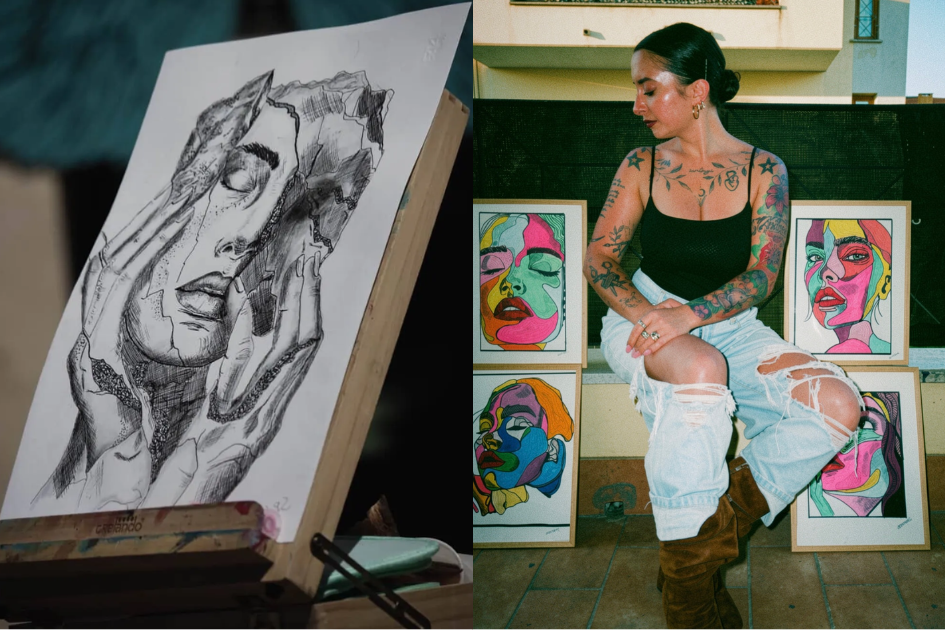
It is within this long visual tradition that we can also read the work of Alessia Mazzarella, known artistically as Artesia, and her exhibition Black & White. Not as an isolated aesthetic exercise, but as part of a broader language, one explored by many artists before her and now reinterpreted through a personal, contemporary, emotional sensitivity.
Black and white has always carried a particular force because it belongs both to memory and to the unconscious. We can think of ancient engravings, preparatory drawings, twentieth-century photography, posters, film noir, early war images, portraits that seem to live more in the mind than in reality. Before being color, an image is light and shadow.
In this sense, black and white does not impoverish the work. On the contrary, it makes it more severe. More direct. More difficult to hide.
Artists such as Francisco Goya, with his darker and more visionary works, showed how the absence of color can become unease, tension, confession. In Goya, darkness is not merely a background: it is a moral, almost psychological presence. Black becomes the place of nightmare, fear, and human fragility.
Later, Pablo Picasso, with Guernica, used a palette made almost entirely of white, black, and gray to transform historical suffering into a universal image. Color might have made the work more descriptive. Black and white, instead, makes it definitive. Like a wound impressed upon collective memory.
In the twentieth century, artists such as Franz Kline brought black and white into a gestural, almost architectural dimension. His large black brushstrokes on white backgrounds do not describe a body or a landscape, but an energy. Gesture becomes structure. Contrast becomes force.
Pierre Soulages, too, through his research on black, demonstrated that black is never a simple color. It can absorb, reflect, hold, and return light. In his work, black becomes living matter, surface, depth. Not the end of vision, but the beginning of another form of vision.
Black and white, therefore, crosses the history of art as an autonomous language. It does not belong to a single movement or a single era. It can be tragic, elegant, violent, spiritual, graphic, mental, erotic, silent. It depends on how the artist uses it.
And this is precisely where the work of Alessia Mazzarella finds its place.
In the image for the exhibition Black & White, the human figure seems to emerge from an interior territory. The face is turned upward, almost suspended between surrender and resistance. The body is not treated as simple anatomy, but as an emotional surface. Shadows move across the skin, signs build tension, and flowers introduce a poetic fragility that does not completely soften the image, but makes it more ambiguous.

The body, in her work, never appears entirely pacified. It is a body crossed by something. By thoughts, symbols, shadows, by something that seems to rise from the inside toward the outside. The figure is not simply represented: it is almost revealed.
Here, black and white becomes essential. If there were color, perhaps the eye would stop at decoration, at immediate beauty, at the surface. Instead, the monochromatic choice forces the viewer to enter the construction of the image. To follow the lines. To observe where the black thickens. To understand where the white allows the figure to breathe.
The result is a work that lives through contrast, but not only in a visual sense. The contrast is also emotional: delicacy and unease, femininity and wound, nature and body, silence and tension.
In this, Alessia does not use black and white as a simple style. She uses it as an interior filter. As if the world, in order to be truly understood, first had to be stripped of the noise of color.
It is a mature choice, because black and white does not forgive easily. Every line becomes more evident. Every mistake carries more weight. Every empty space must have a function. In a monochromatic work, one cannot hide behind a seductive palette. What remains is only the mark.
And Mazzarella’s mark is interesting precisely because it seems to unite control and instinct. On one side, there is a strong graphic construction, almost illustrative; on the other, a more visceral tension, as if the image were trying to escape its own form. The floral details, the shadows on the face, the darker areas of the body create a composition that is not simply decorative, but narrative.
It tells something. Even without saying it openly.
The exhibition Black & White can therefore be read as a small poetic declaration: black and white is not nostalgia, it is not limitation, it is not lack. It is possibility. It is the territory in which the artist can remove everything that distracts and leave standing only what resists.

In a time dominated by hyper-colored, immediate, fast images, often constructed to be consumed in a matter of seconds, the work of Alessia Mazzarella asks for a different kind of time. It asks for attention. It asks for silence. It asks the viewer to pause before a face, a line, a shadow.
And this, today, is already an artistic position.
Editor’s Reflection
What is striking in the work of Alessia Mazzarella is not only her choice of black and white, but the way she manages to use it without making it feel cold.
Many artists choose black and white for elegance, drama, or synthesis. Alessia seems to use it instead as an emotional language. In her lines, there is something fragile, but also decisive. The figure is never left entirely to decorative beauty: it is crossed by a deeper intensity.
It is precisely this ability that makes her work interesting. Alessia knows how to use black and white not as the absence of color, but as the presence of feeling. Black becomes shadow, weight, depth. White becomes breath, space, vulnerability. Between these two poles, she builds images that speak of body, identity, transformation, and memory.
Her talent lies in understanding that black and white does not have to explain everything. It must leave something suspended. It must allow the gaze to enter, but not to completely possess the image.
And it is there, in that space between what is seen and what remains hidden, that her work finds its strength.



Leave a Reply