
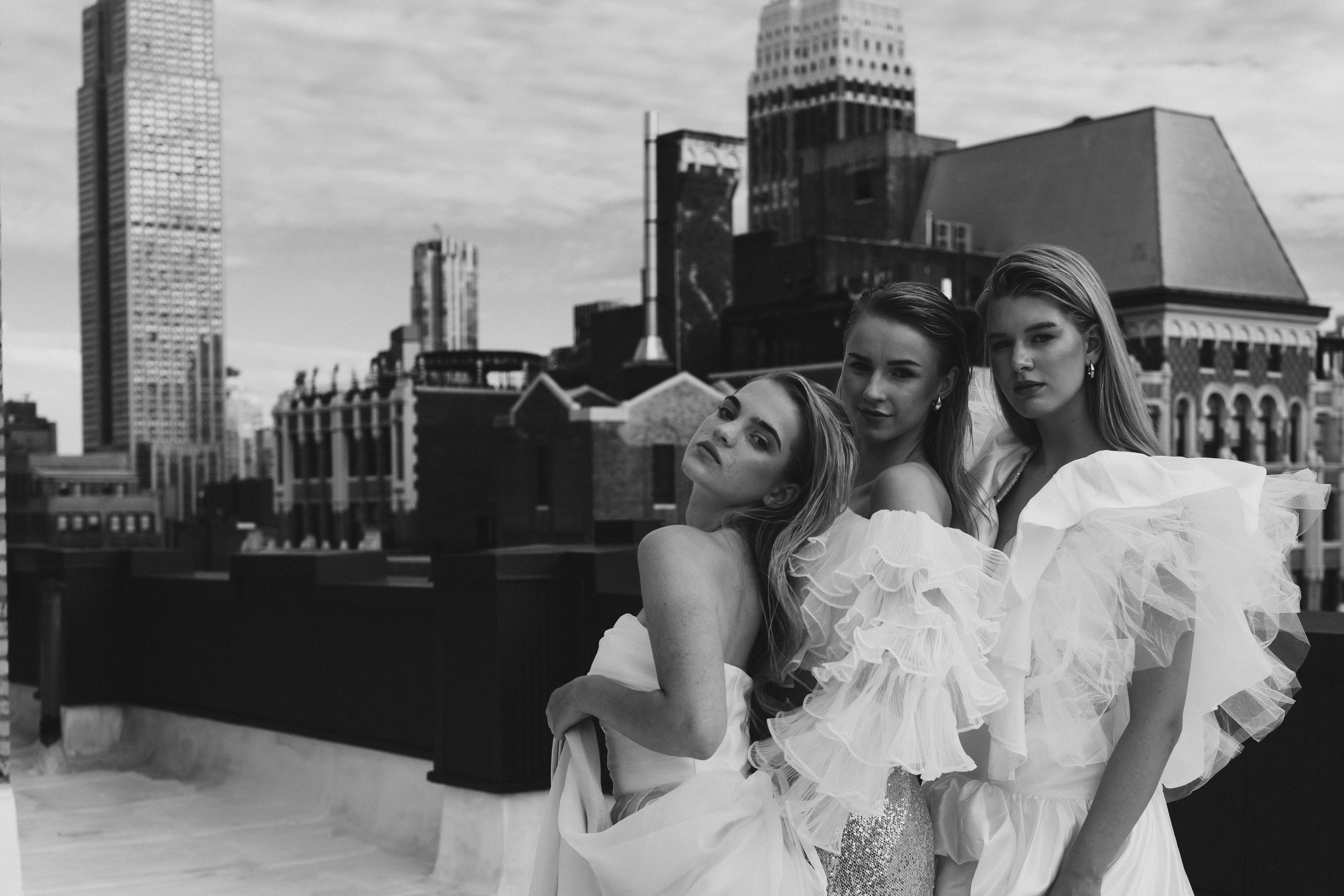
On his first New York Fashion Week, the photographer known as Monsieur Alpha found the rooftop he had imagined for years, the people behind fashion’s finished images, and a reason to keep looking after losing his camera.
By QEditorial

Less than twelve hours after landing in New York, Tiago Santos was standing on a rooftop with a camera in his hands. A model was in front of him; behind her, the skyline extended into the distance. He had pictured this photograph long before he knew whether he would ever have the chance to make it.
“I had arrived in New York to photograph Fashion Week,” he tells QEditorial, “and almost immediately, I was standing on a rooftop doing exactly what I had always imagined I would one day do.”
There is a difference between recognizing a city from films and photographs and having to decide where to place a person within it. Santos had come to New York after photographing fashion in Lisbon, Paris and Milan. He knew the pace of a fashion week. What he did not know was what this city would ask of his eye.
Photography entered Santos’s life only about three and a half years ago. He had studied watchmaking in Switzerland, worked in events and later run a bar in Portugal. After the pandemic altered that world, he began teaching himself to photograph through books, videos, experiments and the encouragement of people around him. Fashion, which had interested him for years, gave the new practice a direction. Within roughly a year of picking up a camera, he was photographing Paris Fashion Week.
The name Monsieur Alpha predates all of it. It began as a nickname when he was seventeen or eighteen, with a French inflection drawn from years around French-speaking culture in Switzerland. Santos recognizes that “Alpha” can sound like a claim of superiority. For him, it describes the impulse to take initiative and make a path when one is not already laid out. Photography gave that older name a new language.
QEditorial asked what he hoped to discover in New York after working in other fashion cities. His answer was more precise than adding another destination to a portfolio. He wanted to see what would happen when his European perspective met a city with its own architecture, cultural history and way of staging fashion.
The first rooftop photographs show that encounter in its clearest form. The model does not stand in front of a generic city backdrop. Her presence, the light and the buildings compete and cooperate within the frame. Santos remembers the force of her expression and the layers of streets and towers receding behind her. For him, the image records the instant an imagined New York became a place where he could actually work.

Yet the skyline was only one version of the city he found. In his account, the settings chosen by designers and the spaces he used for editorials became part of the clothes themselves. He photographed Andrew Kwon’s presentation inside a church and worked with Studio Rima and Michelle Ferrer on images made around New York, including a Brooklyn Bridge editorial. Architecture did more than establish location. It changed the scale, light and emotional temperature of each image.
That observation leads to a question at the center of our conversation: what does a photographer contribute when a fashion show has already been constructed to be seen?
Santos is drawn to the hours before the finished image. Backstage, he watches people occupied with different tasks: a hand correcting a garment, someone attending to hair or makeup, a model waiting, a designer taking a final look. The audience may later see one composed procession. He sees the many separate acts that allow it to happen.
“I am there without really being there,” he says of moving through that environment. Sometimes people notice him; sometimes they do not. He waits for a moment that may last only a second.

It would be easy to call these moments candid and leave it there. Santos is making a more considered choice. A close view of a hand or an expression gives the viewer another way into fashion’s authorship. The garment remains important, but so do the people whose work may disappear once it reaches the runway.
That is why his meeting with Japanese nail artist Airi Yamada stayed with him. They met through Fashion Week and began talking about more than nails. He was struck by the care and craftsmanship in work that could easily remain outside the spotlight, despite contributing to the image everyone eventually sees.
Santos mentions other people from the week too: photographer Diego Echevers; Charel, experiencing her first Fashion Week as a photographer; Diana Claudia Lechon, whom he knew from Paris and Milan; and the designers and teams with whom he collaborated. He resists choosing a single person to stand for the experience. Fashion Week, in his telling, is a temporary convergence of crafts, cultures and careers.
We asked Santos about the photograph he nearly missed. He did not describe a dramatic accident backstage. He described waiting for a model’s eyes.
There is, he says, a silent exchange between photographer and subject. The look may arrive for a fraction of a second, when the expression changes and the composition comes together. He has learned that a photograph does not always depend on ideal light or a perfectly controlled setting. Sometimes its timing is the entire point.
The same attentiveness carried him beyond the shows. After Fashion Week, Santos stayed in New York for several days and walked without a fixed destination, a habit he had developed in Tokyo. He photographed and made short films as he moved between streets, buildings and quieter spaces. Later, looking through the work, he recognized that shoots with young freelance models in Chinatown, Little Italy and around Central Park mattered to his memory of the trip as much as the official events.
For the middle image of his Fashion Week story, though, he chooses the Brooklyn Bridge. He remembers working there in the middle of the night, with few people passing and the city’s lights continuing behind the model. The picture he describes is about immersion: a photographer who arrived with an image of New York in his mind finding himself inside a scene he could not have arranged alone.
Then the week broke its rhythm. During a Fashion Week event, Santos’s camera equipment was stolen: camera, lenses, flash, tripod and other tools essential to his work. He was across the Atlantic from home and suddenly unable to do the job he had travelled to do. He later saw surveillance footage showing the equipment being taken. It was not recovered.
The loss was financial, but it also cost him time. Santos says he missed around three days of content, collaborations and shows while he processed what had happened and began replacing his gear with help from his savings, family and friends. There is no reason to turn that interruption into a convenient lesson. It was painful, expensive and disruptive.
What followed nevertheless changed his understanding of the people around his work. Colleagues in New York urged him to come to shows even without a camera and to make content with his phone. Friends and family called. A photographer friend in Portugal suggested a fundraiser, which Santos initially hesitated to start; his sister helped him take that step. The contributions did not replace everything, but the response showed him that people who followed his photographs were willing to stand beside the person who made them.
“I lost my tools, but I didn’t lose my ability to create,” he says. The statement does not diminish the loss. It identifies what the theft could not take.
Santos returned from New York with another, quieter realization. At one runway, he stood about a metre to the left of other photographers gathered for the same image. He heard comments about how close he was to them. When he reviewed the photographs, his frames were different. He makes no claim that they were better. The slight shift allowed more context, another arrangement of color and light, another way of seeing the same event.
“Sometimes one metre is enough.”
It is an idea that reaches beyond camera position. On this first New York Fashion Week, Santos looked a little to the side of the finished spectacle: toward the person preparing a model, the craft held in a small detail, the city outside the venue and the community that appeared when he could no longer work as planned. The collections and collaborators remain part of the story. His photographs ask us to see the relationships that hold their images together.
He hopes to return to New York. He also wants to spend more time photographing Japan, make another book after publishing one drawn from his work there, and perhaps follow the preparations surrounding a Met Gala appearance. Cinema increasingly informs the horizontal compositions and moving images he creates. None of those ambitions yet has a fixed form.
For the final photograph of this story, Santos chooses Andrew Kwon’s show: fashion, people and the atmosphere of a New York church brought into one frame. It is a return to the runway, but our way of looking at it has changed. We have seen the work before the entrance and the life that continued beyond the show.

Santos arrived expecting to photograph New York Fashion Week. Looking back, he says he had left more of himself in the city than he realized at the time. The rooftop image was the dream he brought with him. The photographs that followed belong to a city he came to know by walking through it, working within it, losing something there and finding people who helped him continue.
Editor’s Note
It has been a pleasure to collaborate with Tiago Santos and discover the talent behind Monsieur Alpha. Through his photographs and our conversation, we encountered a perspective attentive to both fashion’s spectacle and the people who bring it to life. We are pleased to share his work and the curiosity, sensitivity and determination that shape his way of seeing.
Discover more of his work on Instagram: @monsieur.alpha.photo
QEditorial
Fashion · Culture · Identity

Photography Credits
All photographs by Tiago Santos / Monsieur Alpha.
Instagram: @monsieur.alpha.photo

Leave a Reply