In an exclusive interview with QEditorial Magazine, Giorgio Casu discusses his return to Sardinia after twenty years abroad, the rediscovery of his roots, his public artworks and his artistic direction of Casa Clàt inside Cagliari’s restored Palazzo Frau.
In an exclusive conversation with QEditorial Magazine, the Sardinian artist reflects on New York, the rediscovery of his roots, the works he has given back to his island and the transformation of Palazzo Frau into Casa Clàt.
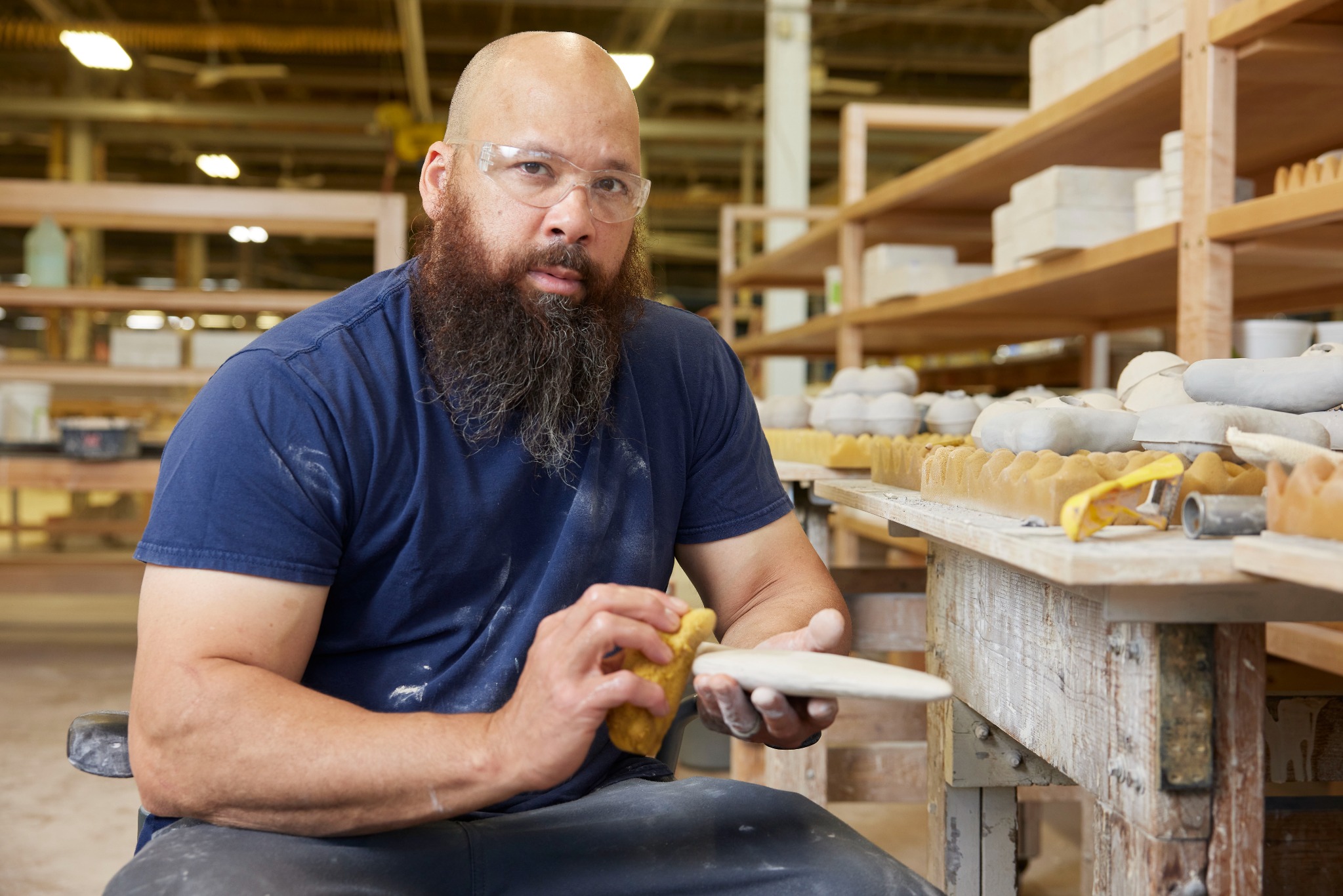
Giorgio Casu. Courtesy of the artist.
When Giorgio Casu returned to Sardinia in 2018, the journey changed scale. The visual language he had carried through England, Australia, Southeast Asia, Mexico and New York began to enter the streets, coastlines and interiors of the island where he was born. San Gavino Monreale became an open-air laboratory for contemporary muralism. Sant’Antioco received monumental steel installations shaped by its maritime identity. In Cagliari, the restored rooms of Palazzo Frau allowed Casu to bring his work into architecture, directing an artistic project that reaches through every environment of Casa Clàt.
His return has produced works conceived for public life and given back to Sardinian communities. Murals have entered the daily geography of his hometown. Sculptures now stand beside the lagoon and the sea. Inside a nineteenth-century palazzo, guests sleep, eat and move through environments in which painting, ceramics, furniture and architecture belong to the same artistic vision.
In this exclusive interview with QEditorial Magazine, Casu describes his return as a renewed encounter with an identity he once tried to escape.
“I lived outside Italy and Sardinia for twenty years, and in a sense I wanted to shake off such a strong culture because I felt it was a limitation. I began travelling because I wanted to become something else, something that would be nourished and improved by discovering new places and cultures.”
Distance altered that perception. “Sardinia was always beside me because those who are born here preserve an intimate bond with their land. Sardinia creates very strong roots.”
Those roots became more visible after he came home. “I have awakened them in my art more recently,” Casu tells QEditorial Magazine. “The island has an ancient and beautiful heritage. Knowing that I can contribute to enriching it is deeply rewarding, even if I do not make extremely traditional work.”
Learning to Read Images
Born in San Gavino Monreale in 1975, Giorgio Casu studied Education Sciences at the University of Cagliari, following a sociological programme that led him towards teaching, mental-health work and art therapy with adults and children.
He describes education as “an extraordinarily interesting profession that reaches the soul.” His years working in mental-health centres and secondary schools shaped the way he observes the relationship between people and images.
“Relating to different realities opens an infinite world. Communication means finding the signs we share, what unites us and makes us feel like a community, part of the same world.”
That experience remains visible in Casu’s public work. He listens while an image is taking shape. Collaborators, residents and passers-by can influence the process, although he retains responsibility for its direction. “Every suggestion or observation can be useful when creating a public work because it gives you a sense of what other people see.”
Becoming Jorghe
The name Jorghe emerged after university, when Casu began painting coconut shells collected from restaurants belonging to friends in the Medio Campidano area. He sold them to finance his summers and occasional journeys, signing Giorgio in a different language on each piece.
Jorghe remained when he moved to England. “It stayed naturally, partly because it is not written that way in any culture. It gave me the feeling that I could express myself in a unique and original way.”
“Jorghe is an instinctive, colourful artist who does not care about labels. He paints because he enjoys painting and enjoys what he paints.”
Giorgio Casu inside Casa Clàt. Courtesy of the artist.
His visual vocabulary developed through travel and study. Images often begin with something briefly encountered: an animal, an unexpected landscape, the memory of a colour or a composition seen years earlier.
“Sometimes an armadillo suddenly appears from a bush in Costa Rica, and I feel that it will be my next painting,” he tells QEditorial Magazine. “It will have very strong colours borrowed from the language of Eighties video games and an improbable perspective perhaps taken from a Dalí painting.”
Painting, murals, photography, performance, ceramics, textiles and design each require their own discipline. “What remains recognisable is the energy. However differently my works may unfold, the energy that generates them is always the same. Sometimes they may appear to be the work of different artists. That is the price of freedom.”
New York and the Education of Space
Casu began working inside restaurants and private homes in England and Australia between 2003 and 2007. The work acquired a different scale in New York, where greater budgets brought greater responsibility. He decorated an apartment at the Plaza valued at approximately $60 million and worked across entire interiors in Gramercy Park. He later developed projects for hotels, beach clubs and restaurants in Tulum, Mexico.
“Every project was different, every requirement was different and every client had different dreams,” he says. “The vocabulary never stops growing, and it continues to refine its accents.”
New York became his base from 2007. His portrait of Barack Obama was shown at the White House in 2010, while his work moved through galleries, performances, publications and private commissions. Those years taught him how an artwork changes when it must coexist with furniture, movement, architecture and the private rituals of daily life.
The Island as a Public Canvas
Through Non Solo Murales, Casu helped bring local and international artists to the façades of San Gavino Monreale, contributing to an open-air collection that now includes more than one hundred works.
Public art enters the streetscape through a painted staircase. Courtesy of the artist.A mural transforms the exterior of a building in Sardinia. Courtesy of the artist.
“San Gavino is my hometown, where I lived for the first twenty-six years of my life, so it has played an especially important role among the projects I am developing,” he says. “The town has changed enormously since we began the project. There is still a great deal to do.”
A public artwork enters directions, meeting places and collective memory. It becomes familiar enough to be embraced, questioned or disputed. Casu accepts that friction as part of the work. In 2025, U OU, a monumental egg in corten steel installed between Via Dante and Viale Rinascita, prompted discussion about identity and the role of contemporary art within the town.
Egg-shaped works presented as an installation. Courtesy of the artist.
An installation expands across the gallery floor. Courtesy of the artist.
At Sant’Antioco, Casu’s work responds to a different geography. A large Pinna nobilis in corten steel joined his earlier Vele installation on the waterfront in 2025. Developed within the Museo Diffuso di Sant’Antioco, the sculpture draws together the lagoon, sea silk, boatbuilding and the vulnerable ecology of the Mediterranean.
Vele on the Sant’Antioco waterfront & Pinna nobilis beside the sea at Sant’Antioco. Courtesy of the artist. .
These permanent works give Casu’s return a physical dimension. They remain outdoors, exposed to weather, debate and daily life. Through them, the experience accumulated abroad becomes part of the region that first shaped him.
Palazzo Frau Becomes Casa Clàt
The restoration of Palazzo Frau in Cagliari offered Casu the opportunity to bring the same thinking indoors. Opened in 2023, Casa Clàt introduced nine suites, a restaurant, bar, garden and rooftop tower into the restored nineteenth-century building.
Casa Clàt occupies the restored Palazzo Frau in central Cagliari. Courtesy of the artist.
Casu served as artistic director, developing a shared identity across architecture, contemporary art, interior design and Sardinian craftsmanship. “Casa Clàt is a project created from strong roots,” he says. “Having the conceptual foundation clearly in mind made it easier to unfold the project.”
The restaurant at Casa Clàt, where painting follows the historic architecture. Courtesy of the artist.
Each room had its proportions, light and surviving materials. Every collaborator brought a distinct language. Casu’s role was to direct those voices and establish a rhythm capable of moving through the entire building.
When Casu confronts an empty room, no single element dictates the beginning. “Creativity often moves through very immediate and instinctive channels. It is like solving a puzzle that must have the same background colour.”
A hotel room introduces a specific responsibility. A painting may be observed for minutes; a room accompanies movement, rest and intimacy for hours or days. Casu considers the emotional duration of a space as carefully as its first visual impact.
The Corallo suite translates marine form into a red wall drawing. Courtesy of the artist.
“Rooms that shout too loudly have an immediate impact, but living in them pleasantly becomes demanding, a little like being around people who are too loud. Hotel rooms must simply offer peace and tranquillity. The rooms at Casa Clàt also tell stories, and every detail is designed to make the guest part of them.”
Artwork and sculptural furniture animate a passage inside Casa Clàt. Courtesy of the artist.
A Casa Clàt suite shaped by pattern, timber and light. Courtesy of the artist. Entering the Depths
The Abissi Suite emerged from Casu’s experience of deep-water immersion and night diving in Thailand and Australia. Its interior is surrounded by black slate and silver reflections. The terrace introduces a field of colour created with approximately seven hundred Cerasarda elements.
“I imagined the sea seen from below during the safety stop,” he explains. “The scene is fragmented by waves that create different shades of blue from the sea and the sky.” Eight blue gradients reconstruct the water overhead. An ochre yellow represents sunlight divided into fragments by the moving surface.
A custom plate carries Casu’s graphic language into the table setting. Courtesy of the artist.
Casu also acknowledges the visual demands placed on contemporary hospitality. “A luxury hotel must be an authentic place with artistic intention because that is the only way for it to become truly special and stand out. In its communication, it also needs spaces that can tell their story immediately and choreographically.”
Artist as the Complete Definition
Asked whether he now identifies as an artist, artistic director, interior designer or author of environments, Casu’s answer is immediate.
“I believe the definition of artist contains everything I do: I create, imagine, produce and transform. The specifics of what I do on individual projects define me at that particular moment, but the soul remains that of a dreamer who takes pleasure in seeing his visions realised.”
His story now moves through Sardinia in permanent forms: murals in his hometown, steel beside the sea and rooms inside a recovered palazzo. New York remains part of the language, alongside every country and encounter that expanded his visual vocabulary. Casu returned with a wider world. In Sardinia, that world has become public, inhabitable and shared.
Final Editor’s Note
I have followed Giorgio Casu’s work with deep respect, drawn to the consistency with which he moves across languages, materials and scales without losing energy. I personally regard him as an artist unique in every aspect of his practice: in Jorghe’s instinct, in Giorgio Casu’s precision, in his ability to listen to people and in the courage to create works that genuinely enter the life of a place.
This exclusive interview grew from a desire to allow Giorgio to describe that complexity in his own words and to give his work the attention it deserves.
Nicolò Di Stefano
Founder & Editor-in-Chief, QEditorial Magazine
Thank you for reading. Join Q Letter to stay connected with QEditorial’s latest stories and become part of a growing community supporting independent fashion and cultural journalism.
Images are used solely for editorial, cultural, commentary, review, reporting or educational purposes. All rights remain with the respective copyright owners, artists and photographers. Rights holders may contact contact@qeditorial.com regarding credits, corrections or removal requests.



Leave a Reply