
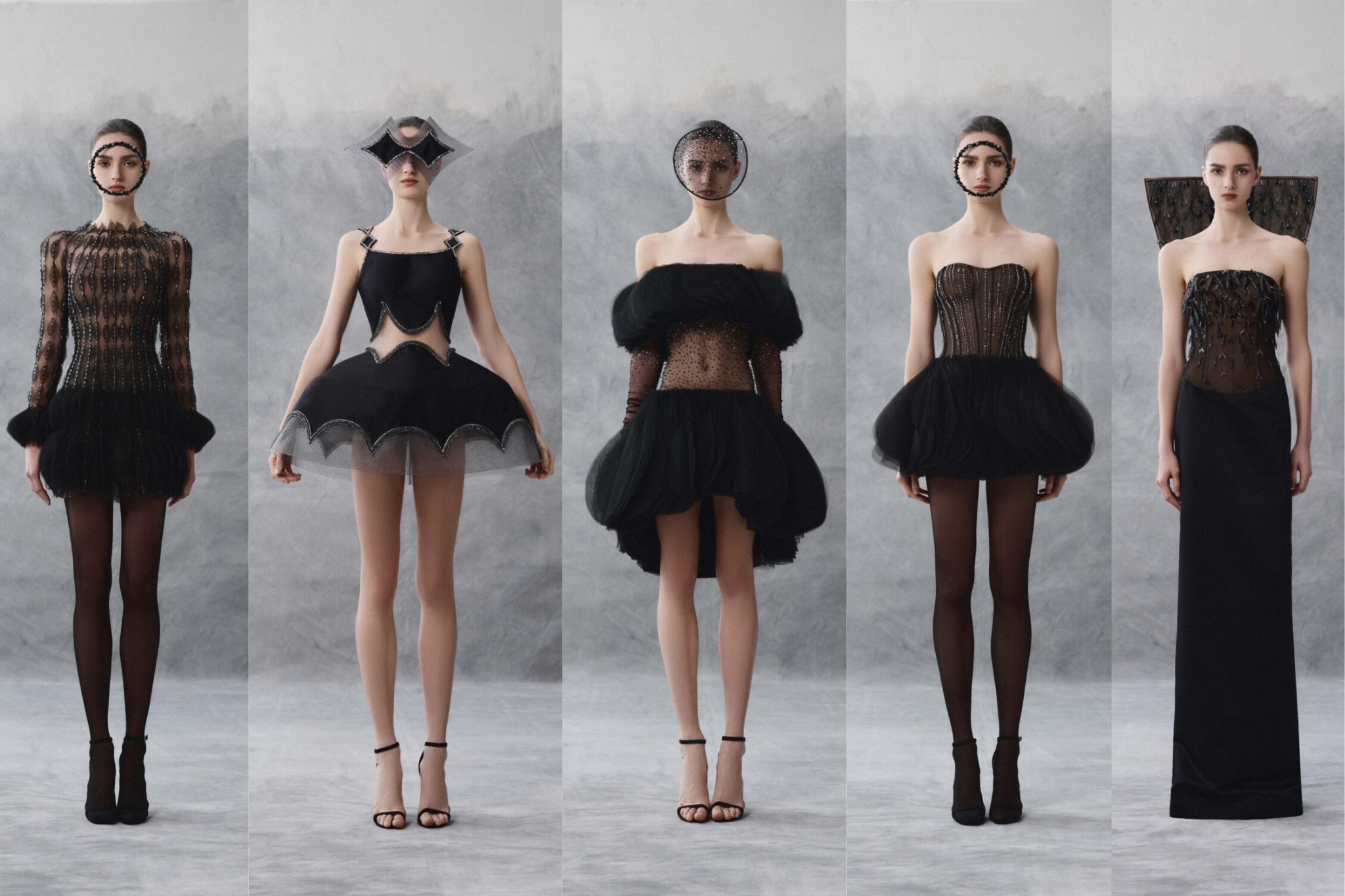
Vietnamese designer Phan Nguyễn Nguyên Huy, known as Phan Huy, establishes his place in haute couture through gracefully romantic silhouettes and sculptural structures.

The Inspiration
Speeding through the dark night, Huy sat in front of his father on a motorbike. Moths slammed into his eyes, following the light. The discomfort stayed with him. He could not understand why the tiny creatures were flying toward it. Even so, their instinct piqued his curiosity.
Moths are believed to navigate by the moon, yet artificial light can distract them, pulling them toward something they mistake for direction. Despite their fragile nature, these tiny creatures give everything to move toward what they believe is beautiful.
The Depth in the Details
Phan Huy’s Pre-Fall Collection 2025/2026 examines the precision required to chase the light — and the romance of defining identity.
This is how he enters haute couture: by turning the intricate details of a garment into something that transforms once placed on the body.
The details of the dresses demand attention. The structures he chooses frame and emphasize the feminine form. Beadwork traces the silhouette across several looks, becoming part of the architecture of each garment.
Huy brings a distinctly romantic vision to couture. Vogue Arabia described him as the youngest designer ever to present during Paris Couture Week.
Structured Softness

Fashion today feels increasingly limitless. Boundaries are pushed and new ideas are introduced constantly. Phan Huy explores this freedom through sheer garments that cover both the body and, at times, the face.
This collection asks us to consider both the body and what surrounds it. Floral wires create an ethereal structure around the figure. Each design is individual, yet they share a similar emotional language. Mesh combined with floral elements creates softness, while the wires hold and frame the silhouette, producing an almost angelic effect.
When fashion becomes architectural drama, Huy approaches it with precision and modern sensuality. An A-line gown elongates the body, while the scale of an expansive ball gown introduces ideas of royalty, restraint, and quiet power.
A sweetheart neckline traces the bodice, deliberately emphasizing the chest. A dress that exposes the shoulders softens the silhouette and draws the eye upward toward the collarbone and neck, allowing posture itself to become part of the expression. The positioning of the shoulders creates a tension between what we already are and who we aspire to become.
𝑻𝒉𝒊𝒆̂𝒖 T𝒉𝒂̂𝒏
Thiêu thân refers to a nocturnal insect that flies directly into a flame or bright light. The decision to use this as the title of the Pre-Fall Collection suggests something daring yet fragile. Huy’s delicate beadwork and lightweight fabrics move with the curvature of the body.
Because mesh is sheer, the body beneath remains visible as light passes through it. Tulle, by contrast, offers a recognizable stiffness and structure to the gowns. On stage, a ballet dancer wearing a tulle skirt can appear almost untouchable. Tulle gives the body shape while still allowing movement.
The way silk hugs the body, while mesh reveals and protects, speaks to what we choose to present and what we choose to conceal about identity.
Silk carries a sense of sophistication, with clean lines that define the figure. Its softness, balanced by its weight, lends the body a sculptural definition rooted in romantic sensibility.
Perhaps identity and vulnerability are slowly uncovered and reinvented through Huy’s recurring use of fabrics that feel light yet remain structurally present.
The sheer covering of the eyes brings attention to what is seen and what remains hidden. The eyes stay visible beneath a layer of mesh, turning concealment into a form of self-preservation. These coverings suggest hidden vulnerability. The way you present yourself becomes a choice — the decision of when, and how, to unmask your layers.
Subtle Power

Huy’s arrival into haute couture is shaped by sartorial precision and a distinctly graceful visual language. His approach to wedding glamour preserves romance while remaining aware of how ideas of femininity are changing today.
Across the collection, the palette moves from nude, white, and tan into black and gold. Each color seems to carry its own reflection of identity. The combination of black and gold introduces a stronger sense of authority.
Gold leaf appliqué gives certain looks an almost goddess-like presence.
Huy’s idea of protection is instead carried through irregular beadwork and carefully placed embellishment. It is often the smallest details that leave the strongest impression on the body. The beads offer flashes of light as they trail the silhouette.
Huy’s attraction to light is found in these details.
Structure is just as significant as the apparent chaos of the beadwork. Through this tension, we begin to understand how a garment is constructed. The making of a garment is where craftsmanship is learned, tested, and refined.
Beadwork contributes to the overall sense of structural elegance. Its placement traces the silhouette and enhances the movement of the body. When it intersects with cutouts in the fabric, the symmetry of an A-line dress is interrupted, introducing something less predictable.
One to Wear

The grace and gravity of a woman today are reflected in the construction of each garment. Every dress takes on a different form, allowing the body to express the individuality of its wearer through silhouette, structure, and movement.
This particular kind of elegance gives the wearer agency over how she is seen. A bodice can accentuate the curves of the body before the garment shifts into the length and movement of a floor-sweeping gown.
Huy’s collection understands the distinction between sensual and sexual.
A woman hidden and a woman known. What is designed to reveal, and what is designed to conceal. A sculpted collar rising behind the head creates both privacy and curiosity. The wearer becomes a figure of wonder.
Soft materials continue across the gowns. Crepe gives depth without overwhelming the silhouette. Layers exaggerate the tension around the body, raising the question of what might still be buried beneath the light.
Through Huy’s work, his designs appear to be in constant search of light, but they do more than simply expose the body. His clothes are interpreted by the wearer, who ultimately decides what to show and what to keep hidden.
Editor’s Note
This article reflects Anna Kofitsas’s personal editorial interpretation of Phan Huy’s Pre-Fall 2025/2026 collection. The text has been lightly edited by QEditorial for grammar, clarity, and flow while preserving the writer’s original voice and perspective.
Written by Anna Kofitsas
Q Voice Fashion Runway


Leave a Reply