
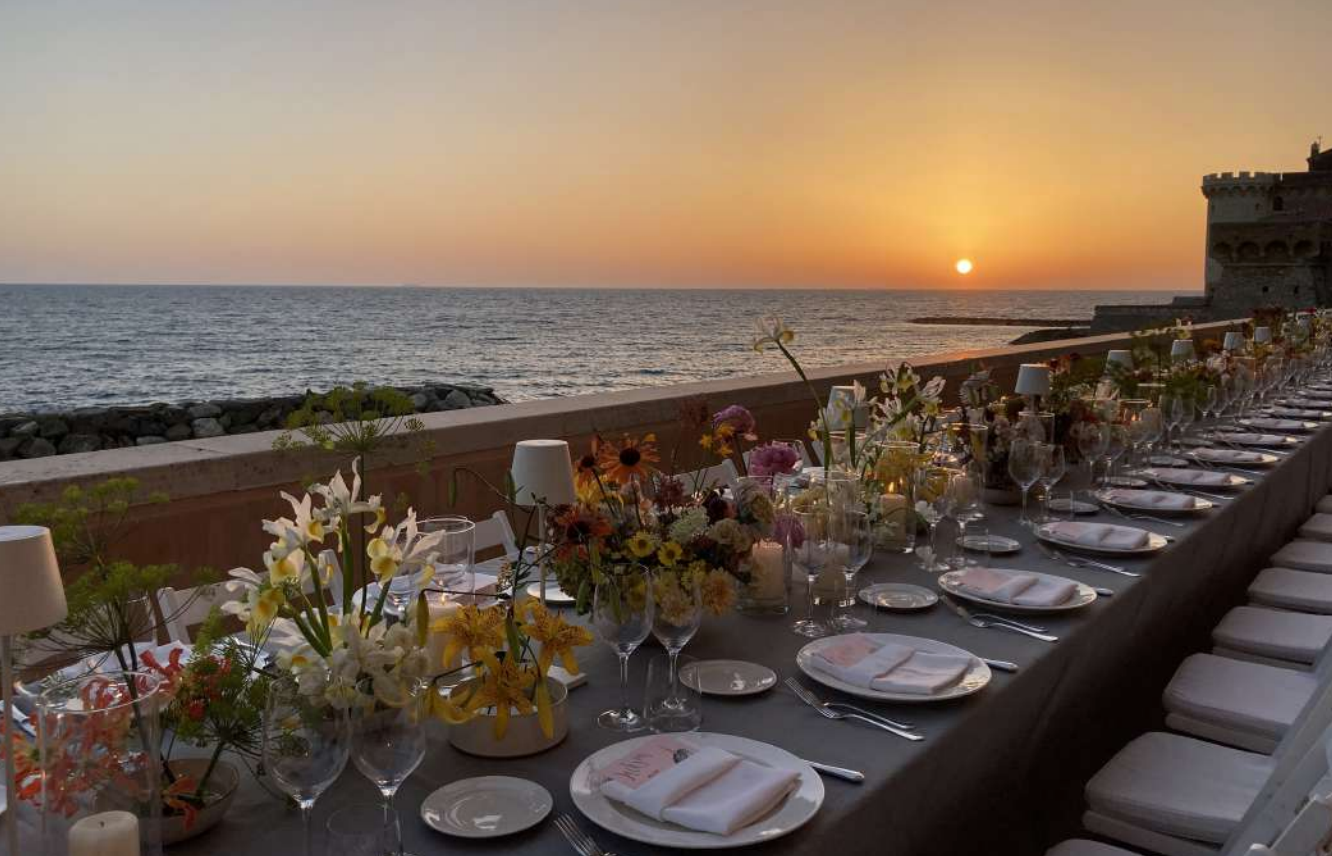
On the coast outside Rome, a seventeenth-century villa preserves the remains of ancient Alsium, the collection of Jean Paul Getty, and a deeply personal vision of Italian hospitality.

The sea appears before the full history of La Posta Vecchia reveals itself. Beyond the gardens and ochre façade, the Tyrrhenian horizon gives the estate its sense of distance from Rome, though the capital lies approximately forty minutes away along the Via Aurelia. Inside, a Roman emperor carved in marble shares the house with seventeenth-century tapestries, Renaissance references, hand-painted tiles, a Piranesi map and rooms shaped by the eye of Jean Paul Getty. Beneath it all lie mosaics, ancient walls and fragments of a settlement dating to the second century B.C.
This accumulation gives La Posta Vecchia its unusual character. The hotel occupies a palazzo at Palo Laziale, near Ladispoli, on a coastline whose history reaches back to the Roman city of Alsium. Its 21 rooms and suites form only the latest chapter in a site that has passed through archaeology, aristocratic life, private collecting and family stewardship. Each period remains visible, allowing the building to carry its past with remarkable directness.
The earliest layer surfaced during restoration work commissioned by Getty in the 1960s. Excavations revealed walls, coloured mosaics, African and Greek marble, plates, amphorae and small glass ampules associated with ancient Alsium. Some ruins remain exposed in the gardens; others continue beneath the foundations of the palazzo. Getty created a museum in the lower level to preserve the discoveries, where they can still be seen today.

The museum changes the rhythm of the house. Hospitality usually presents history through a façade, an archive or a carefully retained decorative detail. At La Posta Vecchia, guests can descend physically into it. The polished rooms above rest on evidence of domestic life from more than two millennia ago. Mosaics and vessels bring human scale to the chronology, recording how people occupied this shoreline long before the arrival of tapestries, cocktails and sea-facing suites.
Centuries later, the property became a seventeenth-century villa for the noble Orsini family. Its placement followed an enduring logic: proximity to Rome, fertile coastal land and an open prospect across the water. The architecture established the formal dimensions that continue to define the estate—symmetry, substantial walls, generous reception rooms and an intimate relationship between the house and its gardens.
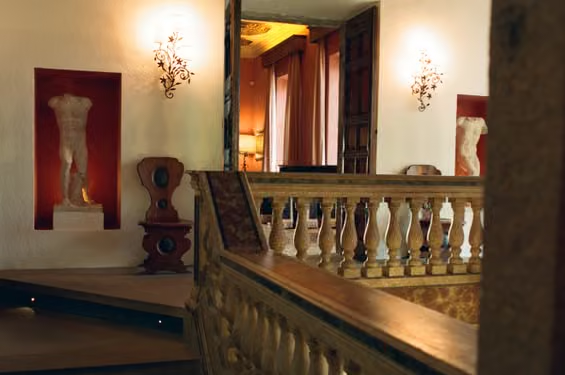
Getty arrived in the 1960s and approached La Posta Vecchia as both a residence and a setting for his collection. The American industrialist filled the rooms with Italian art and objects selected across periods. Seventeenth-century tapestries cover walls; Roman busts occupy consoles and niches; antique furniture stands beside woven carpets and marble. Among the pieces is a map by Giovanni Battista Piranesi, the eighteenth-century artist and printmaker whose visions of Rome transformed architecture into psychological space.
That object feels particularly at home here. Piranesi understood ruins as active presences, capable of directing how the present sees itself. La Posta Vecchia offers a related experience on a domestic scale. Its archaeological remains, noble architecture and twentieth-century collection create a continuous interior landscape. History enters through texture: the density of an old textile, the cool surface of stone, the irregular colour of a tiled wall, the weight of carved wood.
In 1980, Italian businessman Roberto Sciò acquired the villa and its gardens as a family home. He retained its furnishings, artworks and tapestries, preserving the atmosphere assembled by Getty. A decade later, in 1990, he opened the residence as a hotel. The transition established an enduring quality of La Posta Vecchia: it continues to feel organised around the life of a house.
That sensibility is carried forward by his daughter, Marie-Louise Sciò, Creative Director and CEO of Pellicano Hotels. Trained in architecture, Sciò works with the visual language inherited from the property while introducing colour, comfort and a measured dose of wit. Her interiors respect the authority of the collection without allowing the rooms to become solemn. Velvet, patterned textiles and saturated tones bring energy to formal spaces. Antiques remain in use. Careful composition gives every room its individual cadence.

Across the 21 rooms and suites, repetition gives way to individual character. Dormer windows frame the sea or gardens from the Tower Rooms and three Tower Suites. Superior Rooms pair aristocratic proportions with richly worked fabrics. The principal suites develop distinct palettes and moods. In the Getty Suite, elaborate tapestries and period furniture accompany a direct view of the water; antique mirrors, lantern-like lights and ornate copper taps shape the bathroom. The Medici Suite occupies the wing where Getty once lived, placing pieces from his collection near contemporary details. Its deep pink bathtub, positioned between marble staircases and reflected in an ornate mirror, introduces one of the hotel’s most memorable gestures.
Elsewhere, the Red Suite is defined by crimson upholstery and curtains; the Castello Suite combines pale tones with marble and a large living area; the Olive Suite brings vivid fabrics together with a tiled bathroom and sunlit views. These differences preserve the pleasure of discovery. A room at La Posta Vecchia feels chosen from within a larger collection, complete with its own materials, proportions and visual temperature.
The public rooms extend the same approach. Bar Piranesi uses dark wood, velvet stools, low light and upholstered armchairs to create the intimacy of a private drinking room. Its name returns the eighteenth-century mapmaker to everyday life within the hotel. At Da Aurelio, the dining room and terrace face the sea, while the décor recalls the period when Getty occupied the estate. The kitchen is led by Andrea Barcia, who became head chef in 2025 after working across Italy, England, Australia, Switzerland and Denmark. His focus on Palo Laziale and the wider Alto Lazio region anchors the table within its immediate geography.
Gardens provide the transition from formal interiors to the coast. Stone paths, clipped lawns and mature planting descend toward the private beach, while the pool and terraces open the estate to long views across the Tyrrhenian. The shoreline also restores a sense of scale. Rome may be close, yet the light, salt air and quiet horizon establish another pace. Nearby, the Etruscan Necropolis of Cerveteri adds another archaeological dimension to a landscape already marked by centuries of movement and settlement.

The most convincing luxury at La Posta Vecchia comes from continuity. Its value resides in objects that have remained, discoveries that were protected and rooms allowed to retain their individuality. The property offers a form of hospitality shaped through stewardship, where contemporary comfort operates inside an existing cultural fabric.
Along the coast of Palo Laziale, the villa still reads as a private world: compact, richly furnished and open to the sea. Ancient Alsium survives beneath its floors. The Orsini palazzo establishes its silhouette. Getty’s collection supplies much of its visual depth, and the Sciò family continues the house through a distinctly Italian understanding of colour, sociability and place. La Posta Vecchia holds these lives together, giving each generation room to remain visible.
Editor’s Note
La Posta Vecchia reveals how hospitality can become an act of cultural preservation. Its Roman remains, aristocratic architecture, historic collection and deeply individual interiors allow centuries of Italian life to remain tangible. At QEditorial, we are drawn to places whose identity has been shaped through time, care and a profound relationship with their surroundings. Here, every room carries a memory, while the Tyrrhenian Sea provides the enduring horizon.
— Nicolò Di Stefano
Founder & Editor-in-Chief, QEditorial Magazine

Editorial note:
This article was independently produced by QEditorial Magazine using historical and property information supplied through La Posta Vecchia Hotel’s official press materials. No interview or hosted stay formed part of this coverage.
Images: Courtesy of La Posta Vecchia Hotel / Pellicano Hotels. Individual photographer credits should be reproduced exactly as supplied in the official press kit.

Leave a Reply