
From the Faraglioni to the terraces of Ravello, the Italian coastline reveals a vision of luxury shaped not by excess, but by privacy, heritage and the enduring rituals of Mediterranean life.

The first view of Capri arrives across open water.
Its cliffs rise sharply from the Gulf of Naples, pale against a deep-blue horizon. From the upper deck, the details appear slowly: villas hidden among the vegetation, boats gathered near Marina Grande and the Faraglioni standing beyond the island like a monumental gateway.
There is no need for a dramatic entrance. The coastline does the work.
Capri and the Amalfi Coast have long occupied a particular place in the mythology of European leisure. Roman emperors, writers, artists, industrial families and film stars have all found their way here. Each generation has left behind its own interpretation of the Mediterranean, yet the enduring appeal remains remarkably consistent: warm light, difficult terrain, discreet houses and a social life that moves easily between simplicity and ceremony.
Travelling by superyacht returns the landscape to its natural perspective. The roads disappear. So do hotel transfers, fixed check-in times and the daily negotiations of crowded summer travel. The sea becomes the main route, and the vessel provides a private address that changes with the day.
A Different Kind of Grand Tour
“Old money” has become an overused visual shorthand: cream tailoring, vintage cars, silk scarves and expensive objects without visible logos. Along this coast, however, the idea carries greater depth.
The real attraction lies in continuity. Villas remain in families. Gardens mature rather than being redesigned every season. Recipes are closely tied to the surrounding land and water. Objects are repaired, rooms acquire patina and certain rituals survive because no one has found a convincing reason to replace them.
This sensibility is also present in the landscape. UNESCO describes the Amalfi Coast as a place of exceptional physical beauty, shaped by communities that adapted towns, cultivated terraces and architecture to steep and often difficult terrain. Amalfi and Ravello are specifically recognised for works of notable architectural and artistic importance.
A journey by yacht can bring these elements together without reducing them to a checklist. The experience is less about how many destinations can be reached in a week than about choosing where to linger.
One morning might begin beneath Capri’s cliffs. Lunch could be served near Nerano. By late afternoon, Positano appears ahead, its houses stacked against the mountain. The following day belongs to Amalfi and Ravello. The route is familiar; the privilege lies in setting its rhythm.
The Yacht as a Moving Residence

On this itinerary, the yacht is more than a means of transportation. It becomes the centre of the journey.
Contemporary superyachts are increasingly designed as residences rather than formal nautical interiors. Large windows draw daylight through the main salon. Folding terraces sit close to the water. Open decks move from breakfast room to sun lounge to evening dining space without requiring a change of venue.
The strongest interiors avoid predictable extravagance. Pale oak, travertine, linen, brushed metal and hand-finished leather feel more appropriate here than excessive ornament. Italian yacht design has always understood the relationship between elegance and movement: furniture must remain refined but practical; rooms need to feel composed without becoming precious.
Service follows the same logic. It should be present without dominating the atmosphere.
Coffee appears as the yacht leaves its anchorage. Towels are ready after a swim. The chef changes lunch because better fish has arrived that morning. The captain waits for the heat to soften before approaching Positano. These adjustments are rarely announced, but they define the difference between conventional luxury and genuine hospitality.
The finest days aboard often resist detailed planning. A scheduled shore visit is abandoned for an empty cove. Lunch extends into the afternoon. The tender remains unused because no one feels the need to leave the boat.
Capri from the Water
Capri is best understood from the sea.
Much of its coast cannot be reached on foot, and a circumnavigation reveals caves, small bays and rock formations that remain concealed from the island’s streets. The Faraglioni are especially commanding from this perspective, where their scale becomes clearer and the surrounding water shifts between cobalt and transparent blue.
Marina Grande is the island’s principal point of arrival, connected to Capri town by funicular and to other parts of the island by bus and open-air taxi. It is energetic during the day, as ferries, private boats and visitors move through the harbour, but becomes quieter in the evening.
A private yacht makes it possible to engage with both versions of Capri.
The morning can be spent offshore, swimming beneath the cliffs before the busiest boats arrive. Later, the tender enters the marina for lunch, shopping or an aperitivo near the Piazzetta. Guests may walk through Via Camerelle, visit the Gardens of Augustus or continue towards quieter corners of Anacapri.
The wardrobe is instinctive rather than styled: pressed linen, cotton poplin, leather sandals, a silk scarf tied against the wind. Capri has never required excessive formality during the day. Its elegance comes from knowing when not to try too hard.
By sunset, the island changes character. Day visitors return to the mainland, the temperature falls and the terraces begin to fill for dinner. From the yacht, Capri becomes a dark silhouette punctuated by lights.
The most memorable view may not be the famous one. It could be a late dinner on the aft deck, with the island at a distance and the sound of water against the hull.
Nerano and the Long Lunch
From Capri, the yacht crosses towards the Sorrentine Peninsula and Marina del Cantone, the small bay below Nerano.
There are grander destinations on the route, but few express the pleasures of the Italian summer as naturally. The tender approaches a waterfront restaurant. Tables sit close to the sea. Swimsuits remain under linen shirts and lunch begins without a firm ending.
The menu should belong to the place: local fish, vegetables, tomatoes, citrus, chilled white wine and, inevitably, spaghetti alla Nerano. The dish—pasta with zucchini and cheese—has travelled far beyond the village, although it makes most sense within sight of the coastline that produced it.
Here, formality would feel misplaced. The pleasure comes from the precision of simple things: pasta served at the correct moment, bread still warm, a table shaded from the strongest sun and the yacht waiting offshore.
A long lunch in Nerano may be the most convincing example of luxury on the entire itinerary. Nothing is staged for effect, yet every element feels difficult to reproduce elsewhere.
Positano, Seen Whole

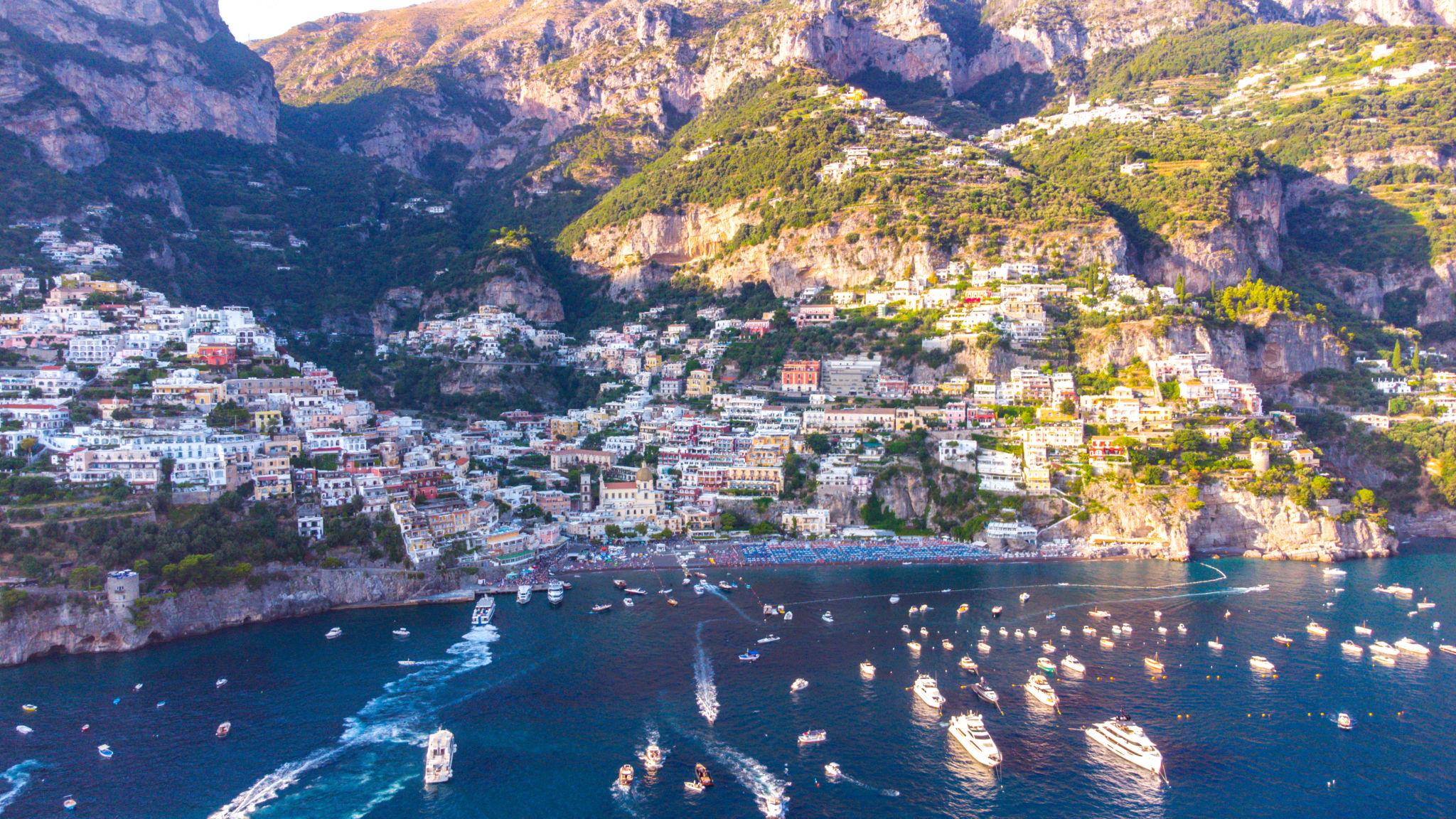
Positano is frequently experienced in fragments: a hotel terrace, a steep staircase, a boutique, a crowded section of beach. From the sea, the town can finally be seen as a complete composition.
Its houses climb the mountainside in layers of white, pink and ochre. The majolica dome of Santa Maria Assunta anchors the view, while hotels, private homes and gardens seem to occupy every available ledge. The official Italian tourism portal describes Positano through its colourful houses and domed churches before the coast continues towards Amalfi, once a powerful maritime republic.
The yacht should arrive early or near sunset.
In the morning, the waterfront has not yet reached its full intensity. In the evening, the façades take on a warmer tone and the vertical town appears almost theatrical. Either moment offers an advantage unavailable to travellers arriving by road: Positano can be observed before entering it.
Ashore, local fashion remains part of the experience. Flowing dresses, handmade sandals, woven bags and light tailoring belong naturally to the heat and architecture. They are not costumes for the destination but products of its way of life—clothing made for stairs, boats, terraces and long evenings outdoors.
Back aboard, the distance changes everything. Positano’s bustle becomes part of the scenery rather than an obligation. A swim can replace shopping. Dinner can be served facing the town instead of within it.
Luxury often depends on having the choice to participate.
Amalfi and Its Maritime Memory
Amalfi carries a different atmosphere.
Where Positano is immediately visual, Amalfi reveals itself through history. The town was once a maritime republic, and its position at the water’s edge remains central to its identity. The cathedral rises above the main square, reached by a broad staircase that gives the building an almost stage-like presence.
The surrounding streets are narrow and animated, with small shops, cafés and workshops offering paper, ceramics, local food and objects connected to the region’s craft traditions.
Amalfi also provides a reminder that the coast is not a decorative backdrop. Its terraces, paths and towns represent generations of work in a challenging landscape. Buildings were fitted into rock. Citrus groves were cultivated above steep drops. Maritime routes connected communities long before modern tourism transformed the region.
This history adds weight to the yacht journey. The vessel may represent contemporary engineering and private comfort, but the ports it enters were shaped by a much older relationship with the sea.
Lunch can be taken ashore, followed by a private visit through the historic centre. Later, the tender returns guests to a very different architectural environment: cool interiors, open decks and the clean geometry of the yacht.
The contrast feels appropriate rather than jarring. The coast has always absorbed new forms of arrival.
Ravello Above the Coast
Ravello requires leaving the water behind for a few hours.
Set high above the Mediterranean, the town replaces proximity with perspective. Its villas and gardens look across the coastline from a distance, framing the sea through stone arches, cypress trees and carefully arranged terraces.
Villa Rufolo, overlooking Ravello’s main square, remains one of the town’s principal historic and cultural landmarks. Villa Cimbrone is equally celebrated for its gardens and dramatic views.
Ravello offers a quieter tempo than the towns below. Music, architecture and landscape matter more here than beach culture. Shoes replace sandals. Lunch may become afternoon tea in a garden. The yacht is temporarily out of view, though never far from the structure of the day.
Returning to the coast in the early evening is part of the pleasure. While the car descends through the hills, the yacht is prepared for dinner. Lights are lowered. The dining table is set outside. Guests arrive back by tender as the last colour leaves the sky.
The day has moved between two distinct forms of Italian refinement: the historic villa and the modern vessel.
Dressing the Journey
A Mediterranean yacht wardrobe should be small, intelligent and adaptable.
During the day, natural materials matter most. Linen tailoring, crisp cotton, fine knitwear and well-cut swimwear move easily between the deck and the shore. Navy, ivory, tobacco, pale blue and faded green feel connected to the surroundings without imitating them.
Evening requires little more. A softly constructed jacket, a silk dress, sculptural jewellery or a beautifully made sandal can carry dinner without becoming overly formal.
The old-money reference works only when it remains subtle. Heritage cannot be manufactured by adding a crest to a blazer or arranging a scarf in the correct way. The more convincing approach is to choose pieces with excellent fabric, proportion and construction, then wear them without ceremony.
The same principle applies to luggage. A week at sea does not require a new appearance for every location. Repetition, when personal rather than formulaic, can become part of style. The same shirt returns with different trousers. A dress moves from Capri to Ravello. Jewellery appears again at dinner because it belongs to the wearer rather than the itinerary.
Dinner at Anchor

Food gives each day its shape.
Breakfast is informal, served while the coastline is still cool. Lunch may take place ashore or beneath the yacht’s shaded canopy. Dinner is more considered, though rarely rigid.
A private chef can build the menu around ingredients collected along the route: mozzarella, tomatoes, lemons, herbs, fish and vegetables sourced from local producers. Amalfi’s cuisine includes dishes such as scialatielli with seafood and pasta flavoured with the region’s lemons, reflecting the close relationship between coastal cooking and local agriculture.
The setting contributes as much as the menu.
A formal dining room cannot compete with a table facing Capri at night. Nor does it need to. Plates can remain simple because the surroundings provide their own sense of occasion.
The best service recognises this and knows when to step back.
Dinner ends, but no one leaves the table. The wine remains open. A breeze moves through the deck and lights from the coast tremble across the water. Conversation slows.
There is nowhere else to be.
The Privilege of Time
Capri and the Amalfi Coast are no longer hidden destinations. Their beauty draws immense attention, particularly during the height of summer. A yacht cannot erase that popularity, but it can create a more measured relationship with the coast.
Early arrivals, longer anchorages and carefully chosen shore visits avoid the need to pursue every famous view at its busiest hour. Local guides can provide context beyond photographs. Smaller villages and family-run businesses can become part of the route rather than incidental stops between recognised names.
The objective is not isolation at all costs. It is access without constant friction.
A superyacht offers that freedom with extraordinary precision. Yet the vessel alone cannot create the journey. The experience depends on the coastline’s villas, food, craft, history and particular social codes—the details that existed before contemporary luxury travel and will remain after its trends have passed.
On the final night, the yacht lies at anchor beneath the dark outline of the coast. Capri, Positano and Amalfi are now behind it, though their lights remain visible in the distance.
There is no need for a final performance. No grand farewell, no carefully arranged photograph.
Only an open deck, a quiet sea and the sense that, for several days, time belonged entirely to those aboard.
Editorial Note
At QEditorial, luxury travel is not measured only by distance, exclusivity or spectacle. It is defined by the way a destination is experienced.
In Old Money, Open Sea, we explore Capri and the Amalfi Coast from the deck of a private superyacht, following a route shaped by Italian craftsmanship, historic villas, Mediterranean cuisine and a slower approach to travel. From the Faraglioni to Positano, Amalfi and Ravello, the journey reveals a landscape where elegance has never depended on excess.
QEditorial continues to explore the places, people and ideas shaping contemporary luxury, where design, culture and identity meet.




Leave a Reply