
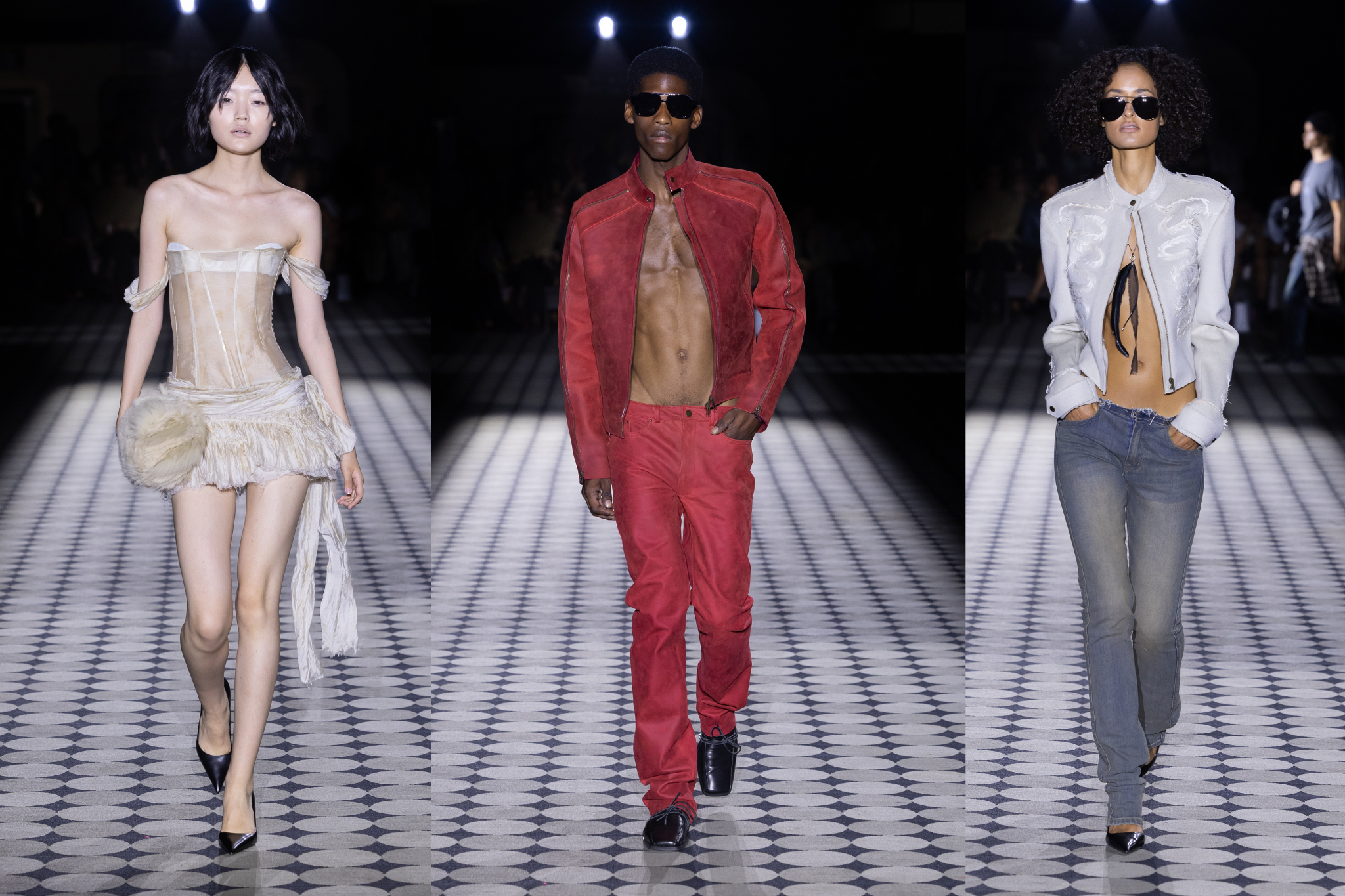
Founded by Robert Friedrichs, the independent label transformed its first runway into a declaration of identity, architecture, strength, and vulnerability.

Some fashion collections begin with a story.
Others begin with a reference, a historical period, a cinematic image, or an imagined character.
For its first runway presentation, UNVAIN chose something more direct: itself.
Presented during Berlin Fashion Week on February 1, 2026, the label’s Autumn/Winter 2026 collection did not attempt to construct an external world around the clothes. There was no elaborate fictional narrative imposed upon the garments and no distant cultural reference used to explain their existence. Instead, the collection became a concentrated expression of the identity UNVAIN had been developing since its foundation.
It was not simply a debut.
It was a declaration.
Founded in Berlin in 2020 by designer Robert Friedrichs, UNVAIN emerged from the raw visual and cultural energy of the German capital. What began as a one-person studio gradually developed into an independent fashion label defined by architectural silhouettes, sharp tailoring, industrial details, and a minimalist language that feels simultaneously controlled and rebellious.
The brand describes its aesthetic through a precise combination of qualities: raw, puristic, and elegant.
Within that apparent simplicity, however, there is tension.
UNVAIN’s clothing moves between protection and exposure, discipline and instinct, severity and sensuality. Its silhouettes often appear constructed like architecture, yet they are designed to exist around a moving body. Tailoring provides order, while distressed surfaces, elongated proportions, leather, metallic elements, and unexpected openings disturb that order.
This contradiction has become one of the most compelling elements of Friedrichs’s work.
A Runway Inside a Bunker
The location selected for UNVAIN’s debut could hardly have been more appropriate.
The Autumn/Winter 2026 runway was staged at The Feuerle Collection, an interdisciplinary art institution housed inside a former Second World War telecommunications bunker in Berlin.
The building’s heavy concrete architecture created a natural dialogue with the brutalist vocabulary of the collection. Once designed for military communication and protection, the bunker has been transformed into a space where contemporary art, Southeast Asian sculpture, and Imperial Chinese furniture coexist within an atmosphere of darkness, silence, and historical weight.
Against this environment, the clothes did not appear as decorative objects placed inside an impressive venue. They seemed to belong to the architecture.
The concrete surfaces emphasized the severity of the tailoring. The darkness intensified the collection’s controlled palette. The monumental character of the space gave each silhouette a sense of physical and emotional isolation.
It was a location capable of expressing the central tension within UNVAIN: the relationship between hardness and fragility.
The bunker represented permanence, defense, and strength. The bodies moving through it introduced something more vulnerable, temporary, and human.
Coverage of the debut by SHOWstudio, KALTBLUT Magazine, and other independent fashion platforms documented a runway that felt less like a conventional presentation and more like an encounter between clothing, body, architecture, and atmosphere.
A Collection Without an External Theme

For Autumn/Winter 2026, UNVAIN deliberately avoided constructing an external theme.
According to the brand’s official collection statement, the objective was to present UNVAIN as clearly and honestly as possible, without narrative overlays or borrowed references.
The collection was therefore self-titled.
Its subject was the label itself.
This decision was particularly significant for a first runway. Emerging brands are often expected to introduce themselves through an easily identifiable concept, creating a story that can be rapidly communicated through images and press materials. Friedrichs instead treated the runway as an opportunity to define the internal grammar of UNVAIN.
Brutalism.
Rockstar attitude.
Mysticism.
Architectural minimalism.
These codes were not presented as separate influences, but as elements of a single visual identity.
The brutalist component appeared through structure, reduction, and material intensity. Garments seemed stripped of anything unnecessary, allowing proportion, construction, and surface to become the principal forms of expression.
The rockstar attitude introduced a different energy: a sense of seduction, defiance, and nocturnal glamour. It prevented the minimalism from becoming sterile. Leather, exposed skin, narrow silhouettes, dark layers, and metallic accents suggested a wardrobe built not for anonymity, but for a person whose presence remains visible even when dressed almost entirely in black.
Mysticism added another dimension. Certain looks appeared ceremonial, as though the garments belonged to an imagined underground order. Long lines and controlled movement transformed the body into something between a contemporary figure and an urban apparition.
Together, these elements produced a collection that felt unmistakably connected to Berlin without reducing the city to familiar visual clichés.
Clothing as Emotional Architecture
Friedrichs’s work is particularly compelling when viewed as a form of emotional architecture.
Architecture determines how a person enters, occupies, and experiences space. Clothing performs a similar function on a more intimate scale. It surrounds the body, regulates its visibility, and influences the way it is perceived by others.
In UNVAIN’s Autumn/Winter 2026 collection, garments frequently appeared to operate as protective structures. Strong shoulders, elongated coats, narrow tailoring, and layered surfaces gave the body authority. At the same time, openings, exposed areas, and moments of softness complicated that impression of control.
Strength was never presented as absolute.
It existed alongside vulnerability.
This is where UNVAIN’s work moves beyond the immediate attraction of dark minimalism. The clothes suggest that protection and exposure are not opposites but interconnected states. What we wear can conceal us while simultaneously revealing how we wish to be understood.
The uniform, in this context, does not erase individuality. It becomes a method of constructing it.
UNVAIN proposes a contemporary uniform for those who do not wish to disappear into convention. Its minimalism is not neutral. It carries attitude, emotional tension, and cultural memory.
Berlin Beyond the Stereotype

Berlin has long been associated with underground culture, industrial architecture, electronic music, nightlife, and radical experimentation. These references have become so recognizable that they can easily turn into aesthetic formulas.
UNVAIN avoids that trap by treating Berlin not as a collection of visual symbols, but as a condition.
The city appears in the work through contrast: historical weight and cultural reinvention, severity and freedom, concrete architecture and fragile bodies, collective identity and individual resistance.
Friedrichs does not reproduce Berlin literally.
He translates its psychological atmosphere.
The result is clothing that feels connected to the city while remaining capable of moving beyond it. The architectural silhouettes possess international clarity. The tailoring communicates without requiring knowledge of a particular subculture. The darkness of the palette becomes less a Berlin cliché than a framework through which construction, texture, and physical presence can be examined.
That balance may explain why the label has begun to attract attention beyond its original community.
From Debut to “SKINS”
UNVAIN did not allow its February debut to remain an isolated moment.
Only five months later, in July 2026, the label returned to Berlin Fashion Week with its second runway presentation: Spring/Summer 2027, titled “SKINS.”
Presented on July 3 at Berlin’s ICC, the collection expanded the emotional questions already visible in Autumn/Winter 2026. This time, clothing was examined as a second skin: a layer capable of protecting the individual while also exposing something about the person underneath.
The title carried more than one meaning.
It referred to the physical relationship between clothing and the body, but also drew from the structure of the British television series Skins, in which individual episodes focus closely on one character and one personal reality.
For the collection, each runway look began not with a conventional mood board or seasonal color story, but with a sentence describing an imagined person. The garments were subsequently developed from these written portraits, allowing each look to function as an individual character within the wider UNVAIN world.
The complete Spring/Summer 2027 collection was subsequently featured on Vogue Runway, where its 28 looks were presented as part of the platform’s official Berlin Spring 2027 coverage.
For a label established only six years earlier—and presenting just its second runway—its inclusion represents an important shift in visibility.
Vogue Runway remains one of the fashion industry’s most influential international archives and discovery platforms. To be documented alongside more established participants in the Berlin schedule places UNVAIN within a broader critical and professional conversation.
It does not mean that the brand has abandoned its independent position.
Rather, it suggests that the world outside Berlin is beginning to pay attention.
The Importance of an Emerging Voice

Fashion needs emerging designers not only because the industry requires new names, but because it requires new systems of thought.
Independent labels can question the assumptions that larger houses are often required to preserve. They can develop slowly, communicate directly with their communities, and create visual languages before those languages are fully validated by the established system.
UNVAIN belongs to this category.
Its growth has been supported by a strong digital presence and by a community that understood the brand before it appeared on an official runway. That relationship has given Friedrichs the space to develop a coherent identity rather than chase seasonal reinvention.
The Autumn/Winter 2026 debut demonstrated the value of that consistency.
Instead of using the runway to become something else, UNVAIN used it to become more visibly itself.
The result was a collection that felt disciplined without becoming predictable, dark without becoming empty, and architectural without losing contact with the vulnerability of the human body.
A New Uniform Takes Shape
UNVAIN is still at an early stage in its development.
Two runway collections do not yet define the full trajectory of a fashion house, and international visibility does not guarantee permanence. But the clarity of Robert Friedrichs’s direction already distinguishes the label from many brands attempting to occupy the same territory of dark, independent fashion.
There is intention behind the severity.
There is emotion behind the structure.
There is vulnerability beneath the uniform.
From the concrete chambers of the Feuerle Collection to the international pages of Vogue Runway, UNVAIN’s movement has been remarkably rapid. Yet the brand’s relevance does not come simply from the speed of its rise. It comes from the consistency of the world it is constructing.
A world where clothing becomes architecture.
Where minimalism carries emotional weight.
Where strength does not require the denial of fragility.
And where a young Berlin label can present its first runway not as an attempt to explain itself, but as the confidence to simply exist as it is.
Final Editorial Note
UNVAIN’s emergence reflects the growing international relevance of independent Berlin fashion and the renewed importance of designers capable of building a recognizable visual language. Through architectural tailoring, brutalist references and an exploration of strength and vulnerability, Robert Friedrichs is positioning the UNVAIN Berlin fashion label within a wider conversation about contemporary identity, emotional protection and the future of German fashion.
QEditorial Magazine — Fashion · Culture · Identity



Leave a Reply