
From the battlefield to La Californie, David Douglas Duncan transformed photojournalism into a language of intimacy, memory, and human presence.

Some photographers document history from a distance. Others enter it so deeply that their images become part of the emotional archive of the century. David Douglas Duncan belonged to the second category.
He was not only a war photographer, not only a LIFE magazine photojournalist, not only the man who photographed Pablo Picasso at home. He was a photographer of proximity — a man who understood that the strongest images are often born when access becomes trust.
His life moved across some of the most violent and intimate landscapes of the twentieth century: battlefields, military roads, exhausted soldiers, political uncertainty, artists’ studios, domestic rooms, and the private world of one of the most mythologized artists in modern history. Duncan’s camera could move from the brutality of war to the quiet presence of Picasso in his studio without losing its central quality: attention.
In an age when photography is often consumed quickly, Duncan’s work asks us to slow down. His images do not simply show what happened. They ask what it means to be present when history, creation, and vulnerability reveal themselves.
A Photographer Formed by Movement
David Douglas Duncan was born in Kansas City, Missouri, in 1916. His early path did not begin with art galleries or fashion studios, but with movement, travel, curiosity, and instinct. According to the Harry Ransom Center’s archive of his papers and photographs, Duncan studied zoology and Spanish at the University of Miami, receiving his degree in 1938. His first camera, a 39-cent Bakelite Univex Model A, arrived as an eighteenth birthday gift from his sister.

The beginning feels almost cinematic: a young man, a modest camera, and an eye already trained toward the urgency of life. LIFE magazine recalls that one of Duncan’s earliest photographic moments involved rushing to photograph a hotel fire, only to discover later that the man he had captured was John Dillinger. For Duncan, that episode became one of the decisive moments that pushed him toward photography, as noted in LIFE’s profile, The Photography of David Douglas Duncan.
Before he became associated with Picasso, Duncan belonged to the great generation of photojournalists who believed that the camera could confront the world directly. He photographed across regions, conflicts, cultures, and political landscapes. He was not looking for decorative images. He was looking for witness.
War, Witness, and the Ethics of Looking
Duncan served in the United States Marine Corps during the Second World War and was later hired by LIFE magazine in 1946. His career as a war photographer would become one of the defining parts of his legacy. The Museu Picasso Barcelona notes that Duncan covered the Second World War, the Korean War, and the Vietnam War, eventually receiving the Joseph Sprague Memorial Award from the National Press Photographers Association in 1991 in recognition of his career in photojournalism.
But Duncan’s war photography was never only about combat. It was about the human condition under pressure.
His photographs from the Korean War, later gathered in the book This Is War!, are among the most powerful visual accounts of that conflict. LIFE describes his Korean War photographs as one of the clearest and most emotionally direct chronicles of the so-called “Forgotten War” in Korean War: Classic Photos by David Douglas Duncan.
What makes these images endure is not only their historical value. It is their refusal to turn suffering into abstraction. Duncan photographed soldiers not as symbols, but as men: cold, tired, frightened, determined, human. His camera did not soften war, but it also did not exploit it. It stayed close enough to understand.
That closeness became the signature of his work.
From the Battlefield to Picasso’s Door
The extraordinary turn in Duncan’s life came in 1956, when he entered the private world of Pablo Picasso.
According to the Museu Picasso Barcelona, Duncan met Picasso in February 1956, and the two became close friends. This friendship would lead to one of the most important photographic records ever made of Picasso’s domestic and artistic life.
The story has the quality of legend. Duncan arrived in Cannes hoping to photograph the artist. Jacqueline Roque opened the door. Soon, Duncan was inside. As The Guardian recounts in The Big Picture: At Home with Mr and Mrs Picasso, his first portrait of Picasso was taken in an unexpectedly intimate setting: the artist in the bathtub. What followed was not a conventional portrait session, but years of access.
Duncan was not simply invited to photograph Picasso. He was allowed to remain near him.
This distinction matters. Many photographers capture a famous person. Duncan entered the rhythm of a life.
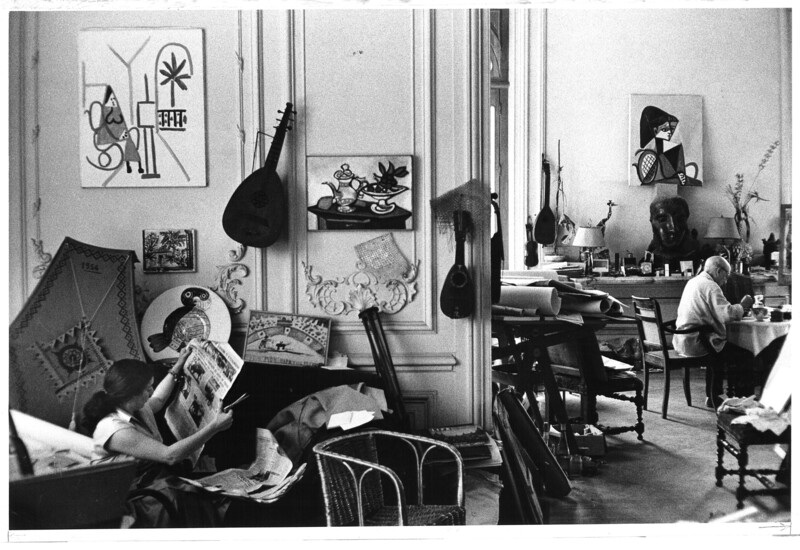
At La Californie, Picasso’s villa in Cannes, and later in other spaces connected to the artist, Duncan photographed Picasso working, moving, resting, looking, playing, arranging objects, and inhabiting the dense visual universe of his own creation. These images do not present Picasso as a distant monument. They reveal him as a living force inside the disorder, discipline, playfulness, and intensity of making.
The Art of Intimacy
What makes Duncan’s photographs of Picasso so important is not only that he had access. Access alone does not create intimacy. A photographer can enter a room and still remain outside the truth of it.
Duncan’s genius was different. He understood how to be present without dominating the scene.
The David Douglas Duncan Collection at the Museu Picasso Barcelona describes his work on Picasso as an exhaustive account of the intimacy of the artist’s studio and the home Picasso shared with Jacqueline Roque. The museum’s documentation emphasizes that these images show Picasso’s life and artistic procedures from the perspective of a friend.
That word — friend — is essential.
Duncan was not photographing Picasso as a spectacle. He was photographing a relationship with creation. His images show the artist surrounded by works, objects, materials, canvases, ceramics, papers, furniture, sunlight, shadows, and domestic life. Picasso appears not as a finished myth, but as a man moving through the endless process of looking and making.
There is a lesson here about photography itself. Duncan’s images remind us that the camera can be intimate without being invasive. It can reveal without consuming. It can enter a private world and still preserve its mystery.
Picasso, Jacqueline, and the House as a Living Archive
In Duncan’s photographs, the home is never just background. It becomes a visual biography.
La Californie was not a neutral space. It was a house full of artistic energy, accumulation, memory, and presence. Paintings leaned against walls. Objects occupied tables. Rooms became extensions of Picasso’s mind. Jacqueline appeared within this world not merely as a figure beside the artist, but as part of the emotional architecture of the home.

Duncan’s images understand that genius does not live only in the finished artwork. It lives in the rooms where the artwork is born. It lives in the pauses, the gestures, the clutter, the waiting, the meals, the animals, the light, the repeated return to the canvas.
This is why his Picasso photographs remain so compelling. They do not only tell us what Picasso looked like. They show us the atmosphere around him.
They allow us to see creation as a daily condition.
Lump: The Dog Who Crossed from Life into Art
No article about Duncan, Picasso, and intimacy would be complete without Lump.
Lump, the dachshund originally connected to Duncan, became one of the most charming and unexpected presences in Picasso’s world. His story sits at the intersection of art, friendship, photography, and pet culture. As Vanity Fair explored in Last of Breed, Lump entered Picasso’s life through Duncan and became deeply associated with the artist’s domestic world.
For QEditorial, Lump is more than a delightful detail. He represents something profound: the way animals enter the emotional and creative spaces of human life.
In Picasso’s world, Lump was not simply a pet. He was a presence. A companion. A figure of affection. A small body moving through a large mythology. Duncan’s photographs helped preserve that presence, allowing us to see how an animal could soften, interrupt, and humanize the image of an artist who has often been described through power, genius, and intensity.
Through Lump, the private Picasso becomes even more private. More tender. More alive.
This is where Duncan’s eye becomes especially valuable. He did not miss the small things. He understood that history is not only made of grand gestures. It is also made of a dog entering a room, a painter looking down, a domestic silence, a moment no one planned.
Books, Archives, and a Monumental Legacy
Duncan’s work with Picasso resulted in several major publications, including The Private World of Pablo Picasso and other books dedicated to the artist’s life and work. These books helped shape the public understanding of Picasso not only as an artist, but as a human presence inside his own creative universe.
His archive is vast. The Harry Ransom Center preserves a major collection of Duncan’s papers and photographs, including photographic prints, negatives, transparencies, manuscripts, correspondence, publications, and personal materials. The scale of the archive reflects the scale of the life: war, travel, journalism, art, friendship, memory.
In 2013, the Museu Picasso Barcelona presented a selection of photographs donated by Duncan to commemorate the museum’s fiftieth anniversary. Taken at La Californie between 1956 and 1962, those photographs offer a glimpse into Picasso’s life and artistic process.
This donation matters because it confirms what Duncan’s images have always suggested: photography is not only documentation. It is cultural memory.
Why David Douglas Duncan Still Matters
David Douglas Duncan died in 2018, at the age of 102. His life stretched across an extraordinary century, but his importance is not only chronological. It is visual, ethical, and emotional.
He reminds us that photography is not simply about seeing. It is about how one chooses to see.
In war, he saw the soldier rather than only the conflict. With Picasso, he saw the man rather than only the myth. With Lump, he saw the small tenderness that history might otherwise ignore.
His camera moved between violence and beauty, public crisis and private creation, masculine endurance and domestic intimacy. Yet across all those worlds, the same principle remained: the image must stay close to life.
Today, when images are produced and consumed at impossible speed, Duncan’s work feels almost radical. It asks for time. It asks for trust. It asks for presence. It reminds us that the most powerful photographs are not always the most dramatic. Sometimes they are the ones that understand when to remain quiet.
David Douglas Duncan did not only photograph Picasso’s private world. He photographed the fragile distance between history and humanity.
And in that distance, he found the image.
Editor’s Note
David Douglas Duncan’s work reminds us that photography is not only the act of capturing what is visible. It is the art of earning proximity. From war to Picasso’s studio, from soldiers to artists, from history to the quiet presence of Lump, Duncan created images that continue to live because they were built on attention, trust, and human intimacy.
QEditorial Magazine — Fashion · Culture · Identity
QEditorial.com
Editorial Image Disclaimer
Images are used solely for editorial, cultural commentary, review, reporting, and informational purposes. QEditorial Magazine does not claim ownership of third-party images, trademarks, or copyrighted materials unless otherwise stated. All rights remain with their respective owners.
If you are a rights holder and believe an image requires updated credit, correction, or removal, please contact QEditorial Magazine and we will review the request promptly.


Leave a Reply