
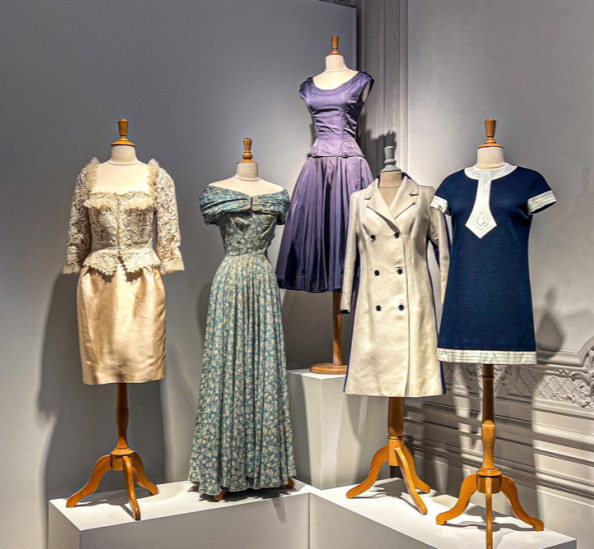
When Couture Became Resistance: Fashion, Survival, and Courage in Nazi-Occupied Paris

There are moments in history when beauty can no longer remain innocent.
In The Last Fashion House in Paris, Renee Ryan enters one of those moments: Paris in 1942, a city occupied by Nazi forces, suspended between fear, silence, compromise, and resistance. The capital that had long defined elegance for the world now exists under surveillance. Couture survives, but it no longer belongs only to beauty. It becomes a language of discretion, survival, and danger.
At the center of the novel is Maison de Ballard, an elegant Parisian fashion house that appears, from the outside, to be a place of refinement. Inside, however, it carries another purpose. Behind couture gowns, fittings, and carefully maintained appearances, a secret resistance network works to help Jews and downed Allied soldiers escape Nazi persecution.
The house is led by Mademoiselle Sabine Ballard, a woman of discipline, intelligence, and immense personal courage. Around her are Paulette Leblanc, a young apprentice trying to redeem herself after a devastating betrayal, and Nicolle Cadieux, a seamstress whose work extends far beyond the atelier. Together, these women transform fashion into cover, craft into strategy, and elegance into protection.
What makes Ryan’s novel compelling is not simply its historical setting, but the way it understands fashion as more than surface. In ordinary times, a dress may express taste, class, fantasy, or desire. In wartime, it can become something else entirely: a disguise, a signal, a form of access, even a way to move unseen through dangerous rooms.
Paulette’s journey is particularly powerful because it begins with guilt. Once interested in sketching dresses, shopping, and the pleasures of youth, she is forced into a far darker reality after her mother’s arrest by the Gestapo. Sent to Paris to work under Sabine Ballard, she enters a world where couture is no longer detached from history. Every room has a secret. Every client may be dangerous. Every decision carries consequences.
Sabine, by contrast, already understands the moral cost of survival. She operates within a world where German officers, collaborators, gangsters, and members of the Paris elite move through the same social spaces. Her ability to maintain appearances becomes part of her resistance. She understands that visibility can be dangerous, but invisibility can also be powerful.

This is where the novel finds its strongest emotional force. Ryan does not present courage as something grand or theatrical. Instead, courage appears in smaller, more intimate forms: a woman choosing whom to trust, a seamstress passing information, a designer opening her house to people in danger, an apprentice deciding that fear cannot be the end of her story.
The book also raises an essential question about identity during occupation. What remains of the self when survival becomes the first priority? What happens to cultural identity when an occupying power tries to control not only territory, but memory, language, movement, and appearance?
Through Maison de Ballard, the novel suggests that identity is not always preserved through open defiance. Sometimes it survives quietly, through work, through loyalty, through the protection of another human being. Sometimes resistance is not a speech or a weapon, but a door opened at the right moment.
Historically, Paris couture during the Nazi occupation remains one of fashion’s most complex chapters. The industry did not simply disappear. Some houses closed, some designers left, and others continued under difficult and morally complicated conditions. Lucien Lelong, head of the Chambre Syndicale de la Couture, famously fought to keep the couture industry in Paris rather than see it transferred to Berlin or Vienna. This history gives Ryan’s fictional Maison de Ballard a deeper resonance: it imagines what could have happened behind the polished façades of a fashion world forced to survive inside an occupied city.
In this sense, The Last Fashion House in Paris is not only a story about clothes. It is a story about the hidden architecture of resistance. The atelier becomes a stage where women perform one life in public while risking another in secret. By day, they measure fabric, shape silhouettes, and serve clients. By night, they gather information, guide people toward safety, and participate in a network where one mistake could mean death.
The emotional weight of the novel comes from the fact that each woman carries loss. Paulette carries guilt. Nicolle carries danger and separation. Sabine carries grief and responsibility. Yet none of them allows suffering to become stillness. Their wounds do not make them passive. They become the reason they act.
Ryan’s own background as an award-winning historical fiction author gives the novel its sense of structure and accessibility. According to her official biography, she has written more than thirty books and studied Economics and Religion at Florida State University. In The Last Fashion House in Paris, that combination of moral inquiry and narrative discipline appears clearly. The novel is emotionally direct, but it is also built around questions of choice, responsibility, faith, and survival.
The final movement of the story looks beyond occupied Paris. After the exposure of Sabine’s resistance network, the idea of beginning again becomes central. The postwar fashion world will soon belong to another vision. Christian Dior would open his house in 1946 and, in 1947, introduce the New Look, a silhouette that helped redefine postwar femininity and restore Paris as the symbolic capital of fashion. But Ryan’s novel reminds us that before fashion could dream again, many people had first fought simply to remain alive.

That is perhaps the deepest meaning of the book. Fashion, in this story, does not escape history. It enters it. It absorbs fear, grief, courage, compromise, and hope. It becomes proof that beauty can exist even in darkness, but only when beauty is tied to humanity.
The Last Fashion House in Paris is ultimately a tribute to women who refuse disappearance. Women who understand that survival is not only the act of enduring, but the decision to protect others while doing so. Through Sabine, Paulette, Nicolle, and the world of Maison de Ballard, Renee Ryan offers a novel about courage dressed in silk, grief hidden beneath elegance, and resistance stitched quietly into the seams of history.
Written by Marina Khamuko, Books & Culture Editor at QEditorial Magazine, this reflection on Renee Ryan’s The Last Fashion House in Paris explores how couture becomes more than beauty in Nazi-occupied Paris. Through the fictional world of Maison de Ballard, the novel reveals fashion as a language of resistance, survival, memory, and female courage.
QEditorial Magazine → qeditorial.com



Leave a Reply