
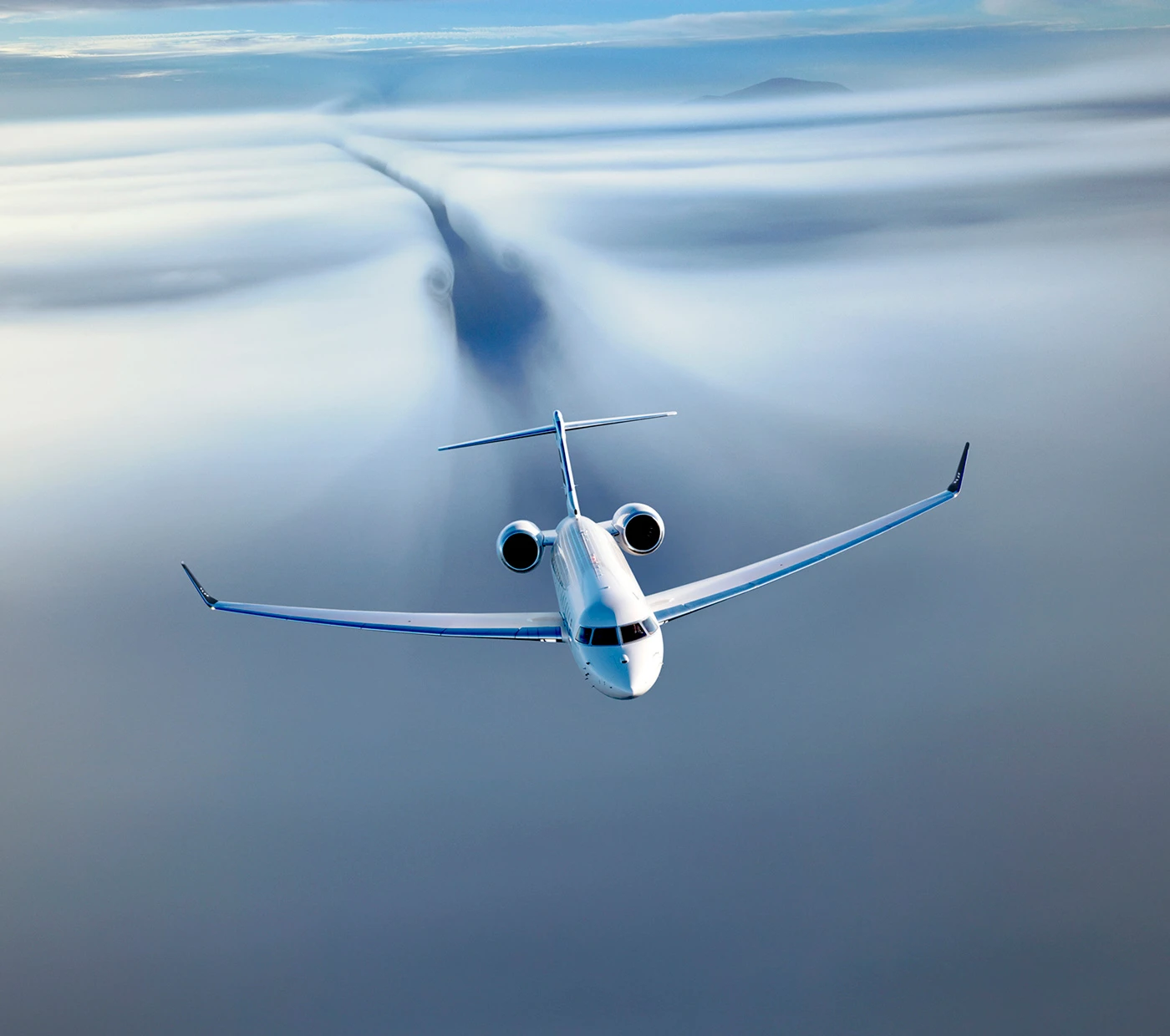
The world’s fastest business jet does not simply want to arrive first. It wants to transform travel into a suspended private residence.

In the world of private aviation, speed has always been a form of power. But in the case of the Bombardier Global 8000, the real revolution is not only in its performance. It is in the way the aircraft interprets space, comfort, and time.
The Global 8000 has been presented as the fastest business jet in the world, with a declared top speed of Mach 0.95 and a range of approximately 8,000 nautical miles, entering that rare category where an aircraft is no longer simply a means of transportation, but an extension of contemporary lifestyle. Reuters described it as the fastest civil aircraft since Concorde, following its FAA certification in December 2025. (reuters.com)
Performance as a Premise, Not a Spectacle
On paper, the Global 8000 belongs to the mythology of speed. It can connect continents, reduce hours of travel, and transform intercontinental routes into direct, almost silent experiences. Yet its true strength is that Bombardier does not build the narrative around power alone. Speed becomes an invisible premise: what truly matters is what happens inside.
This is where the Global 8000 changes language. It does not feel designed as a traditional aircraft cabin, but as a residential interior at high altitude: four living areas, a full-size kitchen, a private suite, an entertainment zone, a meeting area, and a dedicated crew space. The typical configuration includes a Club Suite, a Conference Suite, an Entertainment Suite, and a Principal Suite, creating an interior journey that feels closer to a flying penthouse than to a conventional jet. (europair.com)

The Aircraft as a Private Home in Motion
The most interesting aspect of the Global 8000 is the way it interprets luxury. Not a loud luxury, not decorative, not ostentatious through excessive surfaces. Rather, it is a silent, functional luxury built around three ideas: rest, privacy, and environmental control.
The Club Suite becomes the first salon, with Nuage seats in a zero-gravity position, retractable side tables, screens, and large windows. It is the space for conversation, light work, and the gradual entry into the journey. The Conference Suite brings the jet into the aesthetic of a private boardroom, with a dining and meeting table for six people. The Entertainment Suite transforms the cabin into a cinema lounge, with a convertible sofa, high-fidelity sound system, and large screen. Finally, the Principal Suite introduces the language of the bedroom: a full-size bed, wardrobe, screen, panoramic windows, and, in the most exclusive configuration, access to a private bathroom with a stand-up shower. (europair.com)
Here, design is not simply aesthetics. It is a psychological strategy. Each area corresponds to a moment of the journey: departure, work, dining, sleep, isolation, arrival. The Global 8000 does not merely sell distance; it sells continuity. It allows the body to cross the world without fully suffering the journey.

Invisible Luxury: Air, Light, Silence
In contemporary luxury design, what cannot be seen is often more important than what appears. The Global 8000 works precisely within this invisible dimension. Bombardier describes the cabin as designed for comfort, health, and productivity, with systems such as Pũr Air, HEPA filtration, fresh air circulation, improved humidity preservation, and cabin pressurization designed to reduce fatigue on long-haul flights. (europair.com)
One of the most refined elements is the Soleil lighting system, created to simulate circadian rhythms and help the body adapt to the destination time zone. In an era when luxury no longer coincides only with leather, wood, and metal, but with wellness, sensory control, and the quality of time, this technology becomes an essential part of the design. Light does not simply illuminate the cabin; it builds an atmosphere, accompanies the body, and protects the passenger’s biological rhythm. (europair.com)

The Seat as a Design Object
The Nuage seat is perhaps one of the most important details of the entire project. Bombardier presents it as a new architecture of seating, designed to offer a zero-gravity position, reduce pressure on the lower back, improve weight distribution, and better support the neck and posture during long flights. (europair.com)
This detail says a great deal about the direction taken by luxury aviation design. The seat is no longer simply an expensive armchair. It becomes an ergonomic, almost medical device, translated into the language of luxury. Comfort is no longer left only to the softness of materials, but is designed through biomechanics, posture, and the duration of flight.
The Inevitable Comparison: Gulfstream G800
The natural rival is the Gulfstream G800, another very high expression of ultra-long-range private aviation. Gulfstream declares for the G800 a maximum range of 8,200 nautical miles, a maximum speed of Mach 0.935, up to four living areas, up to 19 passengers, and up to 10 sleeping positions. Its interior focuses on large panoramic oval windows, fresh air renewed every few minutes, quietness, and long-range comfort. (gulfstream.com)
But where the Gulfstream G800 appears as the purest expression of the Gulfstream tradition — elegant, efficient, luminous, perfectly corporate — the Bombardier Global 8000 seems to carry a more theatrical tension. It is closer to the idea of a private residence moving at extreme speed. Not only a means of reaching a place, but a place in itself.
The New Idea of Status
The Global 8000 represents an important transformation: in contemporary luxury, true status is no longer only about owning a rare object. It is about owning a rare environment.
In the case of this jet, status is not measured only in Mach, range, or altitude. It is measured in the possibility of sleeping in a private suite above the Atlantic, dining at 41,000 feet, working in a meeting room suspended between two continents, watching a film in a flying lounge, and arriving on the other side of the world with a less tired body and a clearer mind.
The future of the private jet is not only about flying farther. It is about making travel less visible on the body. It is about transforming speed into comfort, technology into atmosphere, and the cabin into architecture.
The Bombardier Global 8000 is not only the fastest jet in its category. It is one of the clearest examples of how the luxury of the future is becoming increasingly intimate, sensory, and residential.
Editor’s Note
The Bombardier Global 8000 is not only a story about speed. It is a story about how luxury is changing. In an age where time has become one of the rarest forms of privilege, the private jet is no longer defined only by performance, distance, or altitude, but by the quality of the environment it creates around the passenger.
What makes the Global 8000 compelling is precisely this balance: it moves like a machine, but it is designed like a private residence. Its cabin speaks the language of architecture, comfort, silence, and control — reminding us that the future of luxury may not be louder, but more intimate.
QEditorial Magazine → qeditorial.com




Leave a Reply