

In a visual era dominated by digital cleanliness, polished imagery, and the immediate perfection of the screen, there are still artists choosing the opposite direction.
Artists who are not trying to make painting easier, more decorative, or more consumable.
Artists who seem determined to restore weight, wound, and tension to the surface itself.
The work of Giuseppe Barilaro belongs to this category.
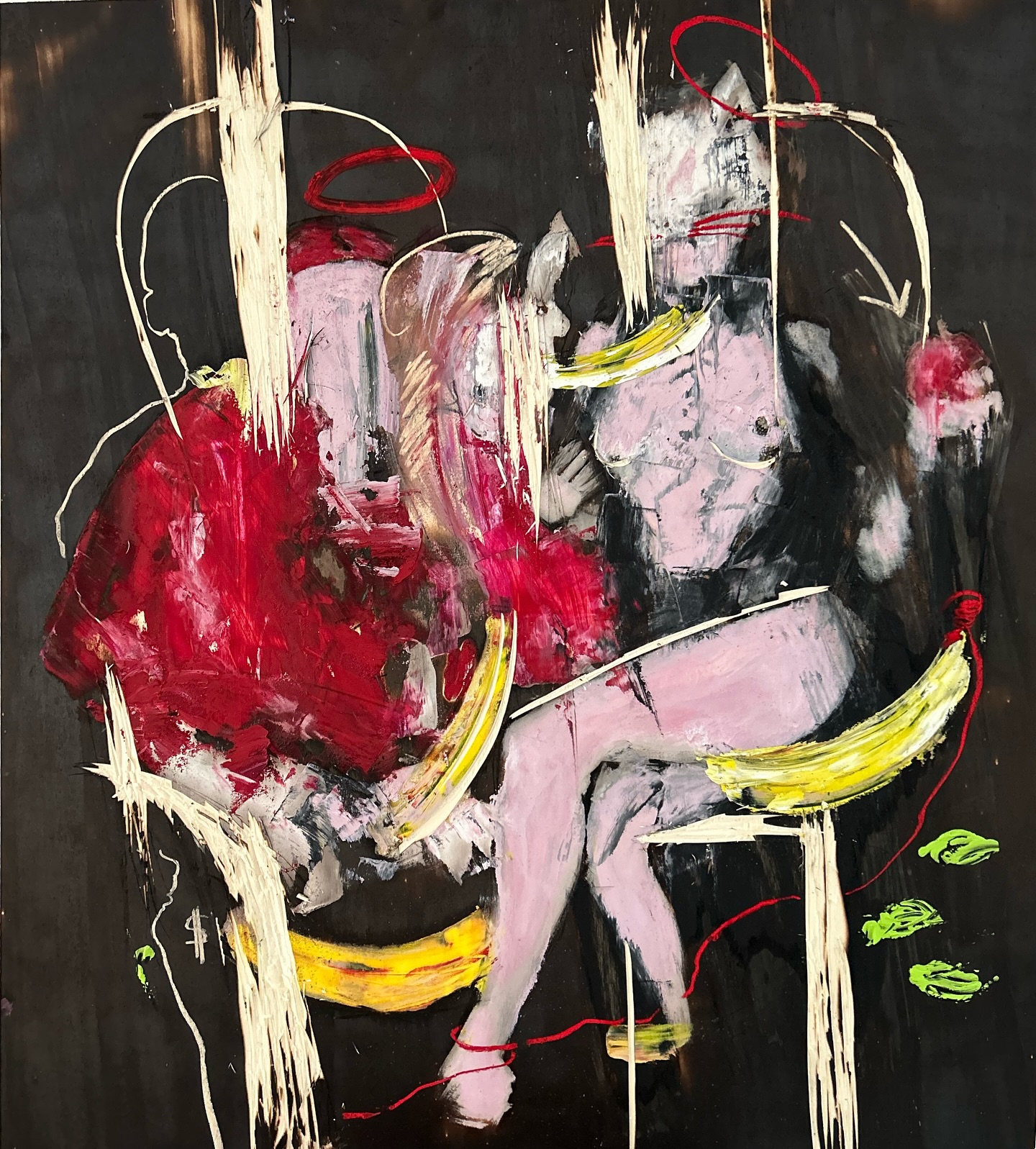
Looking at his paintings, the first sensation is not image, but material.
Color never appears completely stable. The surface feels corroded, excavated, layered. Faces and bodies emerge and disappear at the same time, as if the painting refuses to fully surrender itself to the viewer.
It is a form of painting that rejects cleanliness.
And perhaps this is precisely what makes it so contemporary.

In recent years, much of the contemporary art visible online has progressively developed an increasingly photographable aesthetic.
Works designed to be rapidly consumed through Instagram feeds, digital platforms, art fairs, and social content. Clean colors, perfect surfaces, instantly readable compositions.
Barilaro’s painting seems to resist that logic.
His works do not seek visual comfort.
They require time.
They require distance and proximity.
They demand that the viewer observe the surface almost physically.
In some paintings, figures appear to dissolve into color. In others, material overtakes the subject itself. The result is a continuous tension between presence and disappearance, between image and ruin.
This dimension places his work within a painterly tradition that dialogues with Art Informel, with certain forms of Italian material painting, and with artists who transformed surface into emotional language.
At times, his work recalls the violent gestures of Francis Bacon; at others, a sensibility closer to the worn materiality of Antoni Tàpies emerges.
But the reference never becomes imitation.
Barilaro maintains a deeply personal, almost theatrical dimension that seems to arise from a direct relationship with the decomposition of the image itself.

Color also plays a central role.
Deep blacks, oxidized earth tones, muted reds, dirty whites. Nothing appears truly pure. Everything seems marked by time.
It is also significant that this research emerges from Carrara, a city historically connected to artistic material itself through marble.
In a territory where sculpture has long worked through subtraction, excavation, and erosion of form, Barilaro appears to transfer that same tension into painting.
The result is a surface that does not simply want to be observed, but crossed.
Today, in a cultural system where imagery is often fast, smooth, and immediately legible, works like those of Giuseppe Barilaro bring attention back to something that seemed almost forgotten: the emotional weight of material.

His painting does not seek to reassure.
It does not seek to decorate space.
It disturbs it.
And perhaps that is exactly what makes his work necessary.
Because in a world obsessed with perfect definition, sharpness, and total transparency, painting can still remind us that imperfection is not a flaw.
It is a human trace.
Editor’s Reflection
There is something increasingly rare about encountering a painting that still feels physical.
Not simply visual.
Not optimized for a screen.
Not designed to exist only through reproduction.
The work of Giuseppe Barilaro reminded me that painting can still possess resistance. That a surface can still carry tension, erosion, and silence. In a cultural moment where so much contemporary imagery appears polished, immediate, and infinitely consumable, his work chooses another path entirely.
What struck me most was not only the texture itself, but the refusal of perfection.
The feeling that the image is constantly collapsing and rebuilding at the same time.
Perhaps this is why these works feel human.
Because human memory is not clean.
Emotion is not clean.
Time is not clean.
Great painting does not always explain itself immediately. Sometimes it asks the viewer to remain inside uncertainty a little longer. To observe slowly. To feel the weight of material, not only the comfort of image.
And maybe that is what contemporary culture still desperately needs: works that do not simply decorate space, but alter the emotional atmosphere around them.
— Nicolò Di Stefano
Editor-in-Chief, QEditorial


Leave a Reply