
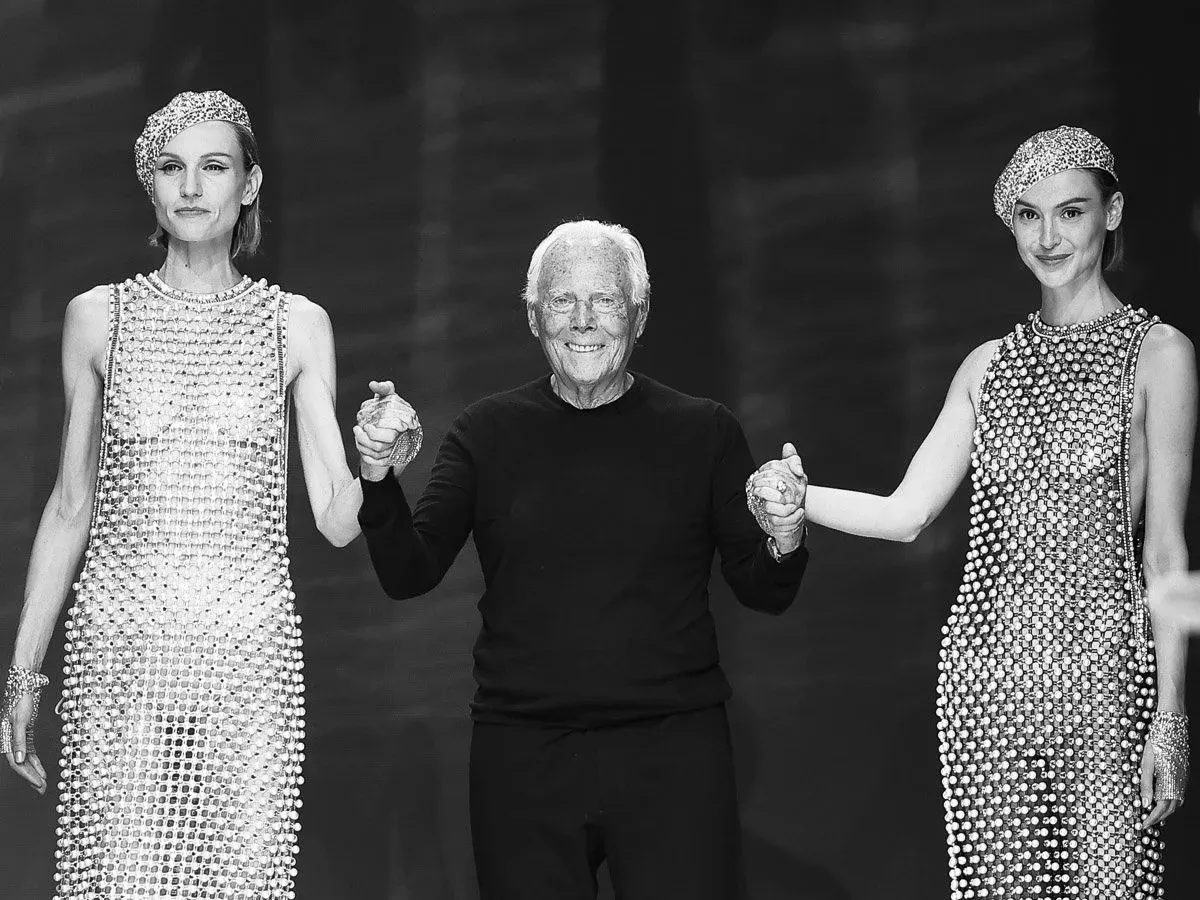
 There are figures who simply follow their time. And then there are those who, with apparent discretion, manage to reshape it. Giorgio Armani belongs to the latter category. He was not merely a successful designer, nor only the founder of one of the most recognizable maisons in the world. He was the man who took the very idea of Italian elegance and transformed it into a global language: more understated, more modern, more authoritative. The Giorgio Armani maison was founded in 1975 together with Sergio Galeotti, and from that moment one of the most influential trajectories in contemporary Italian fashion began to take shape. (armanivalues.com)
Armani’s greatness does not lie in having pursued excess, but in having understood before many others that true luxury does not coincide with noise. In a fashion system often dominated by emphasis, decoration, and spectacle, Armani chose the opposite path: to subtract rather than add, to lighten rather than stiffen, to discipline rather than shout. Treccani places him among the few designers who left an indelible mark on the culture of their time, linking his name to an idea of freedom and simplicity. (treccani.it)
And it is precisely in the jacket that his revolution became legend. Armani took one of the most rigid symbols of Western elegance and transformed it into something new: a softer, more fluid, more natural form of authority. From the very beginning, the signature of his style was a relaxed, informal jacket, conceived for both men and women. Britannica notes that Armani softened the suit by lightening the structure of the jacket, adapting the Neapolitan tradition of removing linings and padding in order to create a more natural silhouette on the body; Treccani, in turn, refers to his deconstructed jackets as the beginning of a revolutionary revision of one of the great pillars of elegance. (britannica.com)

There is something profoundly Italian in this transformation. Armani did not export folklore, but a method. He took the Italian idea of beauty — shaped by measure, cut, proportion, and visual discipline — and made it international. This is how he helped bring Italian fashion to the world: not simply as a product, but as a culture of form. Between the second half of the 1970s and the early 1980s, the brand expanded beyond Italy, while the maison’s growth was consolidated through new lines and an increasingly global presence. (armanivalues.com)
Then cinema arrived, and his name ceased to be merely a fashion name: it became a cultural code. In 1980, Armani created the wardrobe for American Gigolo, a moment that the official history of the maison identifies as the beginning of his relationship with Hollywood. From then on, his style no longer lived only on the runway; it entered the international imagination, fixing a new ideal of masculinity: urban, controlled, sensual without ostentation. (armanivalues.com)

But what makes Armani such a powerful figure is not only his ability to change the silhouette of fashion. It is his ability to do so without losing measure. Many designers have built strong images; few have built a language. Armani taught fashion that neutrality can be magnetic, that restraint can be seductive, that elegance is born not from excess but from precision. He proved that one can be revolutionary even while speaking in a low voice. As Britannica notes, his vision of fashion was also to “soften” the image of men while making women look stronger, redefining the relationship between power, clothing, and identity. (britannica.com)
There is also another element that makes his story even more compelling: endurance. Armani does not embody the myth of the impulsive genius or theatrical rupture. He embodies instead the strength of continuity, discipline, and slow construction. First La Rinascente, then the experience with Nino Cerruti, then the gradual building of a signature that would become one of the most influential in the world. His trajectory tells the story of a form of success that is less romantic but far rarer: that of someone who observes, matures, refines, and continues.
For this reason, Giorgio Armani did not simply leave a mark on the history of fashion. He changed the way elegance presents itself to the world. He turned the jacket into a legend. He brought Italian fashion beyond its borders by transforming it into a universal language. And above all, he demonstrated that true style does not need to impose itself violently: it only needs to remain.
“He did not simply leave a mark on fashion. He changed its rhythm, and made the world dress differently.”
Selected by the Editor
A project from a world where fashion meets animal identity.

For selected advertising and editorial partnerships, contact contact@qeditorial.com



Leave a Reply