
There are architects who design buildings.
And then there are figures like James Wines, who instead redesign the way we look at the world itself.

To speak about James Wines only through architecture would be incomplete.
He was never simply an architect in the conventional sense. He belongs to that rare category of cultural figures capable of moving freely between art, philosophy, urban criticism, environmental consciousness, and visual provocation — transforming architecture into a language rather than a discipline.
Long before sustainability became branding, before “green architecture” became a global industry, and before cities discovered the aesthetic value of vegetation climbing over concrete facades, Wines had already understood something essential: modern architecture had lost its humanity.
And perhaps this is why his work still feels so contemporary today.
Born in 1932, Wines initially emerged from the world of fine art and sculpture. That artistic formation would permanently shape his approach to architecture. Unlike many architects trained through rigid systems of technical order, Wines approached buildings as living cultural objects — emotional structures capable of irony, criticism, contradiction, and narrative.

In 1970, he founded SITE — an acronym for Sculpture in the Environment. The name itself revealed the intention. Architecture, in his world, was never isolated from the environment around it. It was part sculpture, part social commentary, part ecological reflection.
The projects that followed became some of the most radical and intellectually provocative works of late twentieth-century American architecture.
His collaborations with BEST Products during the 1970s and 1980s remain legendary. Buildings appeared cracked open, collapsing, eroding, or being reclaimed by nature itself. Facades peeled away. Corners seemed to slide downward. Entire structures looked as though time, entropy, and the natural world had begun fighting back against commercial uniformity.
At a moment when corporate architecture was obsessed with perfection, efficiency, and sterile repetition, Wines introduced vulnerability, irony, and even humor.
He transformed architecture into cultural criticism.
What made these projects extraordinary was not simply their visual experimentation, but the philosophy beneath them. Wines understood earlier than most that modern cities were becoming psychologically exhausting. The endless repetition of anonymous buildings, reflective glass towers, and industrial logic was producing urban environments increasingly detached from emotional life.
His response was not nostalgia.
It was imagination.

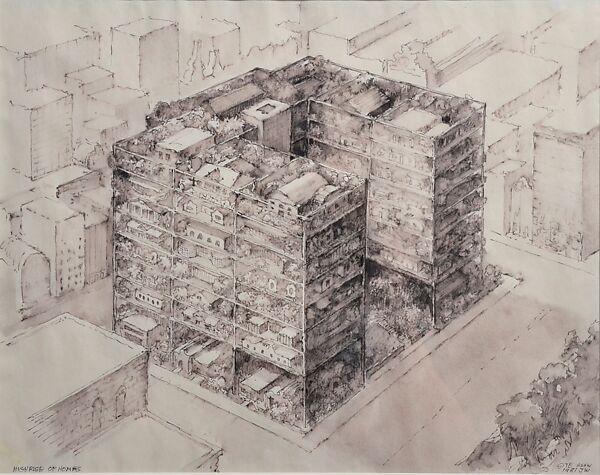
Perhaps no project represents this more clearly than Highrise of Homes (1981), one of the most visionary architectural concepts ever proposed in the late twentieth century.
At first glance, the project appears almost surreal: a vertical structure where individual suburban-style homes are suspended within a giant urban framework, each surrounded by gardens, vegetation, terraces, and personal identity.
But beneath the visual poetry was a radical question:
What if density did not require uniformity?
What if urban living did not have to erase individuality?
What if nature and architecture could coexist emotionally rather than mechanically?
Today, decades later, many of these questions dominate contemporary architectural discourse. Vertical forests, biophilic design, ecological towers, hybrid living systems — concepts now celebrated as innovative were already present in Wines’ imagination more than forty years ago.
But unlike much contemporary sustainable architecture, which often feels technological or corporate, Wines’ work retained warmth, imperfection, and humanity. His buildings were not machines decorated with plants. They were reflections on how human beings emotionally inhabit space.
This distinction matters.
Because James Wines was never interested in architecture as spectacle alone. He understood that architecture also shapes consciousness. It affects memory, behavior, solitude, identity, and even the way people perceive time itself inside a city.
That is why his work still resonates so deeply today.
There is also something profoundly intellectual about Wines that separates him from many architectural celebrities of the modern era. He belongs to a generation where architects still read philosophy, literature, sociology, and art criticism as part of the architectural process itself.
His conversations often moved effortlessly between environmental ethics, visual culture, urban alienation, and artistic freedom. He approached architecture not as isolated construction, but as a mirror of civilization.
And perhaps this is what has always made him so compelling to encounter personally.
Because beyond the public figure, beyond the drawings, books, and projects, there is an extraordinary human presence in James Wines — thoughtful, curious, elegant, deeply observant, and remarkably generous with ideas.

Over nearly twenty years, I have had the privilege of knowing James personally. Not simply through admiration from a distance, but through conversations, shared moments, books signed over time, reflections exchanged privately, and even the rare privilege of seeing certain projects and visions before they entered the public world.
There are people who influence culture through visibility.
And then there are those who quietly alter the intellectual atmosphere around everyone they encounter.
James belongs to the second category.
What has always struck me most is that despite his immense importance within architecture and environmental art, there is no sense of arrogance around him. Only curiosity. A continuous desire to think further. To question further. To imagine further.
And perhaps that openness is precisely what allowed his work to remain timeless.
Because true visionaries rarely belong completely to their own era.
They exist slightly ahead of it.
Today, as architecture increasingly returns to conversations about ecology, emotional space, sustainability, urban anxiety, and the reintegration of nature into modern life, the work of James Wines feels less like history and more like prophecy.
Many architects built towers.
James Wines built questions.
And the world is still trying to answer them.

Leave a Reply