
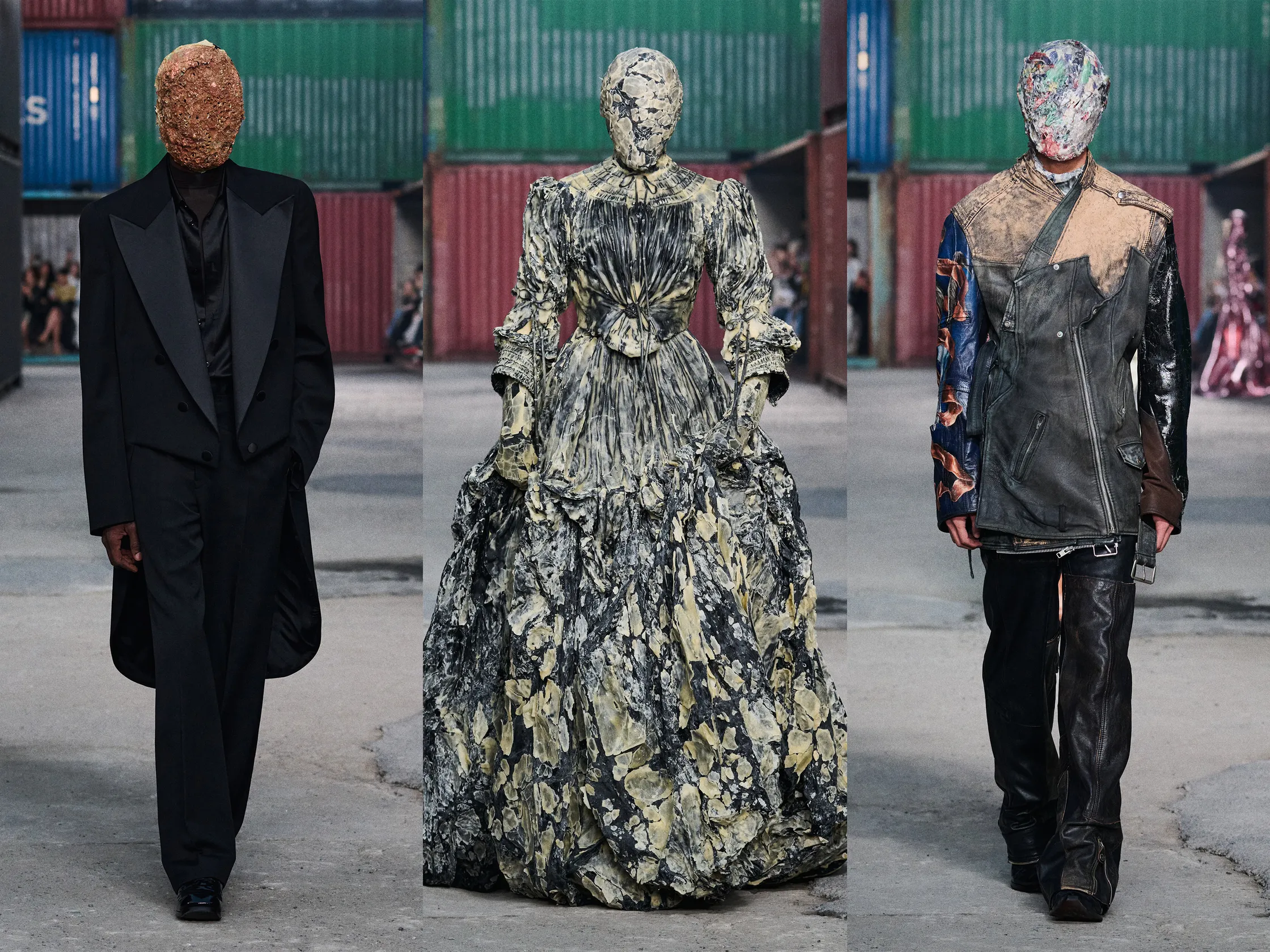
Under Glenn Martens, the mask returns not as spectacle, but as method, restoring mystery, tension, and authorship to fashion.

At Maison Margiela the covered face has never been a mere styling device. It has always been one of the house’s deepest gestures: a refusal of easy identity, a removal of personality from the center of the image, and a return of attention to silhouette, surface, and construction. Under Glenn Martens, that gesture has entered the conversation again with striking force. In the house’s Spring 2026 ready-to-wear debut, anonymity emerged through severe facial structures and metallic mouthpieces; by the Fall 2026 show in Shanghai, masks, skullcaps, and second-skin concealment had returned as part of a broader and more assertive visual language.
What makes this return compelling is that Maison Margiela is not reviving the mask out of nostalgia. It is reactivating it as method. The house itself has formalized Anonymity as one of its selected core codes in the MaisonMargiela/folders project, where concealment, masks, and creativity are positioned as part of the brand’s living language rather than its past mythology. That distinction matters. At Margiela, concealment is never emptiness; it is a way of producing a different kind of image, one in which fashion regains the right to be read before the wearer is.


This is why the new masks do not feel ornamental. They feel disciplinary. In a luxury culture built on exposure, recognizability, and the constant monetization of the self, Margiela continues to insist on distance. The covered face interrupts the contemporary demand that everything be immediately personal, legible, and emotionally available. Instead, it proposes something more difficult and, for that reason, more seductive: fashion as withholding, fashion as tension, fashion as a space where mystery is not a flaw in communication but part of the garment’s authority.
That tension became especially visible in Shanghai. As Yang-Yi Goh wrote in GQ’s Inside Maison Margiela’s Fence-Swinging Chinese Spectacle, published on April 13, 2026, the Fall 2026 presentation did not read as a simple runway stop, but as the opening act of a wider project in China. That framing is important, because it allows the collection to be understood not only as an impressive visual statement, but as a strategic reintroduction of Maison Margiela’s foundational codes — from anonymity to Bianchetto — within a broader cultural geography. The spectacle was real, but it was not empty. It was structured.

Martens seems to understand that the challenge of working at Margiela is not to imitate the archive, but to restore its internal logic. His Spring 2026 collection already suggested a recalibration of the house through sharper tailoring, stricter posture, and an unsettling treatment of the face; the Fall 2026 collection pushed that language further in Shanghai, where masks, layered surfaces, and damaged beauty were not simply quoted from the past, but reabsorbed into a larger proposition about memory, disruption, and form.
And that is perhaps what makes these masks feel newly relevant now. They are not there to make the clothes more theatrical. They are there to make them harder to consume too quickly. In a system that rewards immediacy, the Margiela face-covering slows perception down. It removes the comfort of expression. It refuses celebrity shorthand. It asks the viewer to stay longer with the garment itself — with material, proportion, construction, and tension. In that sense, the mask becomes not a barrier, but a correction. It restores the hierarchy that fashion too often abandons.

For Maison Margiela in 2026, the face disappears so that the house can speak more clearly. Under Glenn Martens, anonymity is no longer a relic preserved in the legend of Margiela; it is active again, sharpened for a moment that has become almost incapable of silence. The result is one of the most intelligent gestures in fashion right now: a collection that covers the face not to erase the body, but to return power to the clothes.

Editor’s reflection
In a fashion system obsessed with visibility, Maison Margiela reminds us that concealment can still be more powerful than exposure. The mask does not silence the collection; it sharpens it. By withdrawing the face, the house restores attention to what fashion too often risks losing — tension, construction, mystery, and authorship. Under Glenn Martens, anonymity no longer feels like an archived code from another era. It feels current again, almost necessary. Not as nostalgia, but as resistance. Not as decoration, but as discipline. And perhaps that is what makes Margiela still so rare: it understands that fashion becomes stronger not only when it reveals, but when it knows exactly what to withhold.

For selected advertising and editorial partnerships, contact: contact@qeditorial.com


Leave a Reply