

How red became his signature, how beauty found form in his silhouettes, and how Valentino carried Italian fashion into the world.

There are designers who create clothes, and there are designers who create a visual language.
Valentino belonged to the second category. He did not simply dress women; he gave shape to an idea of beauty that was theatrical without vulgarity, romantic without weakness, and grand without losing precision. In his hands, couture became both architecture and emotion. Fabric was never merely fabric. It became gesture, movement, memory, and presence.
From the beginning, Valentino Garavani understood something essential: fashion is not only about novelty. It is about recognition. It is about creating a world so coherent, so refined, that it becomes instantly legible across decades. That is exactly what he built. His world was made of purity of line, aristocratic restraint, luminous embellishment, and above all, red. Not any red, but the red that would eventually become inseparable from his name.
Valentino opened his first atelier in Rome on Via Condotti in 1959, after studying in Paris at the École de la Chambre Syndicale de la Couture. The Maison was formally founded in 1960 with Giancarlo Giammetti, whose strategic intelligence would become essential to the house’s growth. Very quickly, Valentino established himself not simply as a Roman couturier, but as a designer with international ambition. By 1962, he was already receiving international acclaim at the Sala Bianca in Florence, and in 1968 his prestige grew even further with the now-iconic “White Collection,” later tied forever to Jacqueline Kennedy Onassis.
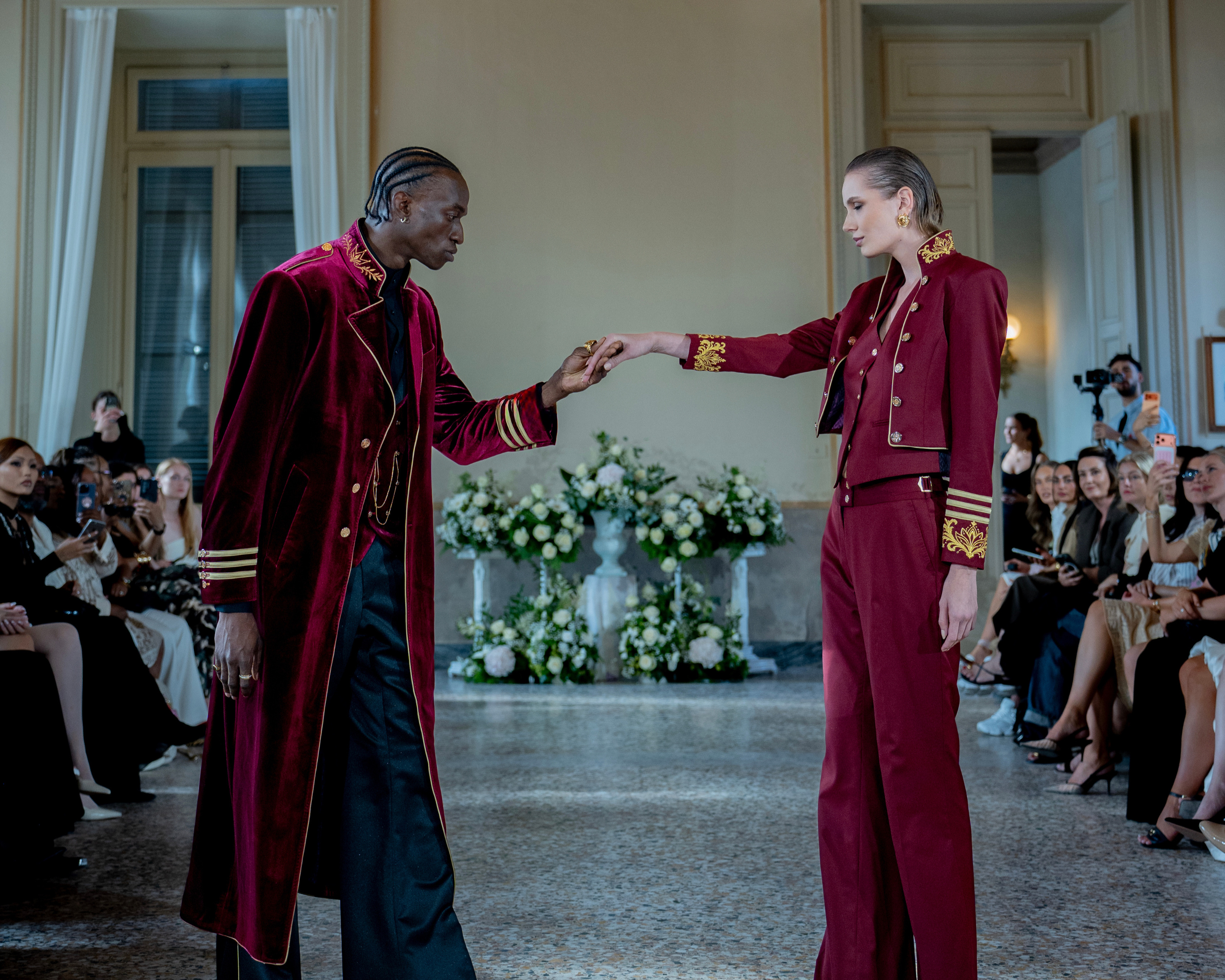
But if white gave him a landmark moment, red gave him immortality.
The mythology of Valentino Red is one of the most powerful in fashion. The house itself traces his love of red to a formative memory in Barcelona, where, as a young man, he saw a woman at the opera in a red velvet dress and never forgot the force of that image. Valentino Beauty, which is part of the wider Valentino universe, still describes that moment as the beginning of his lifelong attachment to Rosso. Then came the first decisive fashion translation: the red dress called “Fiesta,” shown in 1959. Vogue notes that this first red dress became the beginning of a signature he would return to again and again.

Over time, red stopped being a color choice and became a house code. The exhibition Forever Valentino describes red as synonymous with the Maison, noting that it first appeared in the debut collection in 1959 and remained present ever since. It also records that in 1985 a specific shade was formally christened Rosso Valentino, and that more than 550 nuances of red exist within the couture archives alone. This tells us something important: Valentino did not treat red as a gimmick. He treated it as an emotional and aesthetic system.
And yet Valentino’s greatness cannot be reduced to color.
What made him extraordinary was his ability to immortalize beauty in fabric and silhouette. His gowns did not merely flatter the body; they elevated it. They carried the discipline of couture, but also the softness of fantasy. He understood volume, drape, line, and the emotional temperature of a dress. A Valentino gown often feels as though it belongs not only to a moment, but to an ideal. That is why so many of his creations have survived not just as garments, but as images lodged in fashion memory. The Somerset House exhibition Valentino: Master of Couture highlighted fifty years of haute couture and emphasized the intricate handcraft behind the pieces that dressed women from Grace Kelly to Anne Hathaway.
This is where Valentino became more than an admired designer.
He became a bearer of Italian fashion itself.

People did not love Valentino only because he made beautiful dresses. They loved him because his clothes expressed conviction. They believed in glamour unapologetically. They believed in beauty without irony. They believed in femininity not as fragility, but as ceremony and force. Even today, when fashion often oscillates between conceptual severity and commercial speed, Valentino’s legacy continues to feel relevant because it reminds the industry that emotion, romance, and visual splendor are not superficial when they are supported by mastery.
And perhaps that is his deepest contribution.
Valentino taught fashion that beauty could be consistent without becoming repetitive. He taught the world that a silhouette could be both soft and sovereign. He taught Italian fashion that it could travel globally without losing its accent. And he taught us that when a designer finds his true language, that language can outlive trends, decades, and even the era that first produced it.
For Valentino, that language was often spoken in red.
But what he really gave fashion was not just a color.
He gave it permanence.

Editorial Reflection
Valentino did not become immortal simply because he designed beautiful clothes. He became immortal because he knew how to turn beauty into identity. In a world where fashion changes constantly, he created something far rarer: a signature that never lost its authority. Red was his emblem, but elegance was his empire.
By Nicolò Di Stefano
Selected by the Editor
A project from a world where fashion meets animal identity.




Leave a Reply